BSM Function
The BSM function uses radar sensors to detect the following vehicles in adjacent lanes and alerts the driver to their presence using indicators built into the outside rear view mirrors.
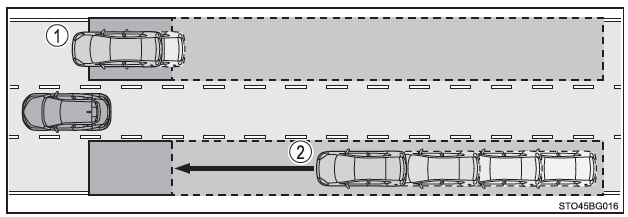
- Vehicles in the outside rear view mirror blind spots
- Vehicles rapidly approaching from behind in the outside rear view mirror blind spots
BSM function detection zones
The zones in which vehicles can be detected are shown below.
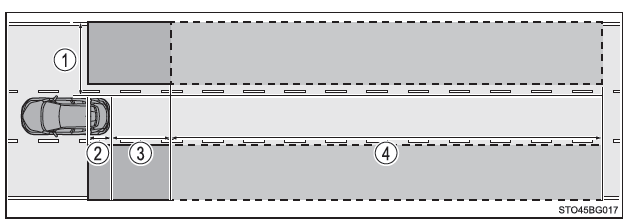
Each sensor has the following detection range:
- Approximately 0.5 m (1.6 ft.) to 3.5 m (11.5 ft.) from each side of the vehicle*
*: Nothing can be detected in the area between the side of the vehicle and 0.5 m (1.6 ft.) from it.
- Approximately 1 m (3.3 ft.) forward of the rear bumper
- Approximately 3 m (9.8 ft.) from the rear bumper
- Approximately 3 m (9.8 ft.) to 60 m (197 ft.) from the rear bumper*
*: The greater the speed difference between your vehicle and the detected vehicle, the farther away the detected vehicle will be detected, causing the indicator built into the outside rear view mirror to light up or flash.
WARNING■ Precautions when using the system The driver is solely responsible for driving safely. Always drive carefully and keep watch on your surroundings.
Blind spot monitor is a supplemental function that alerts the driver to the presence of a vehicle in the blind spot. Do not place too much trust in the blind spot monitor function. The function is not capable of judging whether it is safe to change lanes, and over-reliance on it may result in a serious or fatal accident.
Depending on conditions, the system may not operate correctly.
Therefore, the driver must personally confirm safety visually.
■ BSM function operating conditions
The BSM function operates when all of the following conditions are met:
- The BSM system is active.
- The shift lever is not in R.
- The vehicle is traveling at more than approximately 16 km/h
■ Conditions for vehicle detection by the BSM function
The BSM function detects a vehicle in the detection zone in the following situations:
- Another vehicle passes your vehicle in an adjacent lane.
- Another vehicle enters the detection zone when changing lanes.
■ Conditions in which the BSM function does not detect vehicles The BSM function is not designed to detect the following types of vehicles and/or obstacles:
- Small motorcycles, bicycles, pedestrians, etc.*
- Oncoming vehicles
- Guardrails, walls, road signs, parked vehicles and other stationary obstacles*
- Vehicles following your vehicle in the same lane*
- Vehicles two lanes away from your vehicle*
*: Depending on conditions, a vehicle and/or an obstacle may be detected.
■ Conditions in which the BSM function may not operate properly
- The BSM function may not detect vehicles properly in the following situations:
- When the sensor is misaligned after it or the area around it has been subjected to a strong impact
- When the sensor or the rear bumper area around it is covered with mud, snow, frost, an adhesive, etc.
- When driving on a road surface made wet by standing water in bad weather (e.g., heavy rain, snow or fog)
- When several vehicles are approaching while following closely behind each other
- When the distance is reduced between your vehicle and the vehicle behind it
- When there is a large difference in speed between your vehicle and a vehicle entering the detection zone
- When the speed difference between your vehicle and another vehicle changes
- When a vehicle enters the detection zone while traveling at the same or nearly the same speed as your vehicle
- When your vehicle starts moving after stopping and a vehicle remains in the detection zone
- When driving successively up and down steep changes in elevation, such as a hill or a speed bump
- When driving on a very winding road, through successive curves, or on a deformed road surface
- When lanes are wide, or when driving at the edge of the lane, and the vehicle in an adjacent lane is far from your vehicle
- When a bicycle carrier or another accessory is mounted on the rear of the vehicle
- When there is a large difference in height between your vehicle and a vehicle entering the detection zone
- Immediately after you turn on the BSM system
- Cases in which the BSM function incorrectly detects a vehicle and/or an obstacle may increase in the following situations:
- When the sensor is misaligned after it or the area around it has been subjected to a strong impact
- When the distance is reduced between your vehicle and a guardrail, wall, etc. entering the detection zone
- When driving successively up and down steep changes in elevation, such as a hill or a speed bump
- When lanes are narrow, or when driving at the edge of the lane and a vehicle traveling in a lane other than the one adjacent to yours enters the detection zone
- When driving on a very winding road, through successive curves, or on a deformed road surface
- When the tires skid or spin
- When the distance is reduced between your vehicle and the vehicle behind it
- When a bicycle carrier or another accessory is mounted on the rear of the vehicle