Clutch - GENERAL INFORMATION
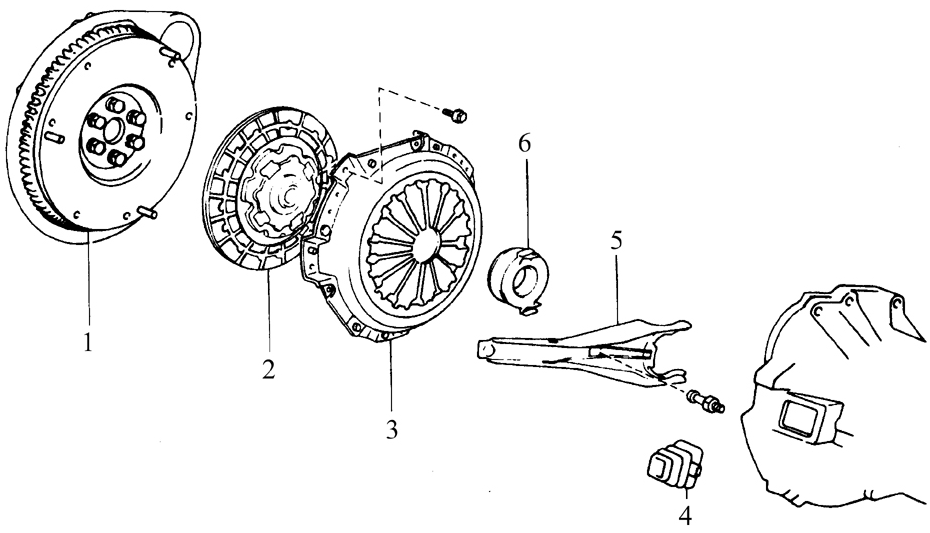
Clutch Components 1. Flywheel
2. Clutch Disc
3. Clutch Cover
4. Release Bearing with Hub
5. Clutch Release Fork
6. Boot
All vehicles with a manual transmission use a dry, single-plate clutch with a diaphragm spring. The clutch disc has a hub with splines on its inner surface, allowing it to slide along the splines of the transmission input shaft. The clutch disc and pressure plate are held together by the pressure of the diaphragm spring fingers mounted in the pressure plate.
The vehicles use a hydraulic clutch release system. It consists of the clutch pedal, master cylinder, fluid reservoir, hydraulic lines, and slave cylinder, which actuates the clutch release fork and release bearing.
When the clutch pedal is depressed to disengage the clutch, hydraulic pressure is transmitted to the outer end of the clutch release fork. When it pivots, the fork presses on the release bearing. The bearing, in turn, presses on the diaphragm spring fingers, which releases the clutch.
Terminology used to describe clutch components may cause confusion, as some older manufacturer names have changed. For example, the clutch disc is often called the driven plate or simply the disc, the pressure plate is sometimes called the clutch cover, the release bearing is sometimes called the throw-out bearing, and the slave cylinder is sometimes called the release cylinder.
Apart from replacing clutch components that show obvious damage, the cause of the malfunction must be diagnosed.
Diagnosis
PROCEDURE
1. First, check the fluid level in the master cylinder reservoir (see subsection 8.2.5). If the fluid level is low, top up the fluid and check the hydraulic system for leaks. If the master cylinder reservoir was empty, bleed the hydraulic system (see subsection 8.2.5) and check the operation of the clutch release mechanism.
2. To check the time required for the released clutch disc to stop rotating, start the engine and let it idle with the transmission in neutral (clutch pedal released - clutch engaged). Depress the clutch pedal, wait a few seconds, and then shift into reverse. You should not hear any scraping noise. If a scraping noise is heard, this indicates possible problems with the clutch pressure plate or driven disc.
3. To check whether the clutch fully disengages, start the engine (with the parking brake applied) and depress the clutch pedal so that it is approximately 12.7 mm from the floor. Shift into first gear and reverse several times. If the gears are difficult to shift, the clutch is faulty. Check the stroke of the release cylinder pushrod. With the clutch pedal fully depressed, the release cylinder pushrod should extend noticeably from the cylinder. If it does not extend, check the fluid level in the master cylinder reservoir.
4. Inspect the clutch pedal bushing above the pedal and check that it does not stick and is not excessively worn or loose.
5. Under the vehicle, check that the clutch release fork is securely installed on the ball stud.
Test yourself
A quick Toyota Corolla quiz: every answer comes with an explanation and a link to the manual page.