Hybrid Electric Vehicle Information

Hybrid Electric Vehicle Information – Troubleshooting

In this manual: Hybrid Electric Vehicle Information
Introduction — 1Symbol Glossary — 1Data Privacy — 7At a Glance — 1Child Safety — 11Seat Belts — 9Personal Safety System™ — 1Airbags — 8Pedestrian Warning System. 911 Assist — 1Keys and Remote Controls — 8MyKey™ — 5Doors & Locks — 5Keyless Entry — 6Easy Entry and Exit — 1Liftgate - Vehicles With: Manual Liftgate — 3Liftgate - Vehicles With: Power Liftgate — 6Safety — 4Steering Wheel — 1Wipers and Washers — 7Exterior Lighting — 8Interior Lighting — 4Windows — 3Interior Mirror — 1Exterior Mirrors — 1Sunroof (if equipped) — 4Instrument Cluster — 16Instrument Cluster Display — 14Trip Computer — 3Head-Up Display (If Equipped) — 1Remote Start — 5Climate Control — 7Cabin Air Quality — 1Front Seats — 5Rear Seats — 1Rear Seat Reminder — 1Memory Function — 1Garage Door Opener — 7USB Ports — 3Power Point - Vehicles With: 12V Outlet — 1Wireless Accessory Charger — 1Storage — 1Starting and Stopping the Engine — 9Hybrid Electric Vehicle Information — 6Auto Start-Stop — 1Fuel and Refueling — 10Catalytic Converter — 1High-Voltage Battery — 1Charging Your Vehicle – Plug-in Hybrid Electric Vehicle (PHEV) — 7Automatic Transmission — 8All-Wheel Drive — 1Brakes — 4Electric parking brake — 1Hill Start Assist — 1Auto Hold — 1Traction Control — 1Stability Control — 1Steering — 1Park Aid — 7Rearview Camera — 1Active Park Assist — 5Cruise Control — 1Adaptive Cruise Control — 10Drive Mode Control — 5Lane Keeping System — 6Blind Spot Information System — 5Cross-Traffic Alert — 5Pre-Collision Assist — 9Driver Alert — 4Traffic Sign Recognition — 4Loading — 6Cargo Area — 1Trailer Hitch Connection — 3Towing a Trailer — 4Trailer Sway Control — 1Driving Tips — 4Breakdown and Emergency Information — 7Towing Your Vehicle — 4Fuses — 4Maintenance — 14Vehicle Care — 5Body Styling Kits — 1Storing Your Vehicle — 1Wheels and Tires Information — 6Tire Care — 4Tire Sealant and Inflator Kit — 8Tire Pressure Monitoring System — 4Road Wheel Replacement — 1Capacities and Specifications — 16Vehicle Identification — 1Connected Vehicle — 4Vehicle Wi-Fi Hotspot — 3Audio System — 8SYNC™ (if equipped) — 9SYNC™ 3 (if equipped) — 41Accessories — 1Ford Protect — 1Scheduled Maintenance — 4Customer Information — 23Appendices — 3
~2min read

Hybrid Electric Vehicle Information – Warning Lamps

Ford Escape. Hybrid Electric Vehicle Information – TroubleshootingIt illuminates if your vehicle has an electrical component malfunction or a fault that causes your vehicle to shut off or enter a limited operating mode. A message may appear in the instrument cluster display.

Hybrid Electric Vehicle Information – Information Messages
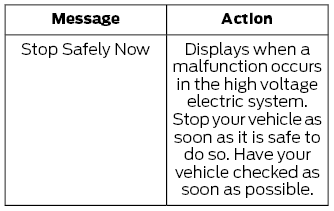
Ford Escape. Hybrid Electric Vehicle Information – Troubleshooting

Hybrid Electric Vehicle Information – Frequently Asked Questions

What is the service life of the high-voltage battery system?

The high-voltage battery system is designed to last for the life of your vehicle.

Does the high-voltage battery require maintenance?

The high-voltage battery does not require maintenance.

What should I do if the vehicle runs out of fuel and the high-voltage battery is discharged?

Refuel and start the vehicle normally. The engine will recharge the high-voltage battery.

Why does the engine sometimes start when the ignition is switched on?

The vehicle computer determines if engine start is required when the ignition is switched on. It starts the engine when necessary to heat the cabin, defrost the windshield, or if the outside air temperature is low.

Can I use E15 or E85 in my vehicle, and how will it affect fuel economy?

Your hybrid vehicle can use E15 (15% ethanol, 85% gasoline) fuel, but you may notice a slight decrease in fuel economy because ethanol contains less energy per gallon than gasoline. Your hybrid vehicle is not designed to use E85 (85% ethanol).

Why does the engine take a long time to shut off?

There are several reasons why the engine remains running for a long time when you first start it. One common reason is to make sure the emission components are warm enough to minimize tailpipe emissions. As the climate becomes cooler, engine running time increases.

Why does my engine run when it is very cold outside?

To make sure the climate control system can begin heating the cabin or defrosting the windshield as soon as the driver requests it, the engine coolant temperature must be maintained sufficiently warm. Keeping the engine running is required to maintain the correct engine coolant temperature.

Test yourself

A quick Ford Escape quiz: every answer comes with an explanation and a link to the manual page.