Adaptive Cruise Control

Adaptive Cruise Control Gap Setting

In this manual: Adaptive Cruise Control
Introduction — 1Symbol Glossary — 1Data Privacy — 7At a Glance — 1Child Safety — 11Seat Belts — 9Personal Safety System™ — 1Airbags — 8Pedestrian Warning System. 911 Assist — 1Keys and Remote Controls — 8MyKey™ — 5Doors & Locks — 5Keyless Entry — 6Easy Entry and Exit — 1Liftgate - Vehicles With: Manual Liftgate — 3Liftgate - Vehicles With: Power Liftgate — 6Safety — 4Steering Wheel — 1Wipers and Washers — 7Exterior Lighting — 8Interior Lighting — 4Windows — 3Interior Mirror — 1Exterior Mirrors — 1Sunroof (if equipped) — 4Instrument Cluster — 16Instrument Cluster Display — 14Trip Computer — 3Head-Up Display (If Equipped) — 1Remote Start — 5Climate Control — 7Cabin Air Quality — 1Front Seats — 5Rear Seats — 1Rear Seat Reminder — 1Memory Function — 1Garage Door Opener — 7USB Ports — 3Power Point - Vehicles With: 12V Outlet — 1Wireless Accessory Charger — 1Storage — 1Starting and Stopping the Engine — 9Hybrid Electric Vehicle Information — 6Auto Start-Stop — 1Fuel and Refueling — 10Catalytic Converter — 1High-Voltage Battery — 1Charging Your Vehicle – Plug-in Hybrid Electric Vehicle (PHEV) — 7Automatic Transmission — 8All-Wheel Drive — 1Brakes — 4Electric parking brake — 1Hill Start Assist — 1Auto Hold — 1Traction Control — 1Stability Control — 1Steering — 1Park Aid — 7Rearview Camera — 1Active Park Assist — 5Cruise Control — 1Adaptive Cruise Control — 10Drive Mode Control — 5Lane Keeping System — 6Blind Spot Information System — 5Cross-Traffic Alert — 5Pre-Collision Assist — 9Driver Alert — 4Traffic Sign Recognition — 4Loading — 6Cargo Area — 1Trailer Hitch Connection — 3Towing a Trailer — 4Trailer Sway Control — 1Driving Tips — 4Breakdown and Emergency Information — 7Towing Your Vehicle — 4Fuses — 4Maintenance — 14Vehicle Care — 5Body Styling Kits — 1Storing Your Vehicle — 1Wheels and Tires Information — 6Tire Care — 4Tire Sealant and Inflator Kit — 8Tire Pressure Monitoring System — 4Road Wheel Replacement — 1Capacities and Specifications — 16Vehicle Identification — 1Connected Vehicle — 4Vehicle Wi-Fi Hotspot — 3Audio System — 8SYNC™ (if equipped) — 9SYNC™ 3 (if equipped) — 41Accessories — 1Ford Protect — 1Scheduled Maintenance — 4Customer Information — 23Appendices — 3
~1min read

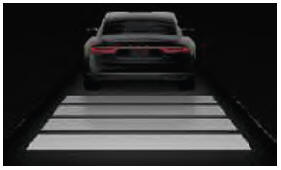
Ford Escape. Setting the Adaptive Cruise Control GapPress the button to cycle through the four gap settings.
Ford Escape. Setting the Adaptive Cruise Control Gap

The selected gap will appear in the instrument cluster display, as shown by the bars in the illustration.

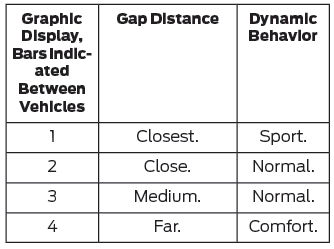
Adaptive Cruise Control Gap Settings
Ford Escape. Setting the Adaptive Cruise Control Gap

Each time you switch the system on, it selects the last gap setting you selected.

Following a Vehicle

When a vehicle ahead enters your lane or a slower vehicle is ahead in your lane, your vehicle speed is adjusted to maintain the gap setting.

Your vehicle maintains a constant gap from the vehicle ahead until:

  • The vehicle ahead accelerates above the set speed.
  • The vehicle ahead leaves the lane you are in.
  • You set a new gap distance.

The system applies the brakes to slow your vehicle down to maintain a safe gap distance from the vehicle ahead. The system applies only limited braking. You can override the system by applying the brakes.

If the system determines that its maximum braking level is insufficient, a warning chime sounds, a message appears in the instrument cluster display and the indicator flashes while the system continues to brake. Take immediate action.

Test yourself

A quick Ford Escape quiz: every answer comes with an explanation and a link to the manual page.