Starting the Engine with an External Battery
Despite the apparent simplicity of the procedure for starting the engine with an external battery, you must observe certain precautions, described below.

WARNING
If the precautions are not observed and the battery is handled improperly during engine starting, the battery may explode, which can cause serious injury to persons nearby.
Do not bring sparks, open flames, or lit cigarettes close to the battery.
To start the engine with an external battery, perform the following operations:
1. Open the hood and check the condition of the battery. In low negative ambient temperatures, check the condition of the battery electrolyte. If ice crystals are floating in the electrolyte or it is covered with an ice crust, do not attempt to start the engine until the electrolyte has completely thawed.
WARNING
If the battery is stored in freezing conditions, the electrolyte may freeze.
When attempting to start the engine, the case of a frozen battery may rupture.
2. Turn off all electrical loads:
climate control system, audio system, lighting, etc.
Place the gear selector in Neutral and apply the parking brake.
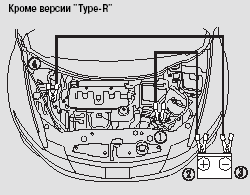
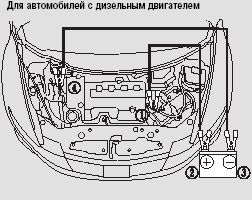
The connection sequence of the cables is indicated by numbers in the illustrations.
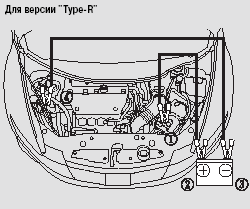
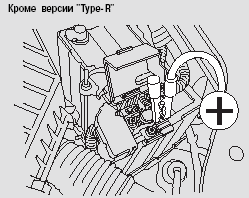
3. Connect one clamp of the positive jumper cable to the positive (+) terminal of your vehicle's discharged battery. Connect the other clamp of this cable to the positive (+) terminal of the external battery.
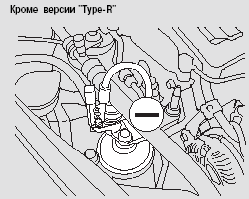
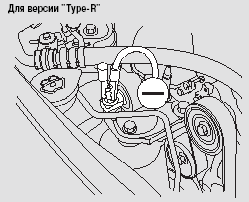
4. Connect one clamp of the second (negative) jumper cable to the negative (–) terminal of the external battery. Connect the other clamp of this cable to the ground point (see illustration). Do not connect the second clamp to other engine components.
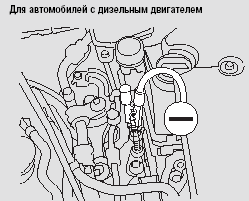
For vehicles with diesel engines
Connect one clamp of the second (negative) jumper cable to the negative (–) terminal of the external battery. Connect the other clamp to the bolt on the engine as shown in the illustration.
Do not connect the second clamp to other engine components.
5. If the external battery is the battery of another vehicle, ask your helper to start that vehicle's engine and set it to a higher idle speed.
6. Start the engine. If the starter still turns the crankshaft slowly, check that the connections of the jumper cables are secure.
7. After the engine starts successfully, disconnect the clamp of the negative jumper cable from the engine of your vehicle, then disconnect the other clamp of this cable from the negative terminal of the external battery. Disconnect the clamp of the remaining (positive) jumper cable from the positive terminal of your vehicle's battery, then disconnect the other clamp of this cable from the positive terminal of the external battery.
When disconnecting the cables, take care not to short the uninsulated parts of one cable to the other cable or to any metal parts of the vehicle. Otherwise, a short circuit may occur.
Vehicles with i-SHIFT transmission: After starting the engine, place the gear selector in Neutral and hold the brake pedal depressed for about 3 seconds, until the N symbol appears on the gear position indicator. Then turn the ignition key to the ON (II) position again.
Test yourself
A quick Honda Civic quiz: every answer comes with an explanation and a link to the manual page.