Air quality control (AQS). MODE ventilation mode button. Defrost button. Ventilation nozzles in the dashboard
The Air Quality System (AQS) in the Kia Opirus automatically detects pollutants in the outside air and reduces their intake into the cabin. This noticeably improves comfort, especially in the city or in heavy traffic. In addition, the MODE button provides individual control of air distribution, whether to the face, feet or windshield. Information on the defrost function and adjusting the ventilation nozzles allows precise control of the cabin climate.
Air Quality System (AQS)
In this mode, the intake of outside air can be controlled automatically. Press this button to switch on automatic air quality control.
When the AQS mode (air quality control) is active, the AQS system automatically detects pollutants in the ambient air and reduces the intake of contaminated air into the vehicle cabin. However, unpleasant or foul-smelling odors present in the ambient air may still be noticeable inside the vehicle.
To switch off this mode:
- Press the button again.
- Press the fresh air/recirculation button.
- Press the AUTO button.
- Select the "Defrost windshield" ventilation mode (
 ) or the "Floor & defrost windshield" mode (
 ).
- With AUTO mode switched on (the indicator light in the AUTO button is lit), press any button of the TEMP switch.
NOTE
- Driving for long periods with air quality control switched on causes the windows inside the vehicle to fog up.
- To remove condensation from the inside of the windows, press the "Defrost" button ( ) or switch to fresh air mode.
- The air quality control sensor is located on the side of the heater core. Make sure the sensor is not damaged.

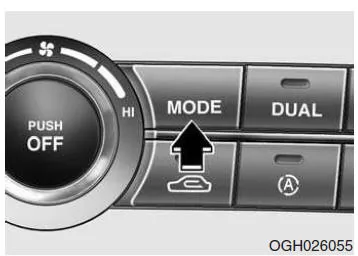
MODE ventilation mode button
The MODE button controls the airflow directions of the ventilation system.
The following ventilation modes can be selected:
Head area
 The airflow is directed to the upper body and the head area. In addition, the airflow can be controlled by adjusting the air vanes.
(Ventilation nozzle: B)
Head area - Footwell
 The airflow is directed to the head area and the footwell. The air directed to the footwell is warmer than the air directed to the head area (exception: the lowest temperature is selected).
(Ventilation nozzles: B, C, E)
Footwell
 The majority of the airflow is directed to the footwell. A small portion is directed to the windshield and side window nozzles.
(Air vents: A, C, D, E)
Floor - Defrost
 Most of the airflow is directed to the floor and the windshield. A small portion is directed to the side window vents.
(Air vents: A, C, D, E)
The A/C is switched on automatically depending on the outside temperature. In addition, fresh air intake is switched on automatically.
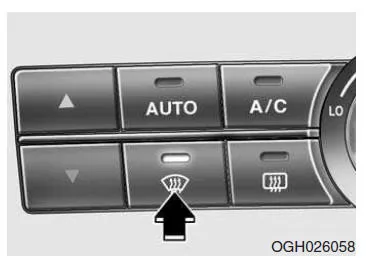
Defrost button
Most of the airflow is directed to the windshield. A small portion is directed to the side window vents.
(Air vents: A, D)
When the defrost mode is on, fresh air intake is switched on automatically and air flows through the vents below the windshield. The A/C is switched on automatically depending on the outside temperature.
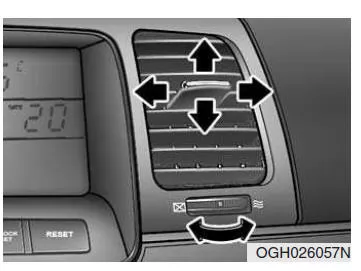
Dashboard air vents
If the automatic airflow control is not satisfactory, additionally operate the dashboard air vents. Air vent (B) can be opened and closed steplessly with the vertical adjustment wheel.
In addition, you can change the airflow direction of these vents by operating the vertical and horizontal adjustment wheels.

The Air Quality System (AQS) in the Kia Opirus 2003–2011 assists the driver by automatically reducing the intake of polluted outside air. This contributes to occupant comfort and health.
The various ventilation modes and the defrost button ensure effective air distribution and clear visibility in all weather conditions. This keeps the Kia Opirus a reliable vehicle in all situations.
Well-designed features such as adjustable air vents complete the climate and ventilation system and increase comfort for all occupants.
Test yourself
A quick Kia Opirus quiz: every answer comes with an explanation and a link to the manual page.