Manual transmission operation
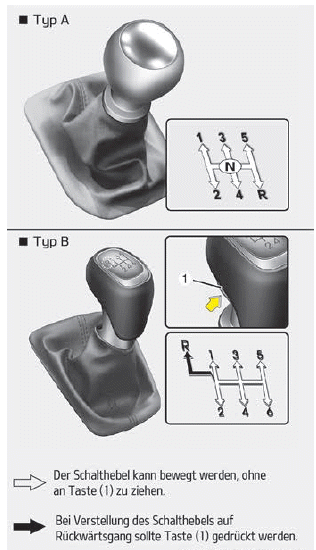
The manual transmission has 5 (or 6) forward gears.
The shift pattern is printed on the gear shift knob. The transmission is fully synchronized in all forward gears, so upshifting or downshifting is possible at any time.
Fully depress the clutch pedal, then release it slowly.
If your vehicle is equipped with an ignition lock, the engine will not start unless the clutch pedal is depressed. (Depending on equipment) The gear shift lever must be in the neutral position before the ignition can be switched on.
Press the button below the gear shift knob, pull the gear shift lever fully to the left, and then select reverse gear (R).
Select reverse gear (R) only after the vehicle has come to a complete stop.
Never run the engine at speeds that enter the red zone.
DANGER
- Be careful when downshifting from 5th to 4th gear. If the gear shift lever is moved too far to the left, you may accidentally select 2nd gear. When downshifting, if a gear is skipped, engine speed may rise high enough to reach the red zone on the tachometer. Such excessive speed may cause the transmission to shift and damage the engine.
- Do not downshift more than 2 gears at once and cause high engine speed (5,000 rpm and above). Such downshifting may damage the engine, clutch and transmission.
- In cold weather, the shift linkage may feel loose until the transmission oil warms up. This is normal and does not harm the transmission.
- If it is difficult to shift the gear shift lever into neutral (N) when the vehicle is stopped, or to engage 1st gear or reverse (R), depress the clutch pedal fully, release it, and then try again. Depress the clutch pedal fully and shift into 1st or reverse gear.
DANGER
- To avoid premature wear and damage to the clutch, do not rest your foot on the clutch pedal while driving. Do not use the clutch to hold the vehicle stationary on a slope, while waiting at a traffic light, etc.
- Do not release your hand during driving. Do not rest your hand on the shift lever, as this may cause premature wear of the shift forks.
- Do not use 2nd gear to start the vehicle unless you are on a very smooth or slippery road. Otherwise, the clutch system may be damaged.
WARNING
- Before leaving the driver's seat, make sure the parking brake is fully applied and the engine is off. Also make sure you place the shift lever in first gear (1) when the vehicle is parked on a level surface or facing uphill, and in reverse (R) when parked facing downhill. If these precautions are not observed or are not performed in the correct order, the vehicle may move suddenly and unexpectedly.
- Do not use engine braking on slippery roads (i.e., do not downshift rapidly from a high gear to a lower gear). The vehicle may skid and cause an accident.
Clutch Operation
Depress the clutch pedal fully to shift gears, then release it slowly. While driving, the clutch pedal must be fully released. Do not rest your foot on the clutch pedal while driving, as this may cause unnecessary wear. Do not partially engage the clutch to hold the vehicle on a slope, as this causes unnecessary wear. Use the foot brake or parking brake to hold the vehicle on a slope. Do not depress the clutch pedal quickly and repeatedly.
DANGER
Always depress the clutch pedal fully. If the clutch pedal is not fully depressed, the clutch may be damaged or noise may develop.
Downshifting
When you are in heavy traffic or need to drive slowly uphill, downshift before the engine runs at low speed. Downshifting reduces the risk of the engine stalling and provides better acceleration when needed. Downshifting when driving downhill can increase engine braking effect, reducing brake use and extending brake service life.
Test yourself
A quick Kia Stonic quiz: every answer comes with an explanation and a link to the manual page.