Camshaft Position Sensor (CMPS)
Description and Operation
Description
The Camshaft Position Sensor (CMPS) is a Hall sensor that detects the camshaft position using a Hall element.
It is synchronized with the Crankshaft Position Sensor (CKPS) and detects the piston position of each cylinder, which cannot be detected by the CKPS.
Two CMPS are installed on the cylinder head cover for Bank 1 and Bank 2 (Intake, Exhaust) respectively and use the target wheel installed on the camshaft.
The camshaft position sensor is a Hall sensor.
When the target wheel passes the Hall sensor, the magnetic field changes in the sensor.
Then the sensor switches the signal, which generates a square wave.
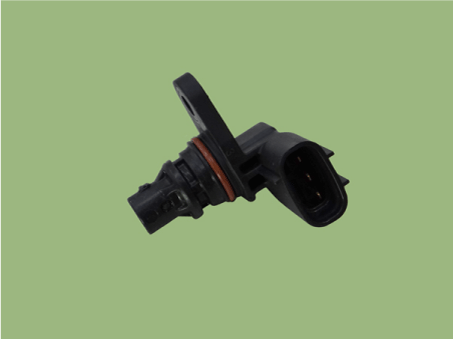
Components and Component Location
Component Location
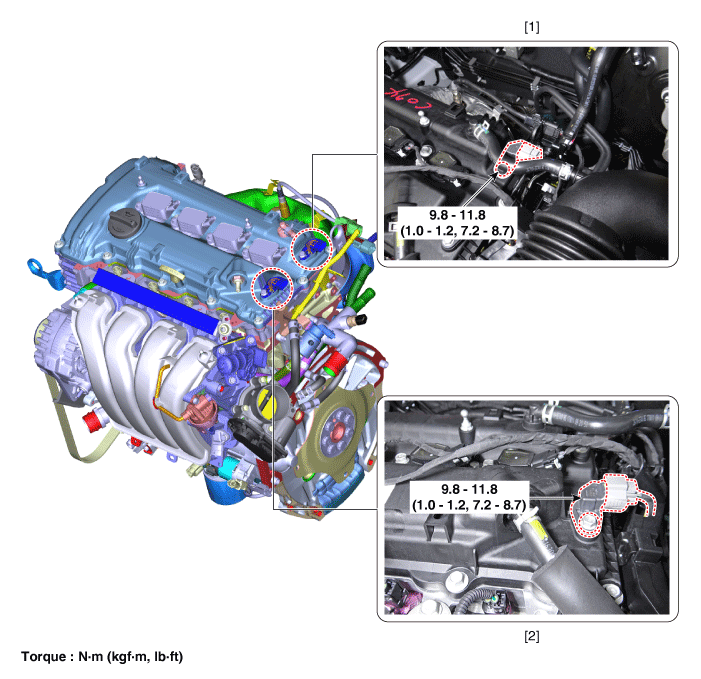
| 1. Camshaft Position Sensor (CMPS) - Exhaust | 2. Camshaft Position Sensor (CMPS) - Intake |
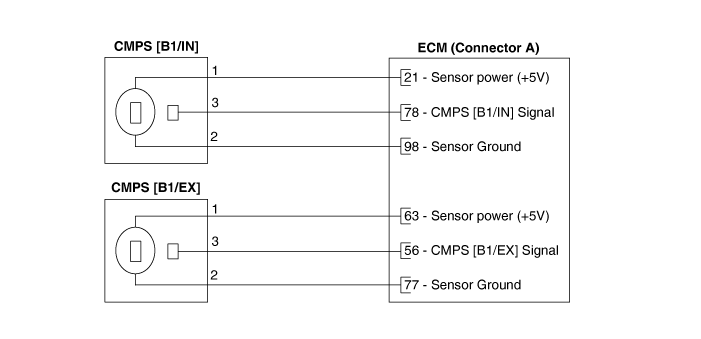
Circuit Diagrams
Wiring Diagram
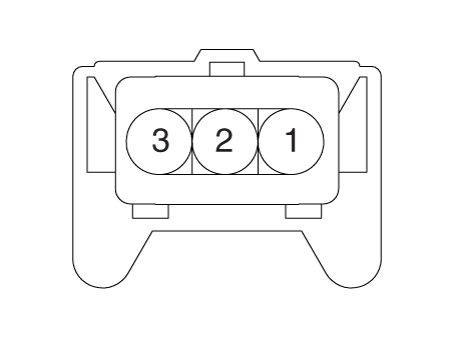
Harness Connector
Repair Procedures
Inspection
The engine control system can be diagnosed more quickly for malfunctions using the Kia Diagnostic System (KDS). (Refer to Diagnostic Trouble Code Guide)
KDS provides the following information.
Self-diagnosis: Checks and displays diagnostic trouble codes (DTC).
Data list: Checks the input/output values of the system.
Active test: Checks the operating condition of the system.
Additional functions: System option control, zero point adjustment, and other functions.
Component Inspection
Check the CMPS signal waveform using the KDS.
Specification: Refer to the Diagnostic Trouble Code Troubleshooting Manual.
Removal
[Intake]
Disconnect the negative battery cable.
Disconnect the camshaft position sensor connector (A).
Loosen the mounting bolt (B) and remove the camshaft position sensor.
Tightening Torque: 9.8–11.8 N·m
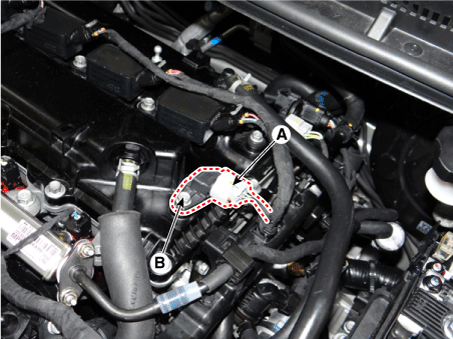
[Exhaust]
Disconnect the negative battery cable.
Disconnect the camshaft position sensor connector (A).
Loosen the mounting bolt (B) and remove the camshaft position sensor.
Tightening Torque: 9.8–11.8 N·m
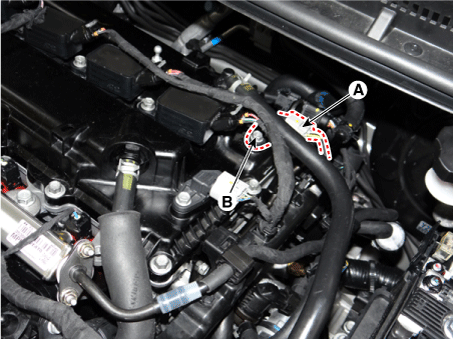
Installation
Install in the reverse order of removal.
Test yourself
A quick Kia Optima DL3 quiz: every answer comes with an explanation and a link to the manual page.