Cruise Control System (CC)
Description and Operation
Cruise Control
The cruise control system is turned on with the cruise control main switch "ON/OFF" located on the right side of the steering column. The system has cruise, coast, accel, and resume functions.
It also has a safety cancel function that operates when the brake pedal is depressed or the transmission selector lever is shifted.
The PCM is the control module for this system. The main components of the cruise control system are the mode control switches, transmission range switch, brake switch, vehicle speed sensor, PCM, and the ETC motor that connects to the throttle body.
The PCM has a low speed limit that prevents the system from engaging below the minimum speed of 30 km/h.
The controller operation is performed by the mode switches located on the steering wheel.
The transmission range switch and the brake switch are used to cancel the cruise control system. The switches are located on the brake pedal bracket and the transmission. When the brake pedal is depressed or the selector lever is moved, the cruise control system is electrically canceled, and the throttle valve returns to the idle position.
Cruise Control Main Switch (ON/OFF)
The cruise control system is turned on by pressing the cruise control main switch "ON/OFF". When the cruise control main switch "ON/OFF" is pressed again, the throttle is reset, cruise control is canceled, the memory speed is erased, and the vehicle returns to non-cruise mode.
Speed Switch
The SET switch is located on the right side of the steering column.
Coast Function - Press and hold the "SET -" switch while cruise control is on. The vehicle will gradually decelerate. Release the switch at the desired speed. The desired speed will be maintained.
Press the "SET -" switch and release it quickly. The cruise speed will decrease by 1 km/h.
Speed Switch
Speed switch located on the right side of the steering column.
Accel Function - Press and hold the "SET +" switch while cruise control is on. The vehicle will gradually accelerate. Release the switch at the desired speed. The desired speed will be maintained.
Press the "SET +" switch and release it quickly. The cruise speed will increase by 2 km/h.
RES/CANCEL Switch
The cruise control system is temporarily deactivated by pressing the "CANCEL" switch.
Circuit Diagrams
System Block Diagram
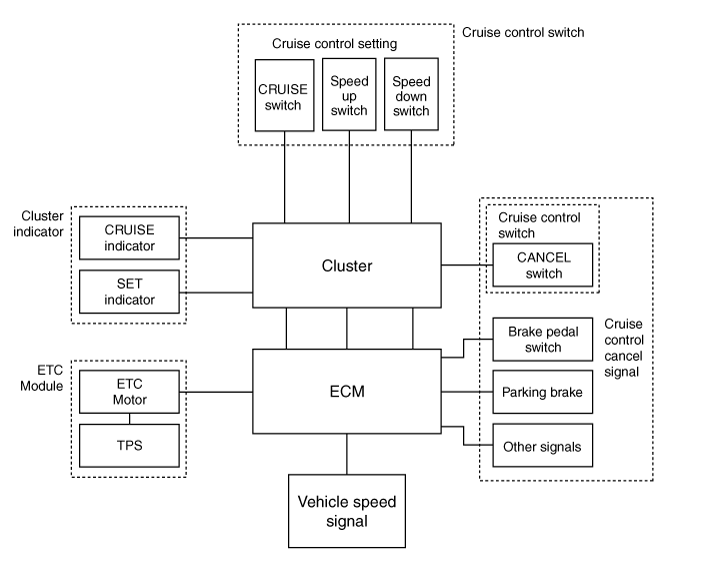
Components and Function Description
| Component | Function | |
| Vehicle speed sensor, ECS/ABS control module | Converts vehicle speed into a pulse signal. | |
| PCM | Receives signals from sensors and switches. | |
| Cruise Control Indicator | Illuminates when the CRUISE main switch is turned on (built into cluster) | |
| Cruise Control Switches | CRUISE switch | Cruise control power switch. |
| Speed Switch | Controls the automatic speed control functions using the speed increase/decrease switch. | |
| Speed Switch | ||
| Cancel switches | Cancel switch | Sends cancel signals to the PCM. |
| Brake Pedal Switch | ||
| Transmission range switch (A/T) | ||
| ETC motor | Controls the throttle valve to the set opening through the PCM. | |
* ETC motor: Electronic Throttle Control motor
Troubleshooting
Symptom Troubleshooting Tables
Symptom Troubleshooting 1
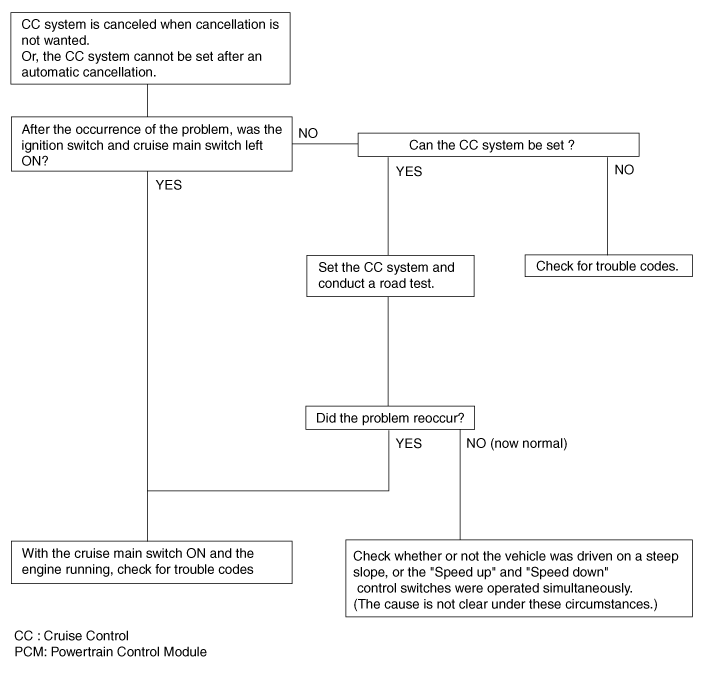
Symptom 2
| Symptom of Malfunction | Probable Cause | Remedy |
| Set vehicle speed fluctuates significantly up or down "Surging" (repeated alternating acceleration and deceleration) occurs after setting the speed. |
Vehicle speed sensor circuit malfunction | Repair the vehicle speed sensor system or replace the component. |
| PCM Malfunction | Check the input and output signals at the PCM. |
Symptom 3
| Symptom of Malfunction | Probable Cause | Remedy |
| CC system does not cancel when the brake pedal is depressed | Brake switch wiring is damaged or disconnected | Repair the harness or replace the brake pedal switch. |
| PCM Signal Malfunction | Check the input and output signals at the PCM. |
Symptom 4
| Symptom of Malfunction | Probable Cause | Remedy |
| CC system does not cancel when the shift lever is moved to the "N" position. (However, it is cancelled when the brake pedal is depressed.) | Inhibitor switch input circuit wiring is damaged or disconnected. | Repair the harness or repair or replace the inhibitor switch. |
| Incorrect inhibitor switch adjustment | ||
| PCM Signal Malfunction | Check the input and output signals at the PCM. |
Symptom 5
| Symptom of Malfunction | Probable Cause | Remedy |
| Cannot decelerate (coast) using the "SET/–" switch. | The input circuit wiring of the "SET -" switch is temporarily damaged or disconnected. | Repair the harness or replace the "SET -" switch. |
| PCM Signal Malfunction | Check the input and output signals at the PCM. |
Symptom 6
| Symptom of Malfunction | Probable Cause | Remedy |
| Cannot accelerate or resume speed using the "RES/+" switch. | The wiring of the "SET +" switch input circuit is damaged or disconnected, or shorted. | Repair the harness or replace the "SET +" switch. |
| PCM Signal Malfunction | Check the input and output signals at the PCM. |
Symptom 7
| Symptom of Malfunction | Probable Cause | Remedy |
| CC system can be set while driving at a speed below 40 km/h (25 mph), or there is no automatic cancellation at this speed. | Vehicle speed sensor circuit malfunction | Repair the vehicle speed sensor system or replace the component. |
| PCM Signal Malfunction | Check the input and output signals at the PCM. |
Symptom 8
| Symptom of Malfunction | Probable Cause | Remedy |
| CRUISE CONTROL main switch indicator light does not illuminate (although the CC system operates normally). | Damaged or disconnected cruise control main switch indicator lamp bulb | Repair the harness or replace the component. |
| Harness is damaged or disconnected |
Test yourself
A quick Kia Optima DL3 quiz: every answer comes with an explanation and a link to the manual page.