Front Radar System
Components and Component Location
Component Location
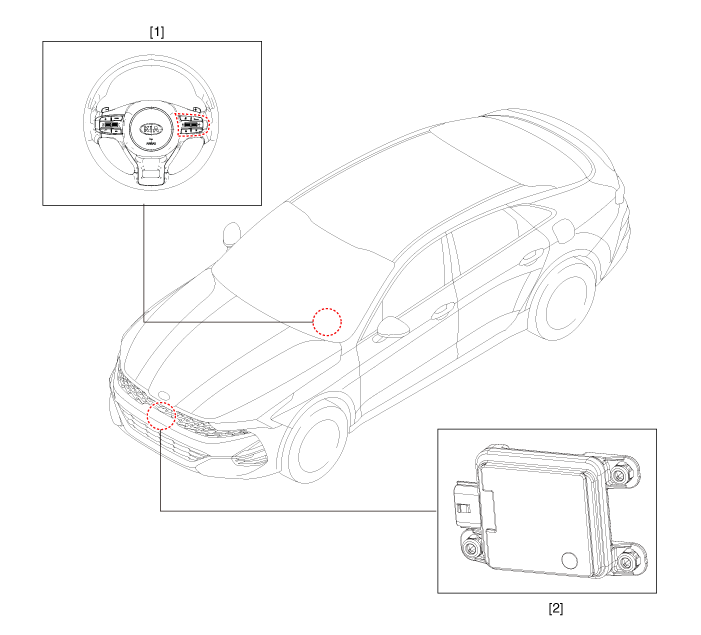
| 1. Smart Cruise Control (SCC) switch | 2. Front radar unit |
Description and Operation
Description
System Features
Forward Collision-Avoidance Assist (FCA): Detects collision risk factors on the road and warns the driver and activates emergency braking to prevent a collision or reduce collision speed.
FCA-JT (Junction Turning): Controls braking in case of a collision risk with an oncoming vehicle from the opposite side when turning left at an intersection.
Smart Cruise Control (SCC): The smart cruise control system allows the driver to program the vehicle to control speed and following distance. The SCC system detects the vehicle ahead without pressing the brake pedal or accelerator pedal.
Description of the System
Forward Collision-Avoidance Assist (FCA)
Operation Specification
Item Sensor Fusion (Front View Camera + Front Radar) Car Car Pedestrian Cyclist Connection Operating speed
(wheel speed)Warning 10–180 km/h 10–180 km/h 10–85 km/h 10–85 km/h 10–30 km/h FULL braking 10–75 km/h 10–85 km/h 10–65 km/h 10–65 km/h Notes Stationary Moving Vehicle - - Warning level Warning Visual/audible warning FULL braking Visual/audible warning + engine drag + FULL braking Alarm sensitivity (user settings menu) Normal - Late System components
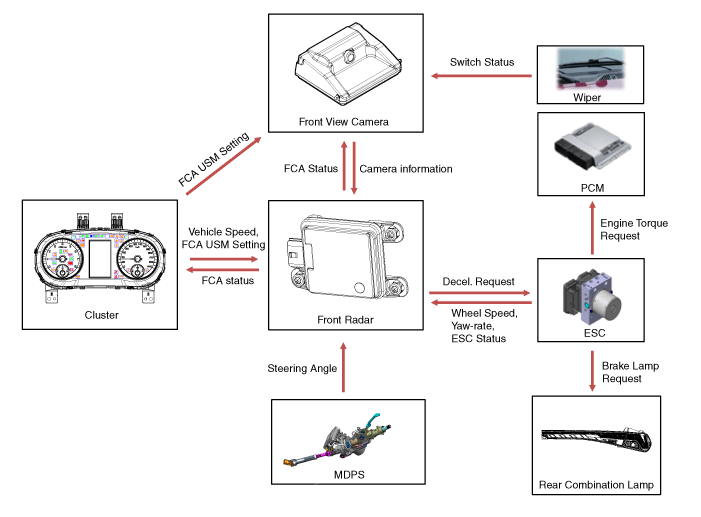
System Block Diagram
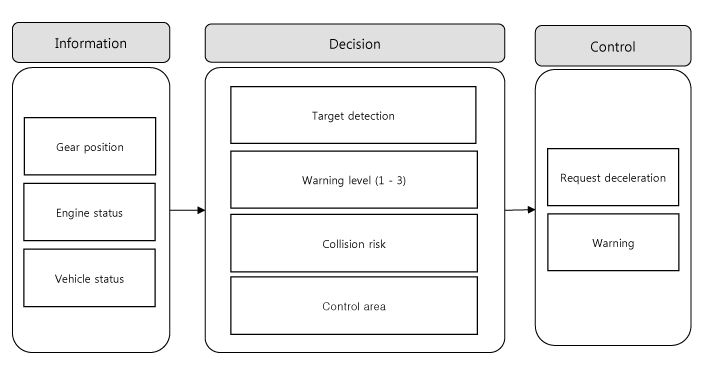
System Operation
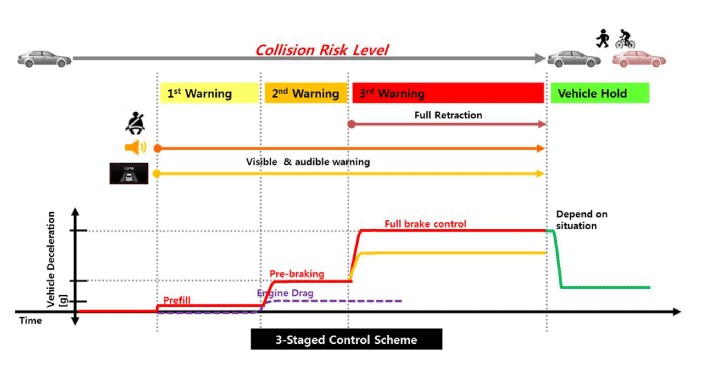
Smart Cruise Control (SCC)
Operation Specification
Item Specification Max./min. speed for speed setting 30–180 km/h Max./min. speed for control 0–190 km/h System components
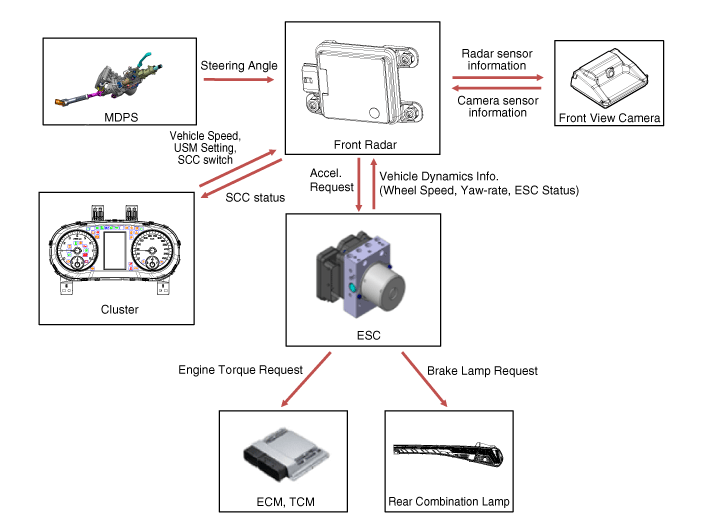
System Block Diagram
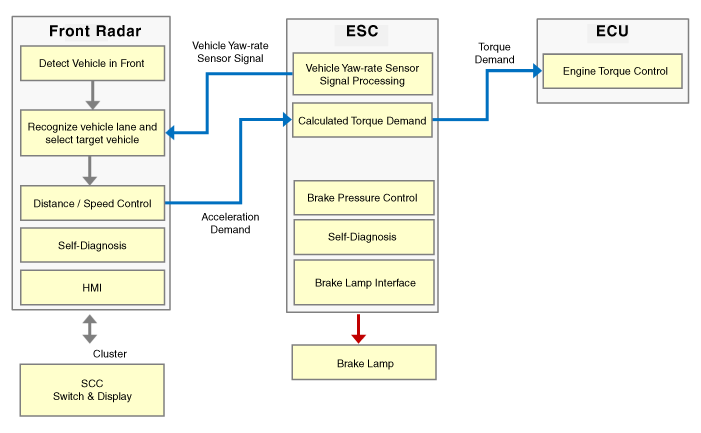
System Limitations
The system uses a camera mounted on the windshield and a radar in the front bumper to monitor driving conditions ahead of the vehicle. The system may malfunction if any situation is outside the detection range or may not operate correctly.
The system may be limited when:
The radar sensor or camera is blocked by a foreign object or debris.
The camera lens is contaminated by window tint or coating, the windshield is damaged, or foreign objects (stickers, insects, etc.) are attached to the glass.
Severe weather, such as heavy rain or snow, blocks the field of view of the radar sensor or camera.
The target ahead is too small to be detected.
The vehicle ahead is an oversized vehicle or trailer that is too large to be detected by the camera recognition system (e.g., tractor trailer, etc.).
The camera field of view is poorly lit (either too dark, or excessive glare or backlight blocks the field of view).
The taillights of the vehicle ahead are not on, or the taillights are located in an unusual position (modified).
The windshield is fogged and the view of the road is obstructed.
The camera or radar is damaged.
Test yourself
A quick Kia Optima DL3 quiz: every answer comes with an explanation and a link to the manual page.