Operating the automatic transmission
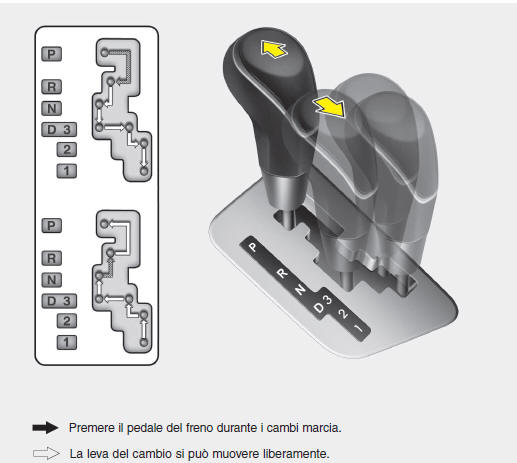
The extremely efficient automatic transmission has four forward gears and one reverse gear. The individual gears are selected automatically, depending on the position of the selector lever.
NOTE The first gear shifts after disconnecting the battery may feel rough. This is normal, and the shift quality stabilises after a few shift cycles by the TCM (Transmission Control Module) or the PCM (Powertrain Control Module).
To ensure smooth engagement, press the brake pedal when shifting from N (Neutral) to a forward or reverse position.
WARNING - Automatic transmission
- Before engaging D (Drive) or R (Reverse), always make sure no one, especially children, is near the vehicle.
- Before leaving the driver's seat, always move the selector lever to P (PARK), then fully apply the parking brake and switch off the engine. If this sequence of precautions is not followed correctly, the vehicle may move unexpectedly.
- Do not use engine braking (downshifting) abruptly on slippery roads.
WARNING
- To avoid damaging the transmission, do not accelerate with the brakes applied when a forward gear or R (Reverse) is engaged.
- Do not use the engine to hold the vehicle stationary on an uphill slope.
Transmission gears The indicator on the instrument cluster shows the position of the selector lever when the ignition switch is in the ON position.
P (Park) Always bring the vehicle to a complete stop before engaging P (Park). This position locks the transmission and prevents the front wheels from rotating.
WARNING
- Engaging P (Park) while the vehicle is moving locks the drive wheels and consequently causes loss of control of the vehicle.
- Do not use P (Park) in place of the parking brake. Always make sure the lever is locked in P (Park) and the parking brake is fully applied.
- Never leave children unattended in the vehicle.
R (Reverse) Use this position to drive in reverse.
WARNING The vehicle must be completely stopped before engaging or disengaging R (Reverse); engaging R while the vehicle is moving may damage the transmission, except as explained in "How to free the vehicle" in this chapter.N (Neutral) The wheels and transmission are not locked. The vehicle can move freely even on slight slopes, unless the brake pedal is pressed or the parking brake is applied.
WARNING Do not drive with the transmission in N (Neutral).
The engine braking would not work and an accident could occur.D (Drive) This is the normal driving position.
The transmission performs automatic shifting through a range of 4 different gear ratios, providing the best balance of fuel economy and performance.
For extra power when overtaking or driving uphill, press the accelerator pedal fully (beyond 80% of its travel) until the kickdown mechanism engages (if fitted); the transmission will automatically downshift.
NOTE Always bring the vehicle to a complete stop before engaging D (Drive).
3 (Third) Use this gear when towing a trailer uphill and to make use of engine braking downhill. When the selector is in position "3", the transmission shifts automatically between 1st, 2nd and 3rd gears. This means that 4th gear is not engaged. However, 4th gear is engaged when a certain speed is exceeded to prevent the engine from overrevving. When returning to normal driving conditions, move the selector to position "D".
2 (Second) Use this position when driving on slippery surfaces or uphill, and to make use of engine braking downhill.
When the selector is in position "2", the transmission shifts automatically between 1st and 2nd gears.
This means that 3rd gear is not engaged. However, 3rd gear is engaged when a certain speed is exceeded to prevent the engine from overrevving. When returning to normal driving conditions, move the selector to position "D".
1 (First) Use this position to climb very steep hills and to make use of engine braking on steep descents.
When downshifting to position "1", the transmission temporarily stays in second gear until the vehicle has slowed sufficiently to engage the lower gear. Do not exceed 50 km/h with the transmission in first gear. When the selector is in position "1", the transmission uses first gear only. To prevent the engine from overrevving, however, second gear is engaged when a certain speed is exceeded and, if the speed continues to rise, third gear as well.
NOTICE
- To ensure smooth and safe engagement, press the brake pedal when shifting from "N" (Neutral) or "P" (Park) to "R" (Reverse) or to a forward position.
- To move the selector lever out of position "P" (Park), fully press the brake pedal.
- Shifting from "R", "N", "D", "3", "2" or "1" to "P" is always possible. To avoid damaging the transmission, the vehicle must be stationary.
WARNING
- Move the selector lever to "R" or "P" only when the vehicle is stationary.
- Do not accelerate with the brakes applied when reverse or a forward gear is engaged.
- Always press the brake pedal when shifting from "P" or "N" to "R", "D", "3", "2" or "1".
- Check the automatic transmission fluid level regularly and top up if necessary. For the correct type of fluid, refer to the scheduled maintenance.
Shift interlock system (if equipped) For safety reasons, the automatic transmission has a shift interlock system that prevents the shift lever from being moved out of P (Park) unless the brake pedal is pressed.
To move the shift lever from P (Park) to R (Reverse):
- Press and hold the brake pedal.
- Move the shift lever.
If you pump the brake pedal with the shift lever in P (Park), a noise may be heard.
This is normal.
CAUTION Always firmly depress the brake pedal before and while moving the lever out of P (Park) to another position to avoid unintended vehicle movement that could cause injury to persons in or near the vehicle.Test yourself
A quick Kia Picanto JA quiz: every answer comes with an explanation and a link to the manual page.