Manual transmission operation
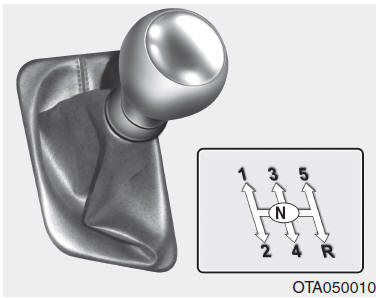
The manual transmission has 5 forward gears.
The gear positions are marked on the gear shift knob. All forward gears are fully synchronized, so upshifts and downshifts are easy.
Fully press the clutch pedal when shifting gears, then release it slowly.
If your vehicle is equipped with an ignition interlock switch, the engine will not start unless the clutch pedal is pressed (if equipped).
To engage reverse (R), first move the gear shift lever to neutral.
Make sure the vehicle is completely stopped before engaging reverse (R).
Never operate the engine with the tachometer needle (RPM) in the red zone.
WARNING
- When downshifting from fifth to fourth, take care not to push the gear shift lever sideways by mistake, which could engage second gear. Such a sharp downshift could over-rev the engine.
Over-revving the engine may damage it.
- At low temperatures, gear shifts may be difficult until the transmission lubricant has warmed up. This condition is normal and does not harm the transmission.
- If you need to bring the vehicle to a complete stop and it is difficult to shift the gear lever into 1st or R (Reverse), move the lever to N (Neutral) and release the clutch. Press the clutch pedal again, then shift the lever into 1st or R (Reverse).
WARNING
- To avoid unnecessary wear or damage to the clutch, do not rest your foot on the clutch pedal while driving. Also, do not use the clutch to hold the vehicle on an incline while waiting at a traffic light, etc.
- To avoid damage to the clutch system, do not start off in 2nd gear except on slippery surfaces.
- Do not use the gear lever as a hand rest while driving, to avoid premature wear of the shift forks.
WARNING
- Before leaving the driver's seat, always apply the parking brake and turn off the engine. Then make sure the gear lever is in 1st when parking the vehicle on level ground or uphill, or in reverse (R) when parking downhill. If this correct sequence of precautions is not followed, the vehicle could move unexpectedly.
- Do not use engine braking (downshifting from a higher gear to a lower gear) abruptly on slippery roads. The vehicle could skid and cause an accident.
- If your vehicle has a manual transmission not equipped with an ignition lock switch, it could move and cause a serious accident when the engine is started without pressing the clutch pedal while the parking brake is released and the gear lever is not in N (Neutral).
Using the clutch Before shifting gears, press the clutch pedal fully down and then release it slowly. The clutch pedal must always be fully released while driving. Do not rest your foot on the clutch pedal while driving, to avoid premature wear. Do not partially engage the clutch to hold the vehicle on slopes, to avoid premature wear. Use the foot brake or the parking brake to hold the vehicle on slopes. Do not operate the clutch pedal rapidly and repeatedly.
WARNING When operating the clutch pedal, press it fully down. If the clutch pedal is not fully depressed, the clutch may be damaged or noise may occur.Downshifting When you need to slow down due to heavy traffic or when climbing a steep hill, downshift before the engine is under strain. Downshifting reduces the chance of the engine stalling and provides better acceleration when you need to increase speed. When driving down steep descents, downshifting helps maintain a moderate speed and reduces brake wear.
Test yourself
A quick Kia Picanto JA quiz: every answer comes with an explanation and a link to the manual page.