Vehicle load capacity
Do not exceed the load capacity of your vehicle, identified as the "Combined weight of occupants and cargo" on the tire and loading information label. Do not exceed the number of occupants specified in the "Seating capacity" entry on the tire and loading information label.
To determine the "combined weight of occupants and cargo," add the weight of all occupants, then add the total weight of the cargo. The following illustration shows examples.
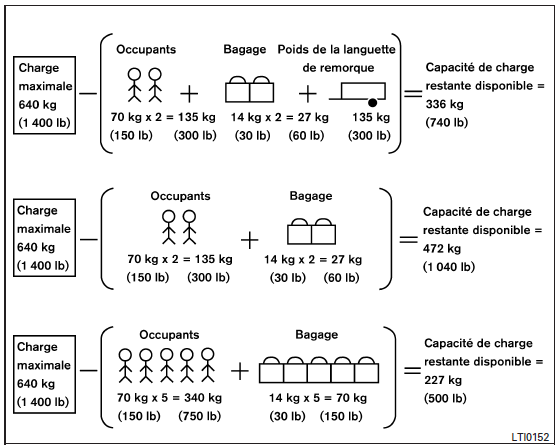
Example
Steps to determine the correct load limit
- Find the statement "The combined weight of occupants and cargo should never exceed XXX kg or XXX lbs" on the vehicle's label.
- Determine the combined weight of the driver and passengers who will be riding in your vehicle.
- Subtract the combined weight of the driver and passengers from XXX kg or XXX lbs.
- The result is the cargo and luggage capacity available. For example, if XXX equals 640 kg (1,400 lbs) and there will be five passengers weighing 68 kg (150 lbs) each in your vehicle, the cargo and luggage capacity will be 300 kg (650 lbs) (640 - 340 [5 × 68] = 300 kg) or (1,400 - 750 [5 × 150] = 650 lbs).
- Determine the combined weight of the cargo and luggage loaded in the vehicle. For your safety, this weight must not exceed the available cargo and luggage capacity calculated in step 4.
Before driving with a loaded vehicle, make sure it does not exceed the specified Gross Vehicle Weight Rating (GVWR) or Gross Axle Weight Rating (GAWR). See "Measuring Weights" later in this chapter.
Also make sure the tire inflation pressures are correct. See the tire and loading information label.
Test yourself
A quick Nissan Altima quiz: every answer comes with an explanation and a link to the manual page.