System Description
SYSTEM DESCRIPTION
GENERAL
(a) The Blind Spot Monitor system has a Blind Spot Monitor function and an RCTA function.
(1) Blind Spot Monitor function
- The Blind Spot Monitor function assists the driver when changing lanes.
This function uses quasi-millimeter wave radar to detect vehicles in adjacent lanes, in the blind spots not visible using the outside rear view mirror assemblies, and vehicles rapidly approaching up to 60 m behind the vehicle, in the blind spots not visible using the outside rear view mirror assemblies.
The function warns the driver of a vehicle's presence by illuminating the outside rear view mirror indicator on the outside rear view mirror assembly.
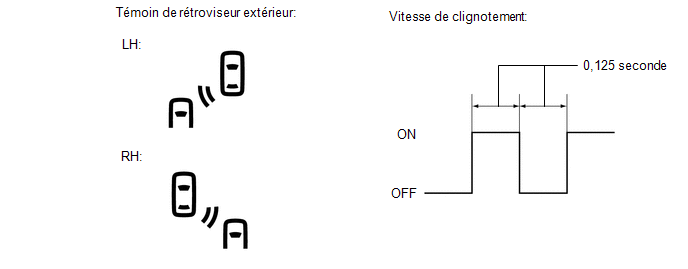
- If the turn signal switch is operated while the outside rear view mirror indicator on the outside rear view mirror assembly is illuminated, the indicator flashes to give the driver an additional warning.
(2) RCTA function
- The RCTA function warns the driver that a vehicle is approaching from the left or right, behind the vehicle. The function uses quasi-millimeter wave radar to detect the position and relative speed of other vehicles. If the function determines that a vehicle is approaching this vehicle, it informs the driver using the outside rear view mirror indicators and the RCTA buzzer.
FUNCTION OF COMPONENTS
Component | Function |
|---|---|
Blind Spot Monitor sensor |
|
Outside rear view mirror assembly
|
Illuminates or flashes the indicator based on a signal from the Blind Spot Monitor sensor. |
Steering pad switch assembly |
|
RCTA buzzer (Rear Cross Traffic Alert buzzer) |
Sounds based on a signal from the Blind Spot Monitor sensor. |
Combination meter assembly
|
|
Main body ECU (multiplex network body ECU) |
Sends the destination information and the high beam/low beam switch signal to the blind spot monitor sensor via CAN communication. |
Skid control ECU |
Sends the vehicle speed signal to the blind spot monitor sensor via CAN communication. |
ECM |
Sends the shift position (R) signal to the blind spot monitor sensor via CAN communication. |
Steering angle sensor |
Detects the steering wheel angle and sends the corresponding signals to the blind spot monitor sensor via CAN communication. |
Airbag sensor assembly |
Sends the yaw rate signal to the blind spot monitor sensor via CAN communication. |
OPERATION DESCRIPTION
(a) Blind spot monitor function operation description
(1) Operating conditions:
- The blind spot monitor system is ON.
- The shift lever is in a position other than R.
- The vehicle speed is above approximately 16 km/h.
(2) Conditions in which a sensor can detect a vehicle
The blind spot monitor function indicates the presence of a vehicle in the detection area when either of the following conditions is met:
- When a vehicle is detected in an adjacent lane that passes your vehicle.
- When a vehicle is detected entering the detection area after changing lanes.
HINT:
The greater the speed difference between your vehicle and the detected vehicle, the farther away the other vehicle will be at the time of notification.
(3) Detection area
Vehicles in the following areas can be detected:
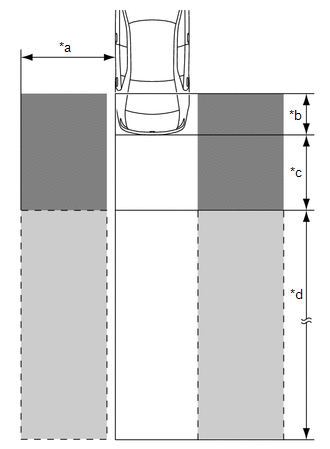
*a |
Approx. 3.5 m (11.48 ft) from the side of the vehicle |
*b |
Approx. 1 m (3.28 ft) forward of the rear bumper |
*c |
Approx. 3 m (9.84 ft) behind the rear bumper |
*d |
Approx. 3 m (9.84 ft) to 60 m (196.86 ft) from the rear bumper |
 |
Detection area (for vehicle in blind spot) |
 |
Detection area (for vehicle approaching rapidly from behind) |
(b) RCTA function operation description
(1) Operating conditions:
- The blind spot monitor system is ON.
- The shift lever is in the R position.
- The vehicle speed is below approximately 8 km/h.
(2) Conditions in which a sensor can detect a vehicle
The RCTA function indicates the detection of a vehicle in the detection area when both of the following conditions are met:
- A vehicle is approaching from the right or left at the rear of your vehicle.
- The vehicle speed is approximately 8 km/h to 28 km/h.
(3) Detection area
Vehicles in the following areas can be detected:
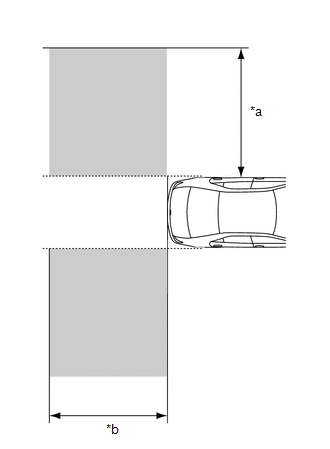
*a |
Approx. 5.5 to 20 m (18.05 to 65.62 ft) from the side of the vehicle (the detection area varies depending on vehicle speed) |
*b |
Approx. 6 m (19.69 ft) behind the rear bumper |
|
Detection area |
HINT:
The RCTA system must be equipped with the Rear View Monitor, because the blind spot monitor sensor cannot detect a vehicle directly behind.
OUTER MIRROR INDICATOR AND RCTA BUZZER OPERATION (BLIND SPOT MONITOR BUZZER)
(a) Initial check
(1) When the blind spot monitor system is turned ON with the ignition switch ON, the outer mirror indicators on the outer mirror assembly light up for 3 seconds and the RCTA buzzer (blind spot monitor buzzer) sounds for 1 second.
(2) When the ignition switch is turned from OFF to ON with the blind spot monitor system ON, the outer mirror indicators on the outer mirror assembly light up for 3 seconds.
(b) Operation description
(1) Blind spot monitor function operation
- When a sensor detects a vehicle in a blind spot area or a vehicle approaching rapidly toward the blind spot from behind, the outer mirror indicator on the outer mirror assembly lights up.
- If the turn signal switch is operated while the sensor detects a vehicle in the outer mirror detection area and the outer mirror indicator is lit, the indicator starts flashing as shown in the illustration.
(2) RCTA function operation
- When all RCTA function operating conditions are met, the outer mirror indicators on the outer mirror assembly flash for 2.5 seconds and the RCTA buzzer (blind spot monitor buzzer) sounds for 2.3 seconds, as shown in the illustration.
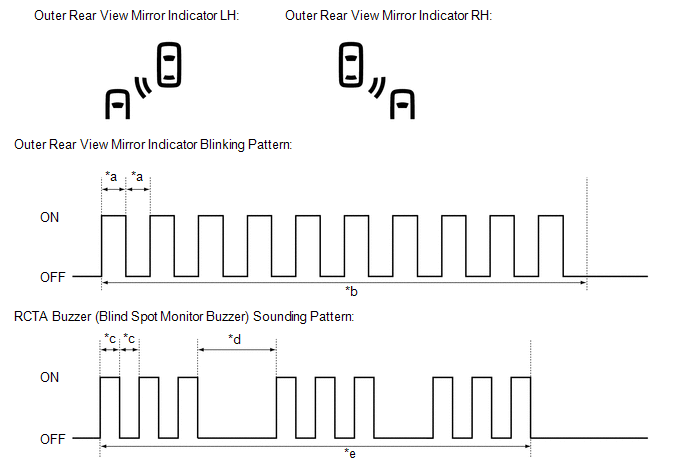
*a |
0.125 seconds |
*b |
2.5 seconds |
*c |
0.1 seconds |
*d |
0.4 seconds |
*e |
2.3 seconds |
- |
- |