FCTA (Front Cross Traffic Alert)

In this manual: FCTA (Front Cross Traffic Alert)
Instrument panel — 1Switches — 1Toyota Prius Interior — 1What to do if... — 1Before driving — 1Seat belts — 1SRS airbags — 1Toyota Prius Front passenger occupant classification system — 1Exhaust gas precautions — 1Child safety — 1Riding with children — 1Child restraint systems — 1Emergency assistance — 1System components — 1Safety Connect LED light Indicators — 1Safety information for Safety Connect — 1Hybrid system — 1Hybrid system features — 1Hybrid system precautions — 1Theft deterrent system — 1Warning lights and indicators — 1Warning lights — 1Indicators — 1Gauges and meters — 1Multi-information display — 1Display contents — 1Driving information display — 1Driving support system information display — 1Settings display — 1Energy monitor / consumption screen — 1System components — 1Consumption screen — 1Key information — 1Keys — 1Digital Key — 1Opening, closing and locking the doors — 1Side doors — 1Back door — 1Smart key system — 1Adjusting the seats — 1Front seats — 1Rear seats — 1Head restraints — 1Adjusting the steering wheel and mirrors — 1Steering wheel — 1Inside rear view mirror — 1Digital Rear-view Mirror — 1Outside rear view mirrors — 1Opening, closing the windows — 1Driving position memory — 1My Settings — 1Driving the vehicle — 1Cargo and luggage — 1Vehicle load limits — 1Power (ignition) switch — 1Toyota Prius EV drive mode — 1Transmission — 1Turn signal lever — 1Parking brake — 1Brake Hold — 1Operating the lights and wipers — 1Headlight switch — 1AHB (Automatic High Beam) — 1Windshield wipers and washer — 1Refueling — 1Using the driving support systems — 1Toyota Safety Sense 3.0 software update — 1Toyota Safety Sense 3.0215 — 1PCS (Pre-Collision System) — 1LTA (Lane Tracing Assist) — 1LCA (Lane Change Assist) — 1LDA (Lane Departure Alert) — 1PDA (Proactive driving assist) — 1FCTA (Front Cross Traffic Alert) — 1RSA (Road Sign Assist) — 1Dynamic radar cruise control — 1Cruise control — 1Emergency Driving Stop System — 1BSM (Blind Spot Monitor) — 1Safe Exit Assist — 1Intuitive parking assist — 1RCTA (Rear Cross Traffic Alert) function — 1RCD (Rear Camera Detection) function — 1PKSB (Parking Support Brake) — 1Parking Support Brake function (static objects to the front and rear/static objects around the vehicle) — 1Parking Support Brake function (rear-crossing vehicles) — 1Parking Support Brake function (rear pedestrians) — 1Toyota Teammate Advanced Park — 1Driving mode select switch — 1Driving assist systems — 1Driving tips — 1Hybrid Electric Vehicle driving tips — 1Winter driving tips — 1Using the air conditioning system and defogger — 1Automatic air conditioning system — 1Heated steering wheel/seat heaters/seat ventilators — 1Using the interior lights — 1Location of the interior lights — 1Operating the personal lights — 1List of storage features — 1Luggage compartment features — 1Other interior features — 1Garage door opener — 1Cleaning and protecting the vehicle exterior — 1Cleaning and protecting the vehicle interior — 1Maintenance requirements — 1General maintenance — 1Emission inspection and maintenance (I/M) programs — 1Do-it-yourself maintenance — 1Do-it-yourself service precautions — 1Hood — 1Positioning a floor jack — 1Engine compartment Toyota Prius 2024-2025 — 112-volt battery — 1Tire pressure warning system — 1Air conditioning filter — 1Cleaning the hybrid battery (traction battery) air intake vent — 1Electronic key battery — 1Checking and replacing fuses — 1Headlight aim — 1Emergency flashers — 1If your vehicle has to be stopped in an emergency — 1If the vehicle is submerged or water on the road is rising — 1If your vehicle needs to be towed — 1If a warning light turns on or a warning buzzer sounds — 1If a warning message is displayed — 1If you have a flat tire (vehicles without spare tire) — 1If you have a flat tire (vehicles with spare tire) — 1If the hybrid system will not start — 1If the electronic key does not operate properly — 1If the 12-volt battery is discharged — 1If your vehicle overheats — 1If the vehicle becomes stuck — 1Maintenance data (fuel, oil level, etc.) — 1Fuel information — 1Customization — 1
~4min read

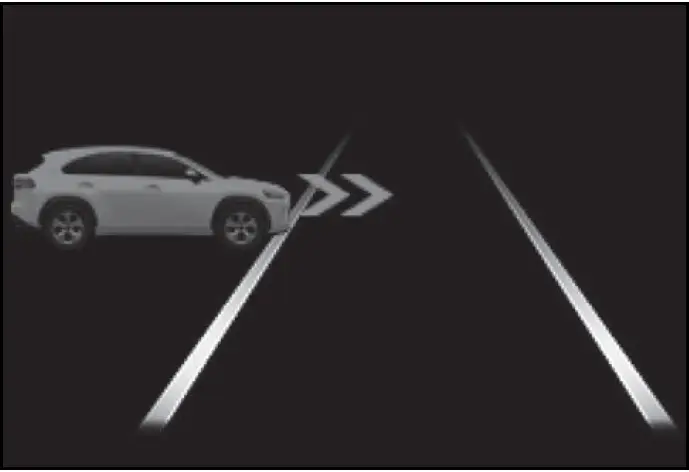
When approaching an intersection, etc., at a low speed, vehicles approaching from the left and right of the front of the vehicle can be detected and the driver informed of these vehicles.

FCTA system control

When the Toyota Prius's FCTA system detects a vehicle approaching from either side as you approach an intersection, it displays a notification. If the system predicts that your vehicle might enter the intersection while a vehicle is approaching, it activates a buzzer and displays a message prompting you to press the brake pedal.

  • Multi-information display
FCTA system control Prius Toyota

WARNING

For safe use

Driving safely is solely the responsibility of the driver. Pay careful attention to the surrounding conditions in order to ensure safe driving. The FCTA system is a supplementary system that informs the driver of vehicles approaching from the left and right of the front of the vehicle.

Over-reliance on this system may lead to an accident resulting in death or serious injury. The details of the warning display may differ from the actual traffic conditions.

Although the warning display will stop being displayed after a certain amount of time, this does not necessarily indicate that there are no longer any vehicles or pedestrians around your vehicle.

FCTA system operating conditions

The system will operate when all of the following conditions are met:

  • A shift position other than P or R is selected
  • The vehicle speed is approximately 15 km/h or less
  • A vehicle is approaching from the left or right in front of your vehicle at a speed between approximately 7 to 60 km/h
  • There are no vehicles in front of your vehicle
  • The accelerator pedal is not being strongly depressed
  • The brake pedal is not being strongly depressed

Situations in which the system may operate even though no vehicles are approaching

In certain situations, such as the following, the system may operate even though no vehicles are approaching:

  • When approaching objects on the roadside, such as guardrails, traffic signs, utility poles, street lights, trees, tall grass, walls, etc.
  • When passing an object on the side of the road, such as a parked vehicle
  • When a vehicle or pedestrian is approaching from the left or right in front of your vehicle in the distance
  • When a vehicle or pedestrian is moving within a parking spot, etc., next to the lane your vehicle is in
  • When a pedestrian or bicyclist is approaching on a sidewalk
  • When a vehicle or pedestrian is moving away from your vehicle
  • When an approaching vehicle is decelerating or stops
  • When an approaching vehicle makes a left/right turn immediately in front of your vehicle
  • When a pedestrian is approaching your vehicle
  • When an oncoming vehicle makes a right/left turn
  • When your vehicle enters an intersection before a vehicle approaching from the left or right in front of your vehicle
  • When stopped at traffic light and a vehicle approaches from the left or right in front of your vehicle
  • When making a left/right turn in front of an approaching vehicle
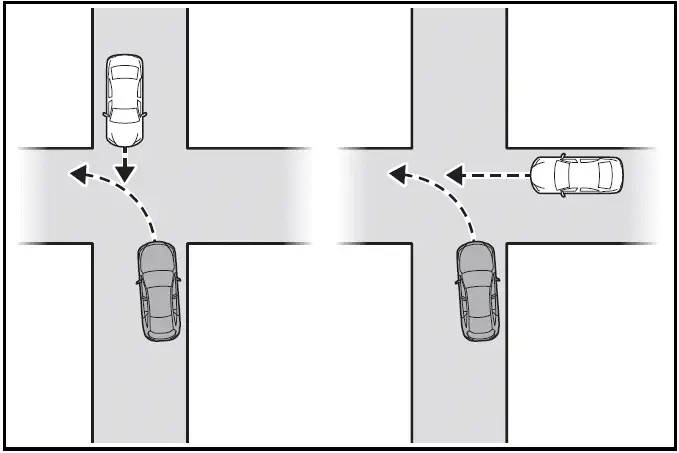
  • When an oncoming vehicle approaches and passes
  • When being overtaken by another vehicle
  • When driving next to another vehicle or a pedestrian
  • When a vehicle or pedestrian approaches the side of your vehicle

Situations in which the system may not operate properly

In situations such as the following, a vehicle may not be detected by a front side radar sensor and the system may not operate properly:

  • If an approaching vehicle moves suddenly (sudden steering, acceleration, deceleration, etc.)
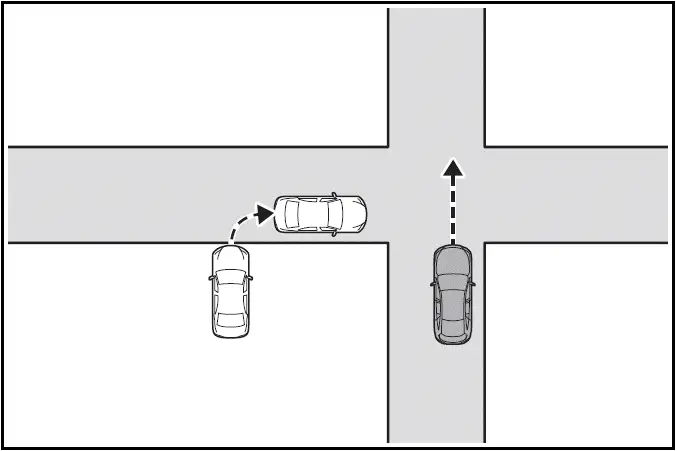
  • If a vehicle is approaching from the left or right of the front of your vehicle diagonally
  • When a vehicle is approaching from the left or right in front of your vehicle in the distance
  • When there is an object between your vehicle and an approaching vehicle
  • When several vehicles are approaching with little space between them
  • Situations in which the sensors may not operate properly
  • Situations in which some or all of the functions of the system cannot operate:

Changing FCTA settings

  • The FCTA can be enabled/disabled through a customize setting
  • The following settings of the FCTA can be changed through customize settings.