Avviamento e guida
Avviamento con cavi ausiliari da un'altra batteria
In questo manuale: Avviamento e guida
12passaggi
~72min
4/5difficoltà
Completati 0 di 12
If the start battery is discharged, current from another battery can be used to start the vehicle.
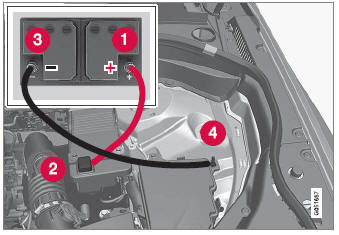
I cavi di avviamento collegano i punti. L'aspetto del vano motore può variare in base al modello e al livello di allestimento del veicolo.
To avoid short circuits or other damage, the following steps are recommended when jump starting the battery using another battery:
- Put the ignition in mode 0.
- Make sure the auxiliary battery (the battery used to jump start the discharged battery) has a voltage of 12 volts.
- If the auxiliary battery is in another vehicle, turn off that vehicle's engine and make sure that the vehicles are not touching each other.
- Clamp the red jumper cable onto the auxiliary battery's positive (+) terminal (1).
- Fold back the cover over your vehicle's positive (+) jump start terminal (2).
- Clamp the other end of the red jumper cable to your vehicle's positive (+) jump start terminal (2).
- Clamp the black jumper cable onto the auxiliary battery's negative (-) terminal (3).
- Clamp the other end of the black jumper cable to your vehicle's negative (-) ground point (4).
- Make sure the jumper cables are securely attached to help prevent sparks while jump starting.
- Start the engine of the assisting vehicle and let it run for a few minutes at a higher idling speed than normal, about 1500 rpm.
- Start the engine of the vehicle with the dead battery.
- Remove the jumper cables in the reverse order ‒ first the black cables and then the red cables.
Make sure that none of the clamps of the black jumper cables come into contact with either vehicle's positive (+) jump start terminals or either of the red jumper cable's connected clamps.
- Non utilizzate mai una batteria di supporto da 48 V per avviare il veicolo.
- External electrical equipment may not under any circumstance be connected to the 48 V battery.
- Only a workshop may replace or perform service on the 48 V battery – an authorized Volvo workshop is recommended.
- Le batterie generano idrogeno gassoso, facilmente infiammabile ed esplosivo.
- Non collegate il cavo di avviamento a nessuna parte dell'impianto di alimentazione o a parti in movimento. Evitate di toccare i collettori caldi.
- Il liquido della batteria contiene acido solforico. Non lasciate che il liquido della batteria entri in contatto con occhi, pelle, tessuti o superfici verniciate.
- In caso di contatto, lavate immediatamente la zona interessata con acqua. Rivolgetevi immediatamente a un medico in caso di contatto con gli occhi.
- Non esponete mai la batteria a fiamme o scintille elettriche. Non fumate vicino alla batteria. La mancata osservanza delle istruzioni per l'avviamento con cavi ausiliari può causare lesioni.
Mettiti alla prova
Un breve quiz sulla Volvo XC90: ogni risposta ha una spiegazione e un link alla pagina del manuale.
Questa pagina ti è stata utile?