Arranque y conducción
Arranque con cables de otra batería
En este manual: Arranque y conducción
12pasos
~72min
4/5dificultad
Hecho 0 de 12
If the start battery is discharged, current from another battery can be used to start the vehicle.
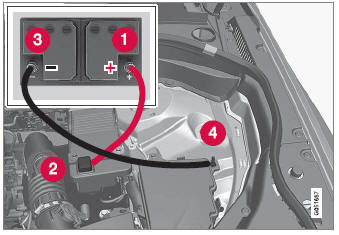
Los cables de arranque conectan los puntos. La apariencia del compartimento del motor puede variar según el modelo del vehículo y el nivel de equipamiento.
To avoid short circuits or other damage, the following steps are recommended when jump starting the battery using another battery:
- Put the ignition in mode 0.
- Make sure the auxiliary battery (the battery used to jump start the discharged battery) has a voltage of 12 volts.
- If the auxiliary battery is in another vehicle, turn off that vehicle's engine and make sure that the vehicles are not touching each other.
- Clamp the red jumper cable onto the auxiliary battery's positive (+) terminal (1).
- Fold back the cover over your vehicle's positive (+) jump start terminal (2).
- Clamp the other end of the red jumper cable to your vehicle's positive (+) jump start terminal (2).
- Clamp the black jumper cable onto the auxiliary battery's negative (-) terminal (3).
- Clamp the other end of the black jumper cable to your vehicle's negative (-) ground point (4).
- Make sure the jumper cables are securely attached to help prevent sparks while jump starting.
- Start the engine of the assisting vehicle and let it run for a few minutes at a higher idling speed than normal, about 1500 rpm.
- Start the engine of the vehicle with the dead battery.
- Remove the jumper cables in the reverse order ‒ first the black cables and then the red cables.
Make sure that none of the clamps of the black jumper cables come into contact with either vehicle's positive (+) jump start terminals or either of the red jumper cable's connected clamps.
- Nunca utilice una batería de apoyo de 48 V para arrancar el vehículo.
- External electrical equipment may not under any circumstance be connected to the 48 V battery.
- Only a workshop may replace or perform service on the 48 V battery – an authorized Volvo workshop is recommended.
- Las baterías generan gas hidrógeno, que es fácilmente inflamable y explosivo.
- No conecte el cable de arranque a ninguna parte del sistema de combustible ni a piezas móviles. Evite tocar los colectores calientes.
- El electrolito de la batería contiene ácido sulfúrico. No permita que el electrolito entre en contacto con los ojos, la piel, las telas o las superficies pintadas.
- En caso de contacto, enjuague de inmediato el área afectada con agua. Busque atención médica de inmediato si los ojos se ven afectados.
- Nunca exponga la batería a llamas o chispas eléctricas. No fume cerca de la batería. No seguir las instrucciones para el arranque con cables puede provocar lesiones.
Pon a prueba tus conocimientos
Un test rápido sobre el Volvo XC90: cada respuesta trae una explicación y un enlace a la página del manual.
¿Le resultó útil esta página?