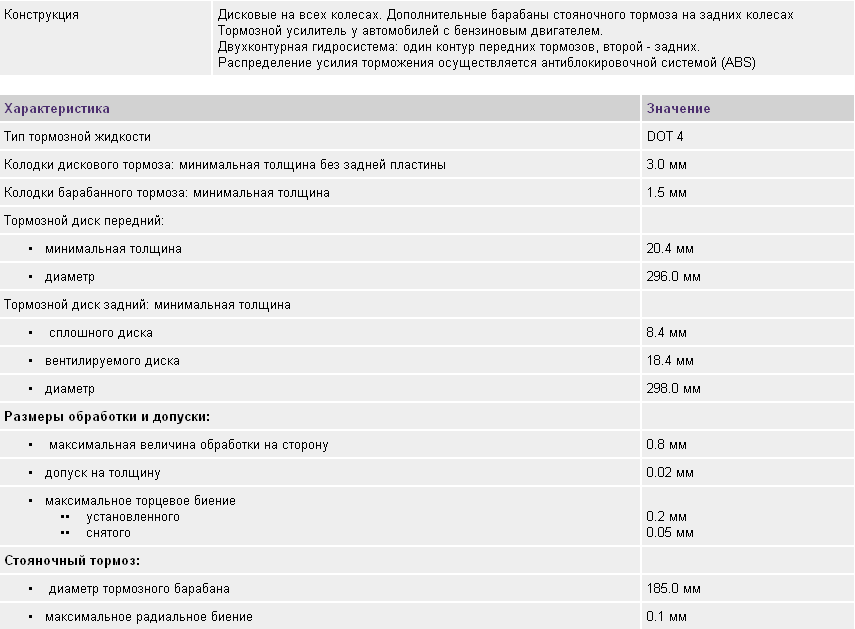
Specifications
* Specifications are also given in the text of this Section; where their observance is mandatory, they are shown in bold.
Tightening torques
Tightening torques for fasteners are given in the text of the Section and in some illustrations*.
*Torques printed in bold in the text must be followed exactly; torques not printed in bold are approximate only.
General information
The brake system consists of the master cylinder, brake booster and disc brakes on the front and rear wheels. The hydraulic brake system has two circuits: one circuit operates the front brakes and the second operates the rear brakes. This allows the vehicle to be braked if one circuit fails, for example due to a leak, by means of the other circuit. Brake fluid pressure is generated in the tandem master cylinder when the brake pedal is pressed. There is no brake force regulator in the system, as brake force distribution is performed by the Anti-lock Brake System (ABS).
The brake fluid reservoir is located in the engine compartment, on the left side under the air cleaner housing. The reservoir supplies fluid to the brake system.
On vehicles with a gasoline engine, the vacuum brake booster uses part of the air drawn in by the engine. Pedal force is boosted through the valve by the available vacuum. A diesel engine does not produce intake vacuum. For this reason, the vacuum for brake boosting is generated by a vacuum pump mounted on the cylinder head.
All disc brakes use rigid calipers. During braking, the piston presses the brake pads against the disc.
The calipers are made of light alloy. This provides good heat dissipation from braking, which helps prevent so-called “brake fade”. “Brake fade” is a reduction in braking effectiveness caused by excessive brake heating.
Brake pad wear sensors are fitted to the front left and rear right brakes.
The parking brake acts on the rear wheels and is operated by a cable. Since a disc brake has certain disadvantages when used as a parking brake, two drum brakes integrated into the brake discs are additionally fitted to the rear wheels. The parking brake is operated by a lever.
Brake dust is produced when cleaning the brake system. This dust is hazardous to health. Therefore, when cleaning the brake system, make sure that brake dust does not enter the respiratory system.
Brake pads are subject to certification by the relevant authorities. In addition, they are designed for use on a specific vehicle model. Genuine brake pads are recommended.
Work on the brake system requires exceptional cleanliness and strict adherence to instructions. If you do not have the necessary experience, it is advisable to have the work performed at a service station.
Used brake fluid must be taken to a designated recycling point. It must not be disposed of with ordinary household waste.
* When driving on wet roads, press the brake pedal periodically to dry the disc brakes. As the wheel rotates, water is thrown off the brake discs by centrifugal force, but a film of silicone, rubber wear products, grease and other contaminants remains, which reduces braking effectiveness.
Test yourself
A quick BMW 1 quiz: every answer comes with an explanation and a link to the manual page.