Rear Brake Disc Removal and Installation
REMOVAL
1. Remove the rear brake caliper. Do not disconnect the brake hose. Otherwise, air must be bled from the brake system after installation.
2. Hang the caliper with wire from the suspension. Make sure the brake hose is not twisted.
3. Unscrew the mounting bolt (arrow) with a 5 mm hex key.
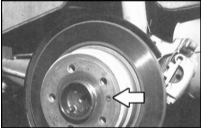
4. Fully release the parking brake.
5. Remove the brake disc. If the disc cannot be removed, retract the parking brake shoes, refer to Parking Brake Shoe Removal and Installation.
Installation
To ensure even braking from both wheels, both brake discs must have the same surface finish. Therefore, always replace or resurface both discs at the same time.
A brake disc may be checked for runout in a workshop. The maximum permissible runout is 0.2 mm (installed disc).
INSTALLATION
1. Measure the thickness of the brake disc, refer to Brake Disc Thickness Measurement.
2. Clean the new brake discs with thinner.
3. Install the brake disc onto the rear wheel hub and secure it with a socket wrench. Rotate the disc beforehand so that the bolt holes align.
4. Install the caliper with the brake pads. Make sure the hose is not twisted. Secure the caliper, refer to Rear Brake Caliper Removal and Installation.
* If the brake hose was removed, secure it and bleed air from the system, refer to Brake System Bleeding.
5. Adjust the parking brake, refer to Parking Brake Adjustment.
6. Install and secure the rear wheels. Do not lubricate the wheel bolts with oil. Install the wheels so that the marks made during removal align. Lower the vehicle onto the wheels, then tighten the wheel bolts in a crisscross pattern to 100 N·m.
* Depress the brake pedal firmly several times until resistance is felt. This moves the brake pads against the disc and into their operating position.
7. Check the brake fluid level in the reservoir. If necessary, top up to the MAX mark.
Caution, check the following:
a) Are the brake hoses secure?
b) Is the brake hose secured in its bracket?
c) Is the bleeder screw tightened?
d) Is there sufficient brake fluid in the reservoir?
e) With the engine running, check the system for leaks. To do this, press the brake pedal with a force of 200 - 300 N (20 - 30 kg) and hold it for 10 s. The pedal force must not decrease.
f) Check all connections for leaks.
New brake discs must be carefully bedded in using three stages.
Stage 1: 5 hard stops from 50 km/h on a road with no traffic.
Stage 2: allow the brakes to cool.
Stage 3: 5 stops from 50 km/h.
Test yourself
A quick BMW 1 quiz: every answer comes with an explanation and a link to the manual page.