Removal and Installation of Rear Brake Calipers
* If the caliper is detached only to remove the brake disc, do not disconnect the brake hose. Otherwise, air must be bled from the system after installation. Hang the caliper with wire so that the hose is not twisted or stretched.
REMOVAL
1. Mark the position of the wheel relative to the hub with paint. This allows the balanced wheel to be installed in its original position. Loosen the wheel mounting bolts with the vehicle on the ground. Raise and support the vehicle on stands and remove the wheel.
2. Lightly depress the brake pedal and hold it. To do this, place a wooden block between the pedal and the seat, moving the seat back and then forward. This prevents brake fluid from draining out of the reservoir and air from entering the system after the brake line is disconnected.
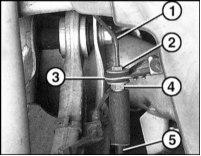
3. Loosen the brake line (1) with the union nut (2) at the brake hose coupling (3). Hold the hose from turning using the hex (4).
* Some brake fluid may leak out. Collect the fluid in a container that is used only for brake fluid.
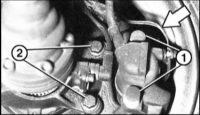
4. Disconnect the wear sensor connector on the right caliper (arrow in the accompanying illustration). Do not pull on the cable.
5. Remove the caliper mounting bolts (2) using a 17 mm open-end wrench and remove the caliper with the brake pads installed from the disc.
INSTALLATION
1. Install the caliper with the brake pads onto the disc.
2. Tighten the caliper mounting bolts to 65 N·m.
3. Connect the wear sensor connector on the right side of the vehicle.
4. Secure the brake hose in the bracket and connect it to the line with the union nut. Make sure the hose is not twisted. Secure the hose in the bracket.
5. Bleed air from the system. Refer to Brake System Bleeding.
6. Install and secure the rear wheels. Do not apply oil to the wheel mounting bolts. Install the wheels so that the marks made during removal are aligned. Lower the vehicle onto the wheels and tighten the mounting bolts in a crisscross sequence to 100 N·m.
* Depress the brake pedal firmly several times until resistance is felt. This causes the brake pads to press against the disc and move into their operating position.
7. Check the brake fluid level in the reservoir. If necessary, top up to the MAX mark.
Caution, check the following for security:
a) Are the brake hoses secured?
b) Is the brake hose secured in the bracket?
c) Is the bleeder screw tightened?
d) Is there enough brake fluid in the reservoir?
e) With the engine running, check the system for leaks. To do this, depress the brake pedal with a force of 200 - 300 N (20 - 30 kgf) and hold it for 10 s. The pedal force must not decrease.
f) Check all connections for leaks.
* Brake fluid must be disposed of in a special manner.
Test yourself
A quick BMW 1 quiz: every answer comes with an explanation and a link to the manual page.