Brake System Bleeding
After any brake system repair that involves opening the system, air may enter the system. The air must then be bled from the system. A drop in brake pressure indicates air in the system. In this case, eliminate the leak in the system and bleed the air from it.
Bleed air from the system by pumping the brake pedal. An assistant is required for this procedure.
At a service station, a special bleeding device is normally used to bleed air from the system. This device creates an excess pressure of 2.0 bar in the system through the brake fluid reservoir.
If air must be bled from the entire system, bleed air from each wheel separately. This is necessary when air has entered every wheel cylinder. If only one caliper was repaired or replaced, it is normally sufficient to bleed air from that specific cylinder.
Bleeding sequence:
- Right rear caliper
- Left rear caliper
- Right front caliper
- Left front caliper
PROCEDURE
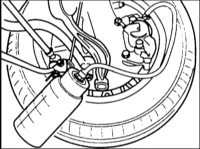
1. Remove the protective cap from the brake caliper bleeder screw. Clean the bleeder screw and install a clean hose on it. Place the other end of the hose into a container half-filled with brake fluid.
2. Ask the assistant to depress the brake pedal as many times as necessary to build pressure in the system. Pressure in the system is felt as increasing resistance of the pedal.
3. After building the required pressure, press the pedal down to the floor. Do not release the pedal.
4. Using an open-end wrench, loosen the bleeder screw by approximately one turn. Collect the escaping fluid in the container. Make sure the end of the hose remains submerged in the fluid. Refer to the accompanying illustration.
5. After the fluid pressure has dropped, close the bleeder screw.
6. Pump the pedal again to rebuild pressure. Press the pedal down again. Open the bleeder screw so that the pressure drops. Close the bleeder screw.
7. Repeat the described process on each brake caliper until the fluid flowing into the container contains no air bubbles.
8. After air has been bled from the system, remove the hose, close the bleeder screw and install the protective cap on it.
During air bleeding, monitor the brake fluid reservoir. The fluid level must not drop significantly, otherwise air may enter the system.
Add only new brake fluid to the system.
9. Bleed air from the other brake calipers in the same way.
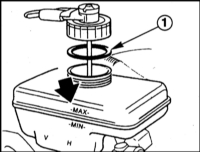
10. After bleeding, top up the brake fluid reservoir to the “MAX” mark. Check the condition of the reservoir cap sealing gasket.
Caution, check the following:
a) Are the brake hoses secured?
b) Is the brake hose secured in its bracket?
c) Is the bleeder screw tightened?
d) Is there sufficient brake fluid in the reservoir?
e) With the engine running, check the system for leaks. To do this, press the brake pedal with a force of 200 - 300 N (20 - 30 kgf) and hold it for 10 s. The force on the brake pedal must not decrease.
f) Check all connections for leaks.
11. After bleeding the system, the brake pedal must not sink when depressed. If it does, repeat the brake system bleeding procedure.
Test yourself
A quick BMW 1 quiz: every answer comes with an explanation and a link to the manual page.