Stereo Audio System
How the Vehicle Audio System Works
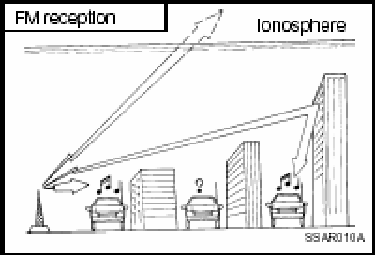
FM reception / ionosphere
AM and FM radio signals are transmitted from broadcast towers located around your city. The radio antenna on the vehicle picks up the signals, then the radio receiver processes the signal and sends it to the vehicle speakers.
When a strong radio signal reaches your vehicle, the audio system provides high-quality reproduction.
However, in some cases the incoming signal is not strong and clear. This is caused by certain factors, such as the distance from the radio station, and the proximity of buildings, bridges or other large obstructions in the reception area.
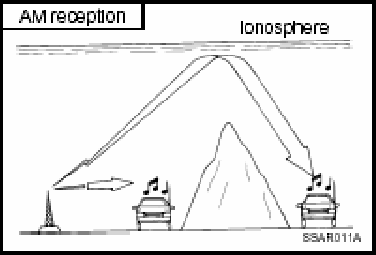
FM reception / ionosphere
Generally, an AM signal is received better than an FM signal, because AM radio waves are transmitted at a low frequency. Long, low-frequency radio waves can follow the irregularities of the earth's surface rather than travel straight into the atmosphere. In addition, they bend around obstacles and can therefore provide a better reliable reception area.
Therefore, good AM reception is possible at greater distances than FM reception.
FM Radio Station
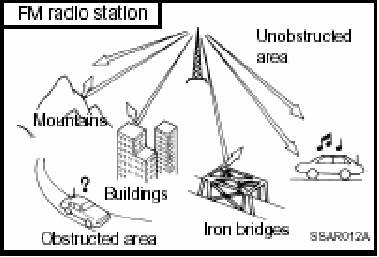
Legend for the figure:
Unobstructed area - unobstructed area Mountains - mountains Obstructed area - obstructed area Buildings - buildings Iron bridges - iron bridges
FM broadcasts are transmitted at a high frequency and do not follow the curvature of the earth's surface.
Therefore, FM broadcasts usually begin to fade at relatively short distances from the station.
FM signals are also easily affected by buildings, mountains or other obstructions. This may result in certain listening conditions and may give the impression that the radio is malfunctioning.
The following conditions are normal and do not indicate a radio malfunction:
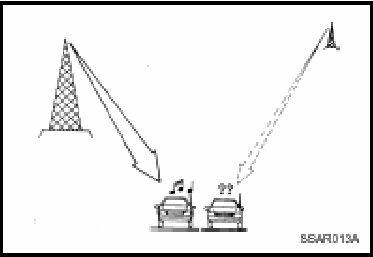
• Signal fading - As the vehicle moves away from the radio station, the signal weakens and the sound begins to fade.
If this occurs, we recommend selecting another station with a stronger signal.
• Sound distortion/interference - Weak FM signals or large obstructions between the transmitter and the radio receiver can interfere with the signal, causing sound distortion and noise interference.
Reducing the treble level may reduce this effect until the interference disappears.
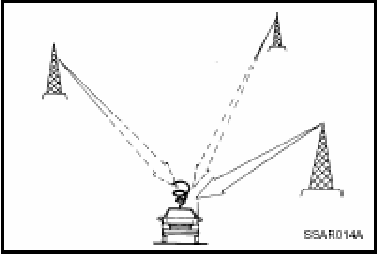
• Station switching - When an FM signal weakens, another, stronger signal near the same frequency may be heard. This occurs because the radio receiver is designed to lock onto the nearest signal. If this occurs, we recommend selecting another station with a stronger signal.
• Multipath cancellation - Radio signals received from different directions can cause sound distortion or distortion. This may be caused by a direct or reflected signal from the same station, or by signals from two stations with close frequencies. If this occurs, select another station until the phenomenon disappears.
Using a Cellular Phone or Two-Way Radio
When using a cellular phone inside the vehicle, noise may be heard from the audio equipment. This does not mean that the audio equipment is malfunctioning. In this case, use the cellular phone in a location as far away from the audio equipment as possible.
 CAUTION
When using communication systems, such as a cellular phone or two-way radio, inside the vehicle, a separate external antenna must be installed. If a cellular phone or two-way radio is used only with an internal antenna, it may cause interference with the vehicle's electrical system and adversely affect vehicle safety.
Do not use a cellular phone while driving. You must stop in a safe place to use a cellular phone.
Test yourself
A quick Hyundai H1 quiz: every answer comes with an explanation and a link to the manual page.