Engine Control System/Fuel System
Manifold Absolute Pressure Sensor (MAPS)
In this manual: Engine Control System/Fuel System
6steps
~36min
2/5difficulty
Done 0 of 6
Description and Operation
Description
The manifold absolute pressure sensor (MAPS) is a speed-density type sensor installed on the surge tank. It measures the absolute pressure in the surge tank and outputs an analog signal proportional to the pressure to the ECM. Using this signal, the ECM calculates the intake air quantity and engine speed. The MAPS consists of a piezoelectric element and a hybrid IC that amplifies the element output signal. The element is made of a silicon diaphragm that has a pressure-sensitive variable resistor using the semiconductor effect. Since one side of the silicon diaphragm is in a 100% vacuum and the other side is exposed to manifold pressure, this sensor can output an analog signal by changing the silicon resistance in proportion to pressure changes.
Specifications
Specification
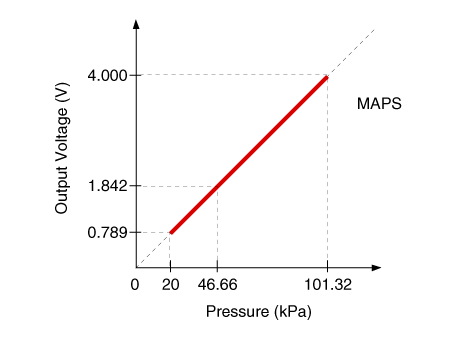
| Pressure (kPa) | Output Voltage (V) [Vref = 5 V] |
| 20,0 | 0,79 |
| 46,66 | 1,84 |
| 101,32 | 4.0 |
Circuit Diagrams
Wiring Diagram


Repair Procedures
Inspection
- Connect the diagnostic tool to the Data Link Connector (DLC).
- Measure the MAPS output voltage at idle with the ignition switched ON.
Pressure (kPa) Output Voltage (V)
[Vref = 5 V]20,0 0,79 46,66 1,84 101,32 4.0
Removal
- Turn the ignition switch OFF and disconnect the negative (-) battery terminal.
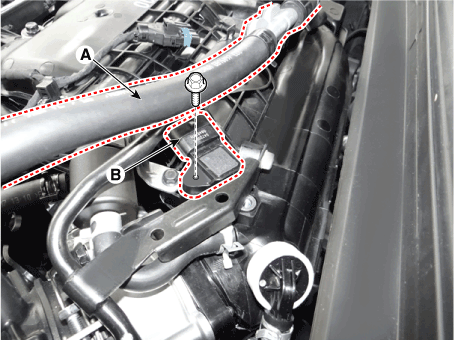
- Disconnect the vacuum hose (A).
- Disconnect the manifold absolute pressure sensor connector (B).
- Remove the sensor by loosening the mounting bolt. Manifold Absolute Pressure Sensor (MAPS) Mounting Bolt: 9.8–11.8 N·m
Installation
|

|

- Install in the reverse order of removal.
Test yourself
A quick Hyundai Palisade quiz: every answer comes with an explanation and a link to the manual page.
Was this page helpful?