Engine Control System/Fuel System
Variable Force Solenoid (VFS)
In this manual: Engine Control System/Fuel System
10steps
~60min
3/5difficulty
Done 0 of 10
Description and Operation
Description
The Continuous Variable Valve Timing (CVVT) system advances or retards the intake and exhaust valve timing according to the ECM control signal, which is calculated based on engine speed and load. By controlling CVVT, valve overlap or underlap is changed, which in turn improves fuel economy, reduces exhaust emissions (NOx, HC), and improves engine performance by reducing pumping losses, creating an internal exhaust gas recirculation effect, improving combustion stability, improving volumetric efficiency, and increasing expansion work. This system consists of the Variable Force Solenoid (VFS), which supplies engine oil to or shuts off engine oil from the cam phaser according to the ECM PWM (Pulse Width Modulation) control signal, and the cam phaser, which changes the camshaft phase using the hydraulic force of the engine oil. The Variable Force Solenoid (VFS) [Intake] changes its force according to the PWM duty to control the stroke of the intake CVVT Oil Control Valve (OCV) spool. The supplied oil rotates the rotor connected to the camshaft in the cam phaser and turns the camshaft in the direction of engine rotation (intake advance / exhaust retard) or in the reverse direction (intake retard / exhaust advance) to change the camshaft phase angle. Variable Force Solenoid (VFS) [Bank 1, 2 / Intake]
Specifications
Specification
| Item | Specification |
| Coil Resistance (Ω) | 7,0–8,0 [20 °C] |
Repair Procedures
Inspection
- Turn the ignition off.
- Disconnect the VFS connector.
- Measure the resistance between terminals 1 and 2 of the VFS.
- Make sure the resistance is within specification.
Specification: 7.0–8.0 Ω [20 °C]
Removal
Variable Force Solenoid (VFS) [Bank 1 / Intake]- Turn the ignition switch OFF and disconnect the negative (-) battery terminal.
- Disconnect the VFS connector (A).
- Remove the mounting bolts (B) and remove the VFS from the engine. Variable Force Solenoid mounting bolt: 9.8–11.8 N·m
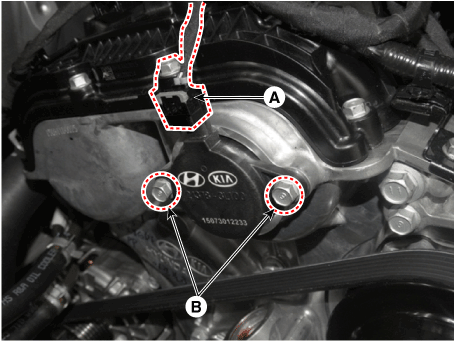
- Turn the ignition switch OFF and disconnect the negative (-) battery terminal.
- Disconnect the VFS connector (A).
- Remove the mounting bolts (B) and remove the VFS from the engine. Variable Force Solenoid mounting bolt: 9.8–11.8 N·m
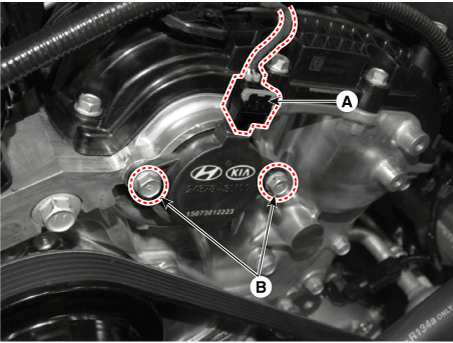
Installation
|

- Install in the reverse order of removal.
Test yourself
A quick Hyundai Palisade quiz: every answer comes with an explanation and a link to the manual page.
Was this page helpful?