Be sure to read and follow the "General Information Safety Precautions" and caution before performing any work involving the high voltage system. Failure to follow the safety precautions may result in serious electrical injury.
Before performing any work, be sure to disconnect high voltage related to the high voltage system (refer to "High Voltage Disconnection Procedure"). Failure to follow safety instructions may result in serious electric shock.
When removing the battery for inspection of the high voltage battery system, it can be connected to the vehicle using SST 0K918-E4100, 0K375-E4100, 0K375-E4200.
Turn the ignition OFF and disconnect the negative (-) terminal of the auxiliary battery.
Disconnect high voltage. (Refer to High Voltage Battery Management System - "High Voltage Disconnection Procedure")
Remove the upper cover of the high voltage battery. (Refer to High Voltage Battery System - "Housing")
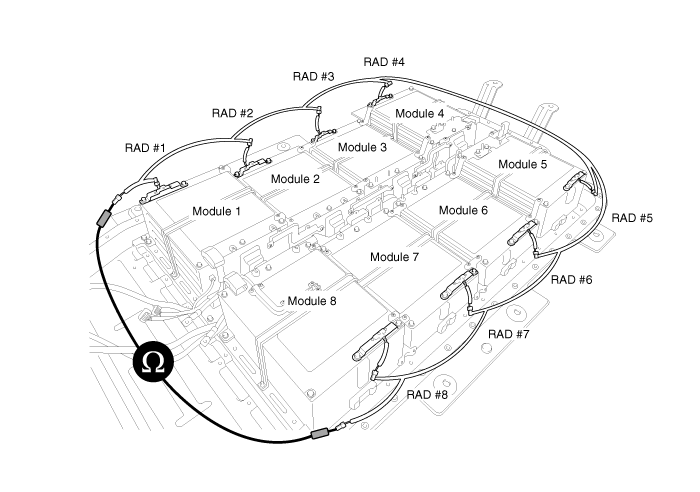
Measure the total resistance of the RAD terminal.
Specification: Less than 3 Ω (20°C)
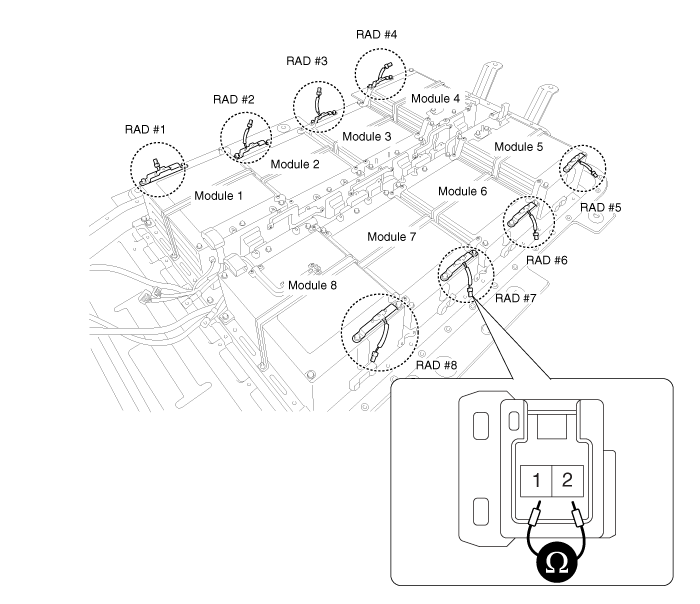
Measure the resistance of each RAD.
Specification: Less than 0.375 Ω (20°C)
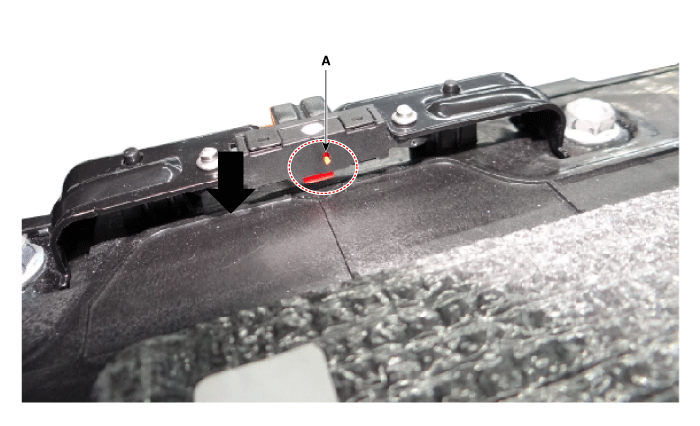
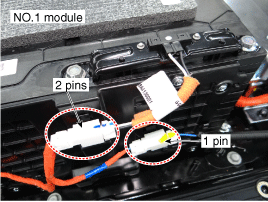
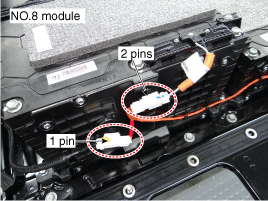
When installing the RAD harness, be sure to check the connector installation. [If incorrect] 1. Precharge failure. 2. RAD malfunction (incorrectly detects that the high-voltage battery is swollen). [Main inspection points] 1. Make sure the RAD switch is facing down.2. Be careful not to confuse the RAD connector of battery module No. 1 (2 pins) with the BMS extension connector (1 pin).3. Be careful not to confuse the RAD connector of battery module No. 8 (2 pins) with the BMS extension connector (1 pin).
?
Test yourself
A quick Kia Soul EV Owner's Manual quiz: every answer comes with an explanation and a link to the manual page.