Coolant
The high-pressure cooling system has a reservoir filled with antifreeze. The reservoir is filled at the factory.
Check the antifreeze quality and coolant level at least once a year, at the beginning of winter, and before traveling to a region with a colder climate.
Checking the Engine Coolant Level
WARNING Removing the
Radiator Cap
- Never attempt to remove the radiator cap while the engine is running or hot.
Doing so could damage the engine and cooling system. In addition, hot coolant or steam could cause serious injury.
Wrap it in a thick cloth, then slowly turn it counterclockwise until it stops.
Step back and let the pressure escape from the system.
When you are sure the system is no longer pressurized, press down on the cap and turn it counterclockwise to remove it. The electric
cooling fan is controlled by engine coolant temperature, refrigerant pressure and vehicle speed. It may sometimes run even when the engine is off.
Be extremely careful when working near the fan blades so you do not get injured by the rotating blades. The electric fan will stop once the coolant temperature has dropped. This operation is normal.
If your vehicle is equipped with GDI, the electric cooling fan may keep running until you disconnect the negative battery cable.
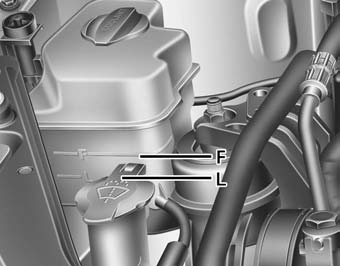
Inspect the cooling system hoses and heater hoses, as well as the connections. Replace any swollen or deteriorated hoses.
With the engine cold, the coolant level should be kept between the F (MAX) and L (MIN) marks on the coolant reservoir.
If the level is low, add enough of the specified coolant to provide protection against freezing and corrosion. Bring the level up to the F (MAX) mark, but do not exceed it.
If you need to add coolant regularly, have the cooling system checked by an authorized Kia dealer.
Recommended Engine Coolant
- Use only soft (distilled) water when mixing the coolant.
- The engine contains aluminum components, which must be protected from corrosion and freezing with an ethylene glycol-based coolant.
- DO NOT USE an alcohol- or methanol-based fluid, and do not mix it with the recommended coolant.
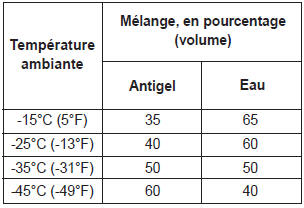
- Do not use a solution containing more than 60% or less than 35% antifreeze. This would reduce the effectiveness of the solution.
Refer to the following table for the mixing ratios.
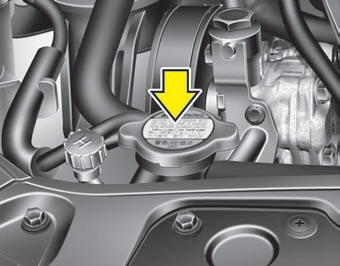
WARNING
 Radiator
Cap
Do not remove the radiator cap when the engine is hot. Boiling coolant and steam may be expelled under pressure and cause serious injury.
Draining the coolant
Have the coolant drained by an authorized Kia dealer at the intervals specified in the maintenance schedule at the beginning of this section.
CAUTIONPlace a rag or thick cloth around the radiator cap neck while filling to prevent overflowing coolant from running onto engine components such as the alternator.
WARNING - Engine Coolant- Do not use engine coolant or antifreeze in the washer fluid reservoir.
- Engine coolant can seriously reduce visibility when sprayed on the windshield, causing loss of vehicle control or damage to the paint and body.
Test yourself
A quick Kia Optima DL3 quiz: every answer comes with an explanation and a link to the manual page.