Tires and Wheels
Tire Maintenance
For safety and fuel economy, in addition to maintaining the condition of the tires, always keep the tires inflated to the recommended pressure and observe the vehicle's load limits and weight distribution recommendations.
Recommended Cold Tire Pressure
Tire pressure (including the spare tire) should be checked when the tires are cold. "Cold tires" means the vehicle has not been driven for at least three hours or has not been driven more than 1.6 km (1 mile).
Maintaining the recommended pressure provides the best possible ride quality, handling, and minimum tire wear.
See the recommended tire pressures under "Tires and Wheels" in section 8.
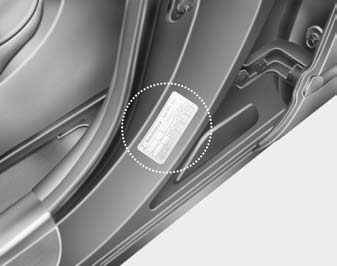
All specifications (sizes and pressures) are shown on a label located on the center pillar, on the driver's side.
WARNING - Underinflated TiresSignificant underinflation can cause excessive heat buildup, a blowout, tread separation, or other problems that could result in loss of vehicle control and serious or fatal injury. The risk is even greater in hot weather and when driving at high speeds for long periods.
CAUTION- Underinflation can also cause excessive wear, poor handling, and higher fuel consumption.
- Normally, the pressure of warm tires exceeds the recommended cold pressure by 28 to 41 kPa (4 to 6 psi).
Overinflation and underinflation can reduce tire life, affect vehicle handling, and lead to a sudden tire failure. This could cause loss of vehicle control and possibly injury.
CAUTION - Tire PressureAlways observe the following points:
- Check tire pressure when the tires are cold (after the vehicle has been parked for at least three hours or has not been driven more than 1.6 km (1 mile) after starting).
- Check the spare tire pressure each time you check the pressure of the other tires.
- Do not overload your vehicle. If the vehicle has a roof rack, be careful not to overload it.
- Old, worn tires can cause accidents. If the tread is severely worn or the tires are damaged, replace them.
Checking Tire Inflation Pressure
Check the tires once a month or more often.
Also check the spare tire pressure.
How to Check Tire Pressure
Use a good-quality tire pressure gauge to check tire pressure.
You cannot tell whether tires are properly inflated just by looking at them. Radial tires can appear properly inflated even when they are underinflated.
Check the pressure when the tires are cold. "Cold tires" means the vehicle has not been driven for at least three hours or has not been driven more than 1.6 km (1 mile).
Remove the cap from the tire valve stem. Press the gauge firmly onto the valve. If the cold pressure matches the recommended pressure on the tire and loading label, no further adjustment is needed. If the pressure is lower, add air to bring the tire to the recommended pressure.
If you overinflate the tire, press the metal pin in the center of the valve to release air.
Recheck the pressure with the tire gauge. Be sure to reinstall the cap on the valve stem when you are finished. The caps prevent air leaks by protecting against dirt and moisture.
WARNING- Regularly check the pressure, tread wear, and condition of the tires. Always use a pressure gauge.
- Tires that are too soft or too hard do not wear evenly, leading to handling problems, loss of control, or sudden failure, which may result in an accident, injury, or even death. The recommended cold tire pressure for your vehicle is listed in this manual and on the tire label located on the center pillar on the driver's side.
- Worn tires can cause accidents.
Tire Rotation
To ensure even tire wear, Kia recommends rotating the tires every 7,500 miles (12,000 km) or more often if uneven wear is noticed.
Also check the wheel balance when having the tires rotated.
When rotating the tires, note any uneven wear or damage. Uneven wear is usually caused by incorrect tire pressure, misaligned geometry, unbalanced wheels, hard braking or sharp cornering. Check the sidewall and tread for any sign of bulging or deformation. Replace the tire if you notice any such condition.
After rotating the tires, make sure to set the front and rear tires to the recommended pressure and make sure the wheel nuts are properly tightened.
See "Tires and Wheels" in section 8.
Without spare tire

Directional tires (if equipped)

Disc brake pads should be inspected each time the tires are rotated.
NOTICE
Radial tires with an asymmetric tread pattern should only be rotated front to rear, not side to side.
WARNING- Do not include the compact spare tire in the rotation.
- Never mix bias-ply tires with radial-ply tires. This could result in unusual handling characteristics and cause serious or fatal injury and property damage.
Wheel alignment and wheel balancing
The vehicle's wheels are carefully aligned and balanced at the factory to ensure the best possible tire life and performance.
In most cases, you will never need to have the wheel alignment corrected. However, if you notice unusual tire wear or if the vehicle pulls to one side or the other, the alignment may need to be corrected.
If the vehicle vibrates when driving on a smooth road, the wheel balance must be corrected.
CAUTIONUsing the wrong wheel weights can damage the vehicle's aluminum wheels. Use only approved wheel weights.
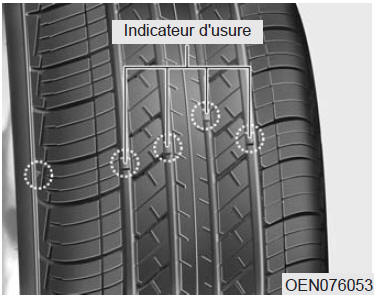
Tire replacement
If the tire wears evenly, the tread wear indicator appears as a solid band across the tread. The indicator appears when less than 1.6 mm (1/16 in) of tread remains on the tire.
Replace the tire when the wear indicator appears.
Do not wait for the wear indicator to appear across the entire tread before replacing the tire.
WARNING - Replacing TiresTo reduce the risk of serious or fatal injury that could result from tire failure or loss of vehicle control:
- Replace tires that are worn, show uneven wear or are damaged. Worn tires reduce braking efficiency, steering control and traction.
- Do not drive with tires that are overinflated or underinflated.
Replacing the compact spare tire
The compact spare tire has a much shorter tread life than a normal tire.
Replace it when the wear indicator appears. A replacement compact spare tire should have the same specifications as the one supplied with the vehicle when new, and should be installed in the same location as the original compact spare tire.
The compact spare tire is not designed to be mounted on a normal wheel, and the compact spare wheel is not suitable for a normal tire.
Wheel replacement
If, for any reason, you replace steel wheels, make sure the new wheels are equivalent to the original equipment wheels in diameter, width and offset.
WARNINGA wheel of the wrong size may affect the service life of the wheel and bearing, braking and stopping capability, handling characteristics, ground clearance, tire-to-body clearance, speedometer and odometer calibration, headlight aiming and bumper height.
Tire traction
Tire traction can be reduced if you drive with worn or underinflated tires or on slippery roads. Tires should be replaced when the wear indicator appears. To reduce the risk of losing control, slow down on wet, snowy or icy roads.
Tire Maintenance
In addition to tire pressure, wheel alignment helps reduce tire wear. If a tire wears unevenly, have the alignment checked by a dealer.
When having new tires installed, make sure they are properly balanced. This will improve ride comfort and tire service life. In addition, a tire should always be re-balanced if it has been removed from the wheel.
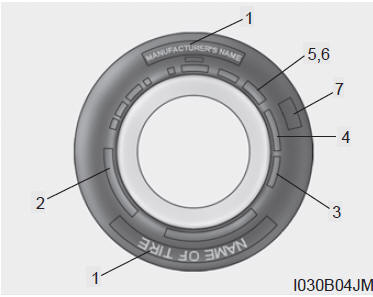
Tire Sidewall Information
The sidewall information identifies the basic tire characteristics and provides the Tire Identification Number (TIN) for safety certification. The TIN can be used to identify the tire in the event of a recall.
1. Manufacturer or brand name
This is the manufacturer's name or brand name of the tire.
2. Tire size designation
The tire sidewall carries a size designation. You will need this information to select a replacement tire for your vehicle. An explanation of the letters and numbers that make up the tire designation follows.
Example designation: (These figures are for example only; the tire designation varies depending on the vehicle.)
P205/65R16 94H
P - Vehicle type (tires marked with a P (Passenger) are suitable for passenger cars or light trucks; however, not all tires carry this letter).
205 - Tire width, in millimeters.
65 - Aspect ratio, i.e. the tire height as a percentage of its width.
R - Construction code (radial).
16 - Wheel rim diameter, in inches.
94 - Load index. Numerical code associated with the maximum load the tire can carry.
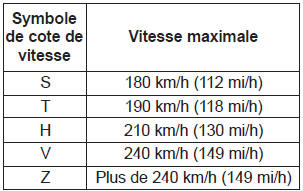
H - Speed rating. See the speed rating chart provided in this section for details.
Wheel Size Designation
Wheels also carry important information you will need if you have to replace them. An explanation of the letters and numbers that make up the wheel size designation follows.
Example designation: 6.5JX16
6.5 - Wheel width, in inches.
J - Wheel flange contour designation.
16 - Wheel rim diameter, in inches.
Tire Speed Ratings
The following table lists the various speed ratings currently used for passenger car tires. The speed rating is part of the tire size designation on the sidewall. This symbol corresponds to the maximum speed at which a tire can safely be driven.
3. Tire Life Check (TIN: Tire Identification Number)
Tires more than 6 years old, based on the manufacture date, (including the spare tire) should be replaced with new tires. The manufacture date is located on the tire sidewall (sometimes on the inside of the wheel), along with the DOT code. The DOT code consists of a series of numbers and letters.
The manufacture date is identified by the last four digits (characters) of the DOT code.
DOT : XXXX XXXX OOOO
The first part of the DOT code identifies the plant code number, the tire size and the tread pattern. The last four characters identify the week and year of manufacture.
For example: DOT XXXX XXXX 1611 means the tire was manufactured in the 16th week of 2011.
WARNING - Tire AgeTires deteriorate with age, even if they are not used.
Regardless of the remaining tread depth, we recommend that tires be replaced after approximately six (6) years of normal service.
Atmospheric heat or frequent heavy load conditions can accelerate aging. Failure to heed this warning may result in a sudden tire failure which could lead to loss of control and an accident, causing serious or fatal injury.
4. Tire ply composition and materials
The number of rubber-coated fabric layers or plies that make up the tire. Tire manufacturers must indicate the materials used in the tire, such as steel, nylon, polyester and others. The letter "R" identifies a radial carcass; the letter "D" identifies a diagonal (bias) carcass; and the letter "B" identifies a belted bias carcass.
5. Maximum permissible inflation pressure
This figure is the maximum air pressure to which the tire may be inflated. Do not exceed the maximum permissible pressure.
Refer to the tire and loading information label for the recommended inflation pressure.
6. Maximum load
This figure indicates the maximum load, in kilograms and pounds, that the tire can carry.
When replacing tires on the vehicle, always fit tires with the same load rating as the original equipment tires.
7. Uniform Tire Quality Grading
Quality grades, where applicable, are located on the tire sidewall between the shoulder and the maximum width section.
Example: TREADWEAR 440 TRACTION A TEMPERATURE A
Treadwear
Uniform Tire Quality Grading is a comparative wear rating system based on tests conducted under controlled conditions on a government test course. For example, a tire graded 150 will wear one and a half (1 ½) times as fast on the government test course as a tire graded 100.
However, the actual performance of tires depends on actual usage conditions and may differ greatly from the standard due to variations in driving habits, maintenance practices, and differences in road and climate conditions. The grades are molded on the sidewall of passenger car tires.
Tires supplied as standard or optional equipment on your vehicle may have a different grading.
Traction - AA, A, B & C
The traction grades, from highest to lowest, are AA, A, B and C. The grades represent the tire's ability to stop on wet pavement, as measured under controlled conditions on a government test surface of asphalt and concrete. A tire graded C may have poor traction performance.
WARNINGThe traction class assigned to this tire is based on straight-line braking traction tests and does not take into account acceleration, cornering, hydroplaning or peak traction characteristics.
Temperature - A, B & C
The temperature grades A (the highest), B and C represent the tire's resistance to generating heat and its ability to dissipate heat under controlled laboratory test conditions on a test wheel.
Sustained high temperature can cause the tire material to degenerate and reduce tire service life. Excessive temperature can lead to sudden tire failure. Grades B and A represent performance levels on a laboratory test wheel, higher than the minimum required by law.
WARNING - Tire TemperatureThe temperature grade of this tire is established for a tire that is properly inflated and not overloaded. Excessive speed, underinflation or excessive load, separately or in combination, can cause heat build-up and possible sudden tire failure. This may result in loss of vehicle control and lead to serious or fatal injury.
Tire terminology and definitions
Tread: The part of the tire that contacts the road.
Vehicle capacity weight: The number of designated seating positions multiplied by 68 kg (150 lb), plus the rated cargo load and luggage load.
Belt: The rubber-coated cord layer located between the plies and the tread. The cords may be made of steel or other reinforced materials.
Maximum load on tire: The load on a particular tire, determined by distributing to each axle its share of the curb weight, accessory weight and normal occupant weight, divided by two.
Maximum load rating: The load rating of a tire at the maximum permissible inflation pressure for that tire.
Speed rating: An alphanumeric code assigned to a tire, indicating the maximum speed at which the tire can be used.
Occupant distribution: Designated seating positions.
Sidewall: The part of the tire between the tread and the bead.
Outboard sidewall: The side of an asymmetrical tread tire that faces outward when the tire is mounted on the vehicle. The outboard sidewall carries white lettering or the manufacturer's name, brand and model name molded higher or deeper than the same moldings on the inboard sidewall.
Designated outboard sidewall: The side of an asymmetrical tread tire that must always face outward when the tire is mounted on the vehicle.
Wear indicators: Narrow bands, sometimes called wear bars, that appear across the tread when only 2/32 in. of tread depth remains. DOT markings: The DOT code includes the tire identification number (TIN), an alphanumeric code that identifies the manufacturer, plant, brand and production date. Load index: A number assigned in the range of 1 to 279, corresponding to the load-carrying capacity of a tire.
Rim: A metal support for a tire on which the tire beads seat.
Kilopascal (kPa): Metric unit of measure of air pressure in the tire.
GAWR REAR: Gross axle weight rating, for the rear axle.
GAWR FRONT: Gross axle weight rating, for the front axle.
Vehicle placard: A label permanently affixed to the vehicle showing the original equipment tire size and recommended inflation pressure.
GVWR: Gross vehicle weight rating.
Bias-ply tire: A tire whose plies are laid diagonally, at an angle of less than 90 degrees to the centerline of the tread.
Radial tire: A tire whose cords extend to the beads and are laid at an angle of 90 degrees to the centerline of the tread.
Passenger car tire (P-metric): A tire fitted to passenger cars and certain light trucks and multipurpose vehicles.
Curb weight: The weight of a motor vehicle with standard and optional equipment, including a full tank of fuel, oil and coolant, but without passengers or luggage.
Accessory weight: The combined weight of all optional accessories. Examples include automatic transmission, power seats and air conditioning.
Maximum loaded vehicle weight: The sum of the curb weight, accessory weight, vehicle capacity weight and optional equipment weight.
Normal occupant weight: The number of designated seating positions multiplied by 68 kg (150 lb).
Cold inflation pressure: The air pressure in the tire, measured in kilopascals (kPa) or pounds per square inch (psi) before the tire has heated up from driving.
Air pressure: The amount of air inside the tire exerting pressure outward. Air pressure is expressed in kilopascals (kPa) or pounds per square inch (psi).
Recommended inflation pressure: The tire inflation pressure recommended by the vehicle manufacturer and shown on the vehicle placard.
Maximum inflation pressure: The maximum air pressure to which a cold tire may be inflated. The maximum air pressure is molded on the sidewall.
Aspect ratio: The relationship between the height and the width of the tire.
Bead: The bead contains steel wires wrapped in steel cables that hold the tire against the rim.
Traction: The friction between the tire and the road surface. Grip.
UTQGS: Uniform Tire Quality Grading Standards. A measurement system for comparing traction, temperature and treadwear ratings.
The ratings are established by tire manufacturers using test procedures set by the government. The ratings are molded into the tire sidewall.
All-season tires
Kia specifies all-season tires on certain models to provide good year-round performance, including on snowy and icy roads.
All-season tires are identified by ALL SEASON and/or M+S (Mud and Snow) on the sidewall. Snow tires offer better traction in snow than all-season tires and may be more appropriate in some regions.
Summer tires
Kia specifies summer tires on certain models to provide superior performance on dry roads. Summer tire performance is greatly reduced in snow and on ice. Summer tires have no M+S traction rating on the sidewall. If you plan to drive on snowy or icy roads, Kia recommends using winter tires or all-season tires on all four wheels.
Snow Tires
If you equip your vehicle with snow tires, they should be the same size and load capacity as the original tires. Snow tires should be installed on all four wheels, otherwise you may experience handling problems.
Snow tires should be inflated 28 kPa (4 psi) above the recommended pressure for the original tires, shown on the tire label on the driver's door center pillar, or inflated to the maximum pressure shown on the tire sidewall, whichever is lower.
Do not drive faster than 120 km/h when the vehicle is fitted with winter tires.
Radial tires
Radial tires offer longer tread life, resistance to road hazards and a smoother ride at high speed. The radial tires used on this vehicle are the belted type and are selected based on the ride and handling characteristics of the vehicle. Radial tires offer the same load capacity as belted bias-ply tires of the same size and have the same recommended inflation pressure. Mixing radial and bias-ply tires on the same vehicle will greatly affect handling. The best rule: always fit identical radial tires on all four wheels.
Tires with slower wear may be more prone to uneven tread wear. It is very important to follow the tire rotation intervals in this section to get the longest possible tread life from these tires. Cuts and punctures in radial tires can be repaired only if they are in the tread area, because the sidewall is flexible. Consult a tire dealer about repairing a radial tire.
Test yourself
A quick Kia Optima DL3 quiz: every answer comes with an explanation and a link to the manual page.