Driving on snow and ice
To drive in deep snow, it may be necessary to use winter tires or fit snow chains.
If winter tires are needed, select tires with the same size and type as the tires the vehicle was originally equipped with. Fitting incorrect tires will negatively affect safety and handling. In addition, driving at excessive speed, rapid acceleration, sudden braking and sharp cornering will pose a potentially very high risk.
When slowing down, make full use of engine braking. Sudden braking on a snowy or icy road may cause the vehicle to skid. Keep a safe distance from the vehicle in front. Use the brakes carefully. Note that snow chains provide more traction, but do not prevent side-slipping.
CAUTION The use of snow chains is not permitted in all jurisdictions (states or countries). Before fitting snow chains, make sure this is allowed under applicable law.
Winter tires
When installing winter tires, make sure they are radial tires of the same size and load rating as the vehicle's original tires. Fit winter tires on all four wheels so that the vehicle handles evenly in all weather conditions. Note that the grip winter tires provide on dry roads may not be as high as that of the vehicle's original tires. Drive carefully even when roads are clear. For information on the recommended speed limits for these tires, contact the tire dealer.
WARNING - Winter tire size Winter tires must have the same size and type as the vehicle's standard tires.If this is not the case, it may have a negative effect on safety and vehicle handling.
Do not fit studded tires without first checking local, state, and municipal regulations to see whether their use is restricted.
Snow chains (anti-skid chains)
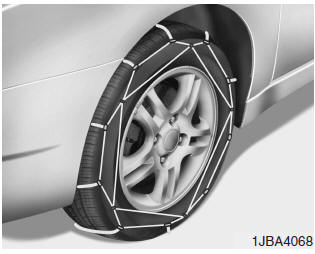
Because radial tire sidewalls are thinner, fitting some types of snow chains may damage the tires. For this reason, winter tires are recommended instead of snow chains. Do not fit snow chains on vehicles equipped with aluminum wheels, as they may damage the wheels. If snow chains are necessary, use wire chains less than 12 mm (0.47 in) thick.
Damage to the vehicle caused by the use of incorrect snow chains is not covered by the vehicle manufacturer's warranty.
Snow chains should be installed on the front wheels only.
CAUTION- Make sure the snow chains are of the correct size and type for the vehicle's tires. Using incorrect snow chains may damage the body and suspension, and damage caused in this way may not be covered by the vehicle manufacturer's warranty.
In addition, the connecting hooks of snow chains may be damaged by contact with vehicle components, which may cause the chains to slip off the tires. Make sure the snow chains are SAE class "S" and certified.
- For safety, always check that the snow chains are correctly fitted after driving about 0.5 to 1 km (0.3 to 0.6 mi). If the chains have loosened, tighten or refit them.
Fitting snow chains
Follow the chain manufacturer's instructions when fitting snow chains. Tighten the chains as much as possible. Once the chains are fitted, drive the vehicle slowly. If you hear sounds indicating that the chains are contacting the body or underbody, stop the vehicle and tighten them. If the chains still contact vehicle components, reduce speed until the chains stop hitting the vehicle. Remove the chains as soon as you resume driving on cleared roads.
WARNING - Fitting snow chains To fit snow chains, stop the vehicle on level ground, away from traffic. Switch on the hazard warning lights and place a warning triangle behind the vehicle, if available. Before starting to fit the snow chains, always place the gear selector in P (Park), apply the parking brake and switch off the engine. WARNING - Snow chains- Using snow chains may have a negative effect on vehicle handling.
- Do not drive the vehicle faster than 30 km/h or faster than the manufacturer's recommended speed, whichever is lower.
- Drive carefully and avoid bumps, potholes, sharp turns, and other road hazards that may cause the vehicle to bounce.
- Avoid sharp turns and braking with locked wheels.
- Incorrectly sized or incorrectly fitted chains may damage the vehicle's brake lines, suspension, body, and wheels.
- Whenever you hear the chains striking the vehicle, stop and tighten them.
Test yourself
A quick Kia Rio YB quiz: every answer comes with an explanation and a link to the manual page.