Idle Speed Adjustments
These adjustments must be carried out with the engine hot, after at least two cycles of the cooling fan units.
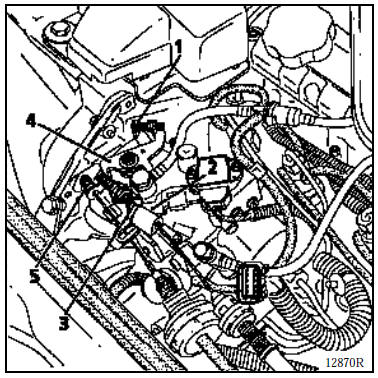
- Idle speed adjustment screw
- Load lever
- Residual flow adjustment screw (anti-stall function)
- Fast-idle lever
- Idle cable clamp
ADJUSTING IDLE SPEED AND RESIDUAL FLOW (anti-stall)
- Make sure the fast-idle function is not active.
- Set the idle speed to 825 ± 25 rpm using screw (1).
- Place a 4 mm shim between the load lever (2) and the residual flow screw (3).
- Adjust the speed to 1,250 ± 50 rpm using residual flow screw (3).
- Remove the 4 mm shim, then open the throttle sharply twice.
- Check that the idle speed is correct; if necessary, repeat the idle speed adjustment and check the residual flow adjustment again.
It is important to adjust the idle speed and anti-stall function correctly, as they directly affect engine behaviour at idle and during deceleration (jerking, engine stalling or idle staying high, etc.).
FAST IDLE
With no vacuum applied to the vacuum unit, position the cable clamp (5) 2 ± 1 mm from the fast-idle lever (4).
NOTE: the fast idle speed value cannot be adjusted directly. It is set on an injection test bench.
MAXIMUM ENGINE SPEED CHECK
Engine warm, accelerate fully. Engine speed must be between 4,500 and 4,700 rpm. This adjustment can only be carried out on a bench at a Renault Injection Centre.
Test yourself
A quick Renault Kangoo quiz: every answer comes with an explanation and a link to the manual page.