Function Overview
In dynamic radar cruise control mode, the vehicle automatically accelerates and decelerates to follow changes in the speed of the vehicle ahead, without the driver needing to operate the accelerator pedal.
In constant speed control mode, the vehicle travels at a steady speed.
Use dynamic radar cruise control on motorways and expressways.
- Dynamic radar cruise control mode
- Constant speed control mode
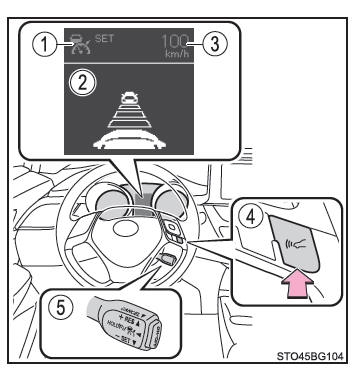
Monochrome display
- Indicators
- Display
- Set speed
- Following distance button
- Cruise control switch
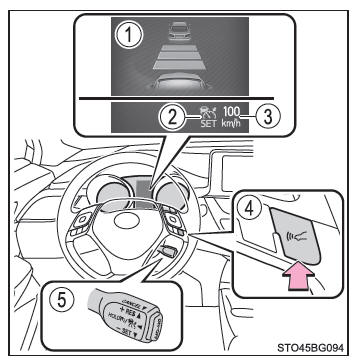
Color display
- Display
- Indicators
- Set speed
- Following distance button
- Cruise control switch
■ Before using dynamic radar cruise control
On the road, the driver alone is responsible for safety.
Do not place excessive trust in the system, and drive carefully, always paying close attention to your surroundings.
Dynamic radar cruise control provides driver assistance that reduces part of the driver's workload. However, there are limits to the assistance provided.
Even when the system operates normally, the driving conditions of the vehicle ahead as detected by the system may differ from those perceived by the driver. Therefore, the driver must always remain alert, assess the danger of each situation and drive carefully. Relying on the system or assuming that it can guarantee safety while the vehicle is in motion is an error that may lead to a serious or fatal accident.
WARNING■ Warnings regarding driving assist systems Observe the following precautions, as there are limits to the assistance provided by the system.
Failure to do so may result in a serious or fatal accident.
- Driver assistance in judging the distance between vehicles
Dynamic radar cruise control is intended only to help the driver judge the distance between their own vehicle and the vehicle ahead. It is not a mechanism that allows the driver to drive carelessly or inattentively, nor a system that can provide assistance when visibility is poor. It is always essential for the driver to stay highly alert to everything around the vehicle. - Driver assistance in judging the correct distance between vehicles
The dynamic radar cruise control determines whether the distance between your vehicle and the vehicle ahead is within a set range. It cannot judge anything else. Therefore, the driver must remain alert and be able to determine whether there is a possible danger in any given situation. - Driver assistance in taking action on the vehicle
The dynamic radar cruise control has limited ability to prevent or avoid a collision with the vehicle ahead. Therefore, if any danger exists, the driver must immediately take direct control of the vehicle and act appropriately to ensure everyone's safety.
■ To avoid inadvertently activating the dynamic radar cruise control Turn off the dynamic radar cruise control with the "ON-OFF" button when you are not using it.
■ Situations in which the dynamic radar cruise control must not be used Do not use the dynamic radar cruise control in any of the following situations.
You may not be able to control the vehicle speed, which could cause a serious or fatal accident.
- On roads used by pedestrians, cyclists, etc.
- In heavy traffic
- On roads with very tight bends
- On winding roads
- On slippery roads (for example wet, icy or snow-covered roads)
- On steep downhill slopes or on roads with frequent closely spaced climbs and descents
The vehicle speed may exceed the set speed on steep downhill slopes. - On motorway and expressway access ramps
- When weather conditions are so poor that the sensors cannot detect properly (fog, snow, sandstorm, heavy rain, etc.)
- When the area in front of the radar sensor or camera sensor is covered by rain, snow, etc.
- When traffic conditions require repeated acceleration and deceleration
- When your vehicle is towing a caravan or trailer, or during emergency towing
- When the proximity warning buzzer sounds frequently