Bleeding Air from the Fuel System
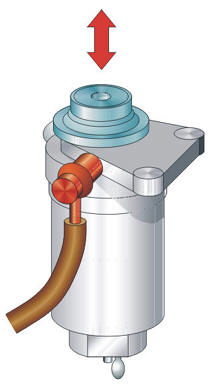
If the fuel has run out, the engine may fail to start after refueling the vehicle. In this case, pump fuel with the pump until resistance is felt.
Emergency Engine Starting
If you do not have the necessary experience, it is strongly recommended to seek help from qualified persons or an automotive service center.
Review the safety precautions for handling the battery.
* Make sure the nominal voltage of the starting battery is 12 V.
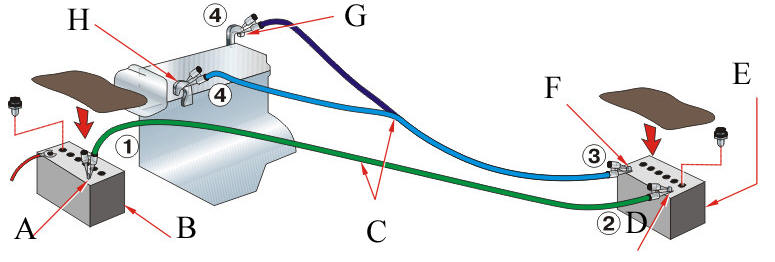
Jump Starting Procedure 1, 2, 3, 4. Jumper cable connection sequence
A. Positive terminal
B. Discharged battery
C. Jumper cables
D. Positive terminal
E. Booster battery
F. Negative terminal
G. On 2E engines, ground to the engine lifting bracket
H. On engines 4E-FE, 4A-FE,
7A-FE and 2C, ground to this engine lifting bracket
PROCEDURE
1. If the engine is to be started from another vehicle's battery, the vehicle bodies must not touch. Turn off all unnecessary electrical loads (lights and additional electrical equipment).
2. If necessary, remove the caps from the cells of the booster and discharged batteries. Cover the openings with a rag (this measure reduces the risk of explosion and personal injury).
3. Start the engine of the vehicle with the booster battery, and after a few minutes increase the engine speed to 2000 rpm.
4. Connect the jumper cables in the order shown in the illustration: connect the positive terminal of the discharged battery to the positive terminal of the booster battery, then connect the negative terminal of the booster battery to the engine or to ground.
5. Connect the cable to the negative terminal of the booster battery and to an unpainted, securely fastened ground point away from the discharged battery (for example, the engine lifting bracket). Do not route jumper cables near moving parts.
6. Diesel engines only: charge the discharged battery from the booster battery, maintaining the engine speed of the vehicle with the booster battery at 2000 rpm for 5 minutes.
7. Start your engine in the normal manner. After starting, increase the engine speed to 2000 rpm.
8. Carefully disconnect the cables in reverse order: negative first, then positive.
9. Dispose of the rag that covered the batteries, as it may be contaminated with electrolyte.
10. Reinstall the cell caps (if removed).
11. If the cause of the battery discharge is not obvious (for example, if you do not recall the vehicle having been left with the headlights on for a long time), inspect the battery.
If the engine stalls while driving
PROCEDURE
1. Smoothly reduce speed without changing the direction of travel. Carefully steer onto the shoulder.
2. Turn on the hazard warning lights.
3. Attempt to restart the engine.
* With the engine off, the vacuum booster and power steering will not assist, so more force will be required on the brake pedal and steering wheel.
Engine Overheating Procedure (Gasoline Engines)
High coolant temperature, loss of engine power, or loud knocking noises indicate engine overheating. In this case, the procedure is as follows.
PROCEDURE
1. Pull over to the shoulder, stop and turn on the hazard warning lights. Shift the selector lever to the P position (automatic transmission) or to neutral (manual transmission), and apply the parking brake. Turn off the air conditioner (if it was on).
2. If steam is coming out of the radiator or coolant is leaking out, stop the engine. After the steam stops, open the hood. If there is no steam or coolant leak, do not stop the engine; make sure the cooling fan is operating. If the fan is not rotating, turn off the ignition.
3. Visually check the coolant pump drive belt for integrity. Check for leaks from the radiator, hoses and under the engine. Note that
if the air conditioner was on, water dripping from the air conditioner components is permissible.
4. If the belt is broken or there is a fluid leak, stop the engine immediately and call an automotive service center.
5. If the belt is intact and there are no leaks, check the coolant level in the reservoir tank. If the tank is empty, add coolant with the engine running. Fill the tank to approximately the middle.
*! Do not remove the radiator filler cap when the engine is hot. Otherwise, you may be scalded by steam or coolant released under pressure.
6. After the coolant has cooled to normal temperature, check the level in the reservoir tank again. If the level has dropped significantly, there is a leak in the cooling system and the vehicle requires immediate repair (contact an automotive service center).
Actions in Case of a Flat Tire
PROCEDURE
1. Gradually reduce speed without changing direction. Pull over to the shoulder and stop on a level, hard surface.
2. Stop the engine and turn on the hazard warning lights.
3. Shift the selector lever to the P position (automatic transmission) or engage reverse gear (manual transmission), and apply the parking brake.
4. Ask the passengers to leave the vehicle.
* Follow the instructions supplied with the jack.
* Use the jack only for lifting the vehicle when changing a wheel.
* Never get under the vehicle when it is supported by the jack.
* Never start the engine when the vehicle is supported by the jack.
Test yourself
A quick Toyota Corolla quiz: every answer comes with an explanation and a link to the manual page.