Sealing Materials
Polyurethane Adhesive Sealant
Designation:
- Polyurethane Adhesive Sealant -AKD 476 KD5 05-
Product description
Polyurethane adhesive sealant -AKD 476 KD5 05- is a one-component, paste-like adhesive sealing material based on polyurethane, which cross-links (cures) through atmospheric moisture to form a rubber-elastic material.
The skin-forming and full-cure times depend on the air humidity and the temperature. The full-cure time additionally depends on the depth of the joint.
These times can be shortened by increasing the temperature and air humidity. Low temperatures and low air humidity, on the other hand, have a delaying effect.
Features:
- paintable, also "wet-on-wet"
- extremely fast through-drying
- slightly self-levelling at the surface
- excellent elasticity
- high ageing resistance
- sandable
- spreadable
Application information
Application
- Polyurethane adhesive sealant -AKD 476 KD5 05- is used for elastic sealing/bonding, in particular seam sealing and sealing of very narrow joints where the lack of sag resistance is not a problem, in bodywork and vehicle construction as well as in vehicle superstructures, especially when the sealed joint is to be painted over. To avoid yellowing/cracking, the material should always be painted over on exterior seams.
- Polyurethane adhesive sealant -AKD 476 KD5 05- can partially replace mechanical fastening methods such as screws, welding and clips. Until the adhesive/sealant has fully cured, temporary fixing with adhesive tape and spacers must be carried out.
- Polyurethane adhesive sealant -AKD 476 KD5 05- offers the major advantage that one material can be used for both bonding and sealing.
- The material is not suitable, or only conditionally suitable, for structural bonding.
Adhesion behaviour
- Polyurethane adhesive sealant -AKD 476 KD5 05- provides good adhesion without glass/paint primer on primed and painted body panels, wood (untreated, stained and painted), and some plastics such as PBTP, rigid polyurethane foam and GF polyester.
- Depending on the substrate, it may be necessary to use a glass/paint primer as an adhesion promoter to achieve optimum adhesion.
- Due to the large number of primers, paints, and different plastic surfaces, application-specific preliminary tests are recommended.
- Careful cleaning of plastic and metal surfaces with a suitable solvent often significantly improves adhesion.

Note
- Before starting work, read the safety data sheet for precautions and safety advice.
- Even for products that do not require labeling, observe the precautions usual for chemical products.
Processing

Note
Body areas to be sealed and bonding surfaces must be isolated with a 2K filler before the material is applied.
- The bonding surfaces must be dry and free of oil, dust, grease and other contaminants. Cleaner A, Cleaner D and plastic cleaner -D 195 850 A1- are suitable for cleaning.
- Polyurethane adhesive sealant -AKD 476 KD5 05- is applied from 310 ml nozzle cartridges using hand or compressed-air guns. The 310 ml foil cartridges are processed with the hand cartridge gun -V.A.G 1628- or the compressed-air gun -V.A.G 1761/1-. For compressed-air application, 2 to 5 bar is required.
- Low sealant material temperatures increase viscosity, which is noticeable as a reduced extrusion rate. To avoid this, it is advisable to temper the sealant before processing.
- If substrates are too cold, falling below the dew point can cause condensation to form. This must be avoided by tempering in good time.
- After application, Polyurethane adhesive sealant -AKD 476 KD5 05- can be smoothed with a joint tool or spatula moistened with water containing a little detergent. If the joint edges are masked off, simply peeling off the tape with a spatula is sufficient.
- Cleaner D is recommended for cleaning tools of uncured adhesive sealing material.
Overpainting behaviour
- Polyurethane adhesive sealant -AKD 476 KD5 05- can be painted "wet-on-wet" with 1K and 2K refinish paints based on alkyd resin/acrylate, as well as all original refinish paints.
- Nitro refinish paints from aerosol cans, and alcohol-containing paints, paint thinners and accelerators are not compatible with the sealing material (no curing).
- Anti-corrosion primers may only be applied to fully cured material, as they greatly impede water vapour diffusion in most cases.
- If accelerated drying is carried out in a drying oven or with an IR radiant heater, a flash-off/waiting time of at least 30 minutes must be observed. Only then may the painted sealing material be heated. The maximum temperature resistance for uncured material is 1 hour at +90 ºC.
Incompatibility
- Polyurethane adhesive sealant -AKD 476 KD5 05- does not adhere to sealants based on MS-polymer and silane-modified polymer.
- Conversely, if materials based on MS-polymer and silane-modified polymer are applied over cured Polyurethane adhesive sealant -AKD 476 KD5 05-, good adhesion is achieved.
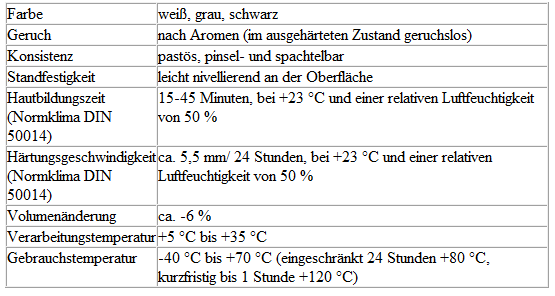
Technical Data
Sealant, sprayable
Designation:
- Sealant, sprayable -D 476 KD1 M2-, colour grey
- Sealant, sprayable -D 476 KD2 M2-, colour black
Product description
Sealant, sprayable -D 476 KD1 M2-/-D 476 KD2 M2- is a sprayable sealant based on MS polymer which cross-links (cures) through absorption of atmospheric moisture to form a rubber-elastic material with good abrasion resistance.
The skin-forming and full-cure times depend on the air humidity and the temperature. The full-cure time additionally depends on the layer thickness.
These times can be shortened by increasing the temperature and air humidity. Low temperatures and low air humidity, on the other hand, have a delaying effect.
Features:
- Sealant and seam sealing in one product
- High sag resistance
- sprayable and brushable
- can be painted over with conventional or water-based paints up to 3 days after application
- broad adhesion range without glass/paint primer
- high initial strength
- spot-weldable
- silicone-free
- low odour
- isocyanate-free
- fast through-drying
- UV-resistant
- high ageing resistance
- damping properties
Application information
Application
- Sprayable sealant -D 476 KD1 M2-/-D 476 KD2 M2- is used on vehicles to seal seams during repairs, for seams that are sprayed at the factory, e.g. in the engine compartment, luggage compartment and passenger compartment. With the application equipment (Multi-Press telescopic gun or -V.A.G 1761/1- compressed-air gun), any desired structural seam can be achieved.
- To repair or supplement PVC underbody protection or stone chip protection, the material is used as a surface coating.
Preparation
- The adhesion surfaces must be dry and free of oil, dust, grease and other contaminants. Cleaner FL is suitable for cleaning.
- Adhesion is improved if the contact surfaces are roughened with abrasive fleece.
- If the material is painted over only after it has fully dried, the preparatory painting steps must be observed in the same way as for plastic preparation.

Note
- Before starting work, read the safety data sheet for precautions and safety advice.
- Even for products that do not require labeling, observe the precautions usual for chemical products.
Processing

Note
Body areas to be sealed and bonding surfaces must be isolated with a 2K filler before the material is applied.
- The sprayable sealant -D 476 KD1 M2-/-D 476 KD2 M2- from 310 ml aluminium cartridges can only be applied with the Multi-Press telescopic gun or -V.A.G 1761/1- compressed-air gun. With these application tools, the material can be applied as a bead (sealant bead) or sprayed using the two-circuit air system.
- The material can be both sprayed and brushed, i.e. structural seams and brush textures can be reproduced.
- Pre-applied sealed seams can be painted over after just 15-30 minutes.
- By making appropriate settings on the application tools, all structures specified by the manufacturer can be reproduced easily and quickly. The spray distance can also be used to vary the width and edge of the seam. For setting and handling of the guns, refer to the operating instructions.
- Cleaner FL is recommended for cleaning tools of uncured sealant. Cured material can only be removed mechanically.
Overpainting behaviour
- After skin formation, the sprayable sealant -D 476 KD1 M2-/-D 476 KD2 M2- can be painted over with 1K and 2K repair paints, including those containing alcohols as solvents.
- Painting over quickly does not prevent full curing, but it does delay it. Do not wait longer than 3 days before painting over.
- Phosphate and epoxy resin primers are particularly suitable as anti-corrosion primers before sealing or coating. It is important that the primers are dry before application.
- If, after accident repair, the body areas to be painted still need to be coated with filler, filler primer or spray putty, these materials must be applied before sealing or coating with sprayable sealant -D 476 KD1 M2-/-D 476 KD2 M2-.
- If a filler must still be applied after sealing or coating with sprayable sealant -D 476 KD1 M2-/-D 476 KD2 M2-, the sealant should be at least 6 hours old and a filler suitable for coating plastics should be used.
Incompatibility
- Sprayable sealant -D 476 KD1 M2-/-D 476 KD2 M2- is not compatible with fresh 1K polyurethane material. Polyurethane products must be fully set before being overcoated with the sealant.
- The material should not be treated with aromatic solvent systems, as these can dissolve or swell the sealant.
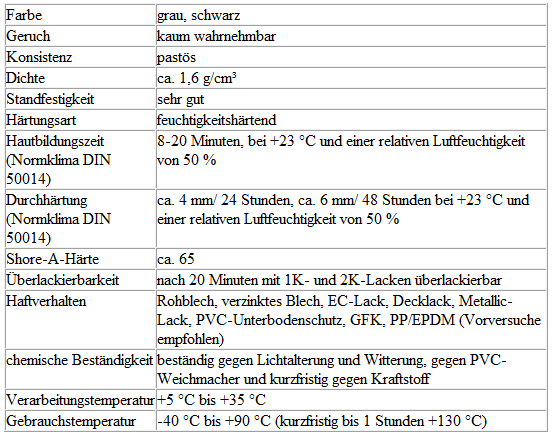
Technical Data
Storage
The material is not at risk from frost.
The guaranteed storage stability is 12 months from the production date. Use by the date stated on the label at the latest, when stored in sealed original containers at +10 °C to +25 °C.

Adhesive/sealant
Designation:
- Adhesive/sealant -D 511 500 A2-, colour grey
- Adhesive/sealant -D 511 510 A2-, colour black
Product description
Adhesive/sealant -D 511 500 A2-/-D 511 510 A2- is used in vehicle repair to protect against corrosion during body repair work, as a fast-curing seal for all visible and hidden seams and joints, and for repairing PVC sealed seams.
The adhesive/sealant is also outstandingly suitable as a spot-weldable sealant between spot-weld flanges to prevent corrosion.
Features:
- High adhesive strength on bare, primed and painted metal, galvanised surfaces, aluminium, wood, glass, and all plastics commonly used in vehicle construction.
- can be painted over immediately
- drying with IR heater possible
- fast drying under paint
- weldable through/spot-weldable through
- no blistering
- no contact corrosion on zinc or aluminium
- excellent corrosion protection
- free of solvents, isocyanates and PVC
- very good UV and ageing resistance
Application information
Application
- Adhesive/sealant -D 511 500 A2-/-D 511 510 A2- is used on vehicles to seal seams during repairs.
Preparation
- The adhesion surfaces must be dry and free of oil, dust, grease and other contaminants.
- Adhesion is improved if the contact surfaces are roughened with abrasive fleece.

Note
- Before starting work, read the safety data sheet for precautions and safety advice.
- Even for products that do not require labeling, observe the precautions usual for chemical products.
Processing

Note
Body areas to be sealed and bonding surfaces must be isolated with a 2K filler before the material is applied.
- To seal, apply adhesive/sealant -D 511 500 A2-/-D 511 510 A2- to seams and joints with the -V.A.G 1761/1- compressed-air gun or the -V.A.G 1628- hand cartridge gun. Then, depending on the visual appearance, leave it as a sealant bead or smooth it with a brush or spatula (observe skin formation time < 10 minutes). After skin formation, the material can still be smoothed with a dampened spatula.
- The adhesive/sealant can be painted over with all repair paints. Painting must be carried out no later than 48 hours after applying the sealant. Drying the paint with an infrared heater does not hinder curing of the sealant.
- If the adhesive/sealant is used as a spot-weldable sealant, apply a sealant bead (diameter 2 - 3 mm) to the flange before fitting the repair part. Spot-weld the repair part before skin formation of the sealant begins (< 10 minutes).
- The material can be spot-welded through within 30 minutes. After welding, squeezed-out sealant can be smoothed.
Incompatibility
- Never apply sealants based on MS polymer or silane-modified polymer onto uncured polyurethane adhesive/sealant. Curing of the polyurethane adhesive/sealant will be impaired or will only occur partially.
- By contrast, adhesion to cured polyurethane adhesive/sealant is good with fresh, sprayable sealants based on MS polymer or silane-modified polymer.
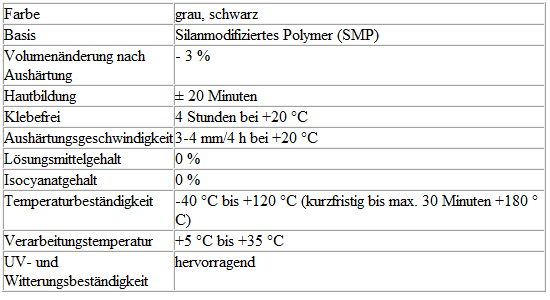
Technical Data
Storage
The guaranteed storage stability is 18 months from the date of production. Usable until the date stated on the label at the latest when stored in sealed original containers at +5 ºC to +30 ºC.