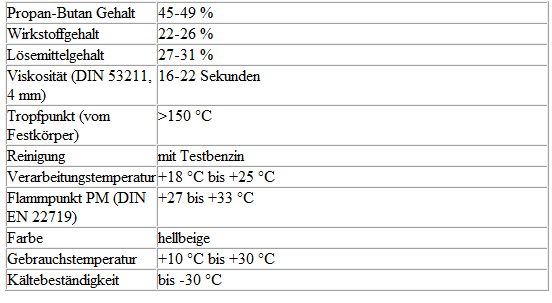
Preservation
Preservation wax
Designation:
- Preservation wax -AKR 321 M15 4-
- Preservation wax -AKR 321 M16 10-
Product description
Preservation wax -AKR 321 M15 4- and Preservation wax -AKR 321 M16 10- is a sprayable wax-based anti-corrosion agent.
After drying, it leaves a firmly adhering, plastically tough and water-repellent film that is almost colorless.
The dropping point of the dry substance is above +100 °C, so there is no risk of it running or dripping, even in the engine compartment.
The dry film adheres well to bare and painted sheet metal.
Application information
Application
- Used for preserving seams, surfaces and cavities on vehicles.
- Due to its light color, it is particularly suitable for protecting the seams on the hood and in the trunk.
- This material is also preferably used to preserve the cleaned engine compartment.
Processing

Note
- Before starting work, read the safety data sheet for precautions and safety advice.
- Even for products that do not require labeling, observe the precautions usual for chemical products.
- Thoroughly clean and dry the parts to be treated with preservation wax beforehand. Remove any rust.
- Shake the can well before use. Spray on the preservation wax and let it flash off. Do not spray onto visible exterior surfaces, as the dried film causes a matte appearance.

Caution!
When preserving the engine compartment of motor vehicles and engines of other equipment, do not start the engines until the protective wax film has flashed off well. There is a risk of flash fire from evaporating solvents!
Technical Data

Cavity preservative
Designation:
- Cavity preservative -D 330 KD1 A2-
- Cavity preservative -D 330 KD2 A1-
Product description
Cavity preservative -D 330 KD1 A2- and Cavity preservative -D 330 KD2 A1- are solvent-based anti-corrosion agents with a high solids content for sealing cavities.
It is supplied as a thixotropic, finely atomizable solution, so that areas that are difficult to reach and narrow gaps between sheet metal panels can also be optimally protected.
The cavity preservative creeps under and displaces moisture; it contains a high proportion of corrosion inhibitors.
When sprayed, the cavity preservative atomizes very finely, is extremely creeping, penetrates well into the gaps to be protected (e.g. weld seams) and still does not run out too heavily from the lower seam points.
The material can be applied at low temperatures from 10 °C, but creeping behavior improves when the product and the body are at room temperature.
After drying, the material forms a plastic, water-repellent film that is beige and almost transparent.
Application information
Application
- In the workshop it is mainly used for spraying the inside of cavities, to supplement existing cavity sealing on new vehicles, for reworking cavity seals after 2-3 years, and after accident repairs.

Note
- Before starting work, read the safety data sheet for precautions and safety advice.
- Even for products that do not require labeling, observe the precautions usual for chemical products.
Application of cavity preservative -D 330 KD1 A2-
- Cavity preservative -D 330 KD1 A2- can be applied without problems using the pressure cup gun and the corresponding probes.
- The application pressure for the pressure cup gun is 5-6 bar. The material pressure regulator should be set to 5 bar.
- With longer storage and at temperatures below +10 °C, the material builds up additional thixotropy. However, this is broken again during spraying at application temperature. After spraying, the product therefore shows its usual properties.

Note
Depending on the type of cavity treated, the drying process can take several days. Make sure there is adequate ventilation during drying.
Application of cavity preservative -D 330 KD2 A1-
- Remove trim panels and covers. Remove any existing rust as far as possible.
- For hard-to-reach surfaces (e.g. half-cavities in doors), replace the spray head with the spray tube from the cap.
- The material should be at room temperature when applied.
- With longer storage and at temperatures below +10 °C, the material builds up additional thixotropy. The can must therefore be shaken vigorously before use until the balls can be heard rattling.
- Spray the dust-free and grease-free body parts evenly, holding the can upright while spraying.
- When working with the "spray tube", move it slowly in circles in all directions while spraying.
- The spray head with the round-jet nozzle allows a fine, even coating of surfaces, e.g. on the underbody, so that they regain a flawless appearance.

Note
Cavity preservative -D 330 KD2 A1- is a product with flammable propellant gas. Make sure that cavities (e.g. door trim) are well ventilated before reassembly, and that the vehicle as a whole is well ventilated during the drying phase. Depending on the type of cavity treated, the drying process can take several days.

Caution!
Functional parts such as brake and exhaust systems must not be sprayed!
Rubber and plastic parts should likewise not be sprayed.
Cleaning
- Preservative that drips out can be wiped off easily.
- Plastic cleaner -D 195 850 A1- is suitable for cleaning dried-on material.
- For larger areas, cleaning is possible with a steam jet cleaner. Remove any spray on painted surfaces immediately.
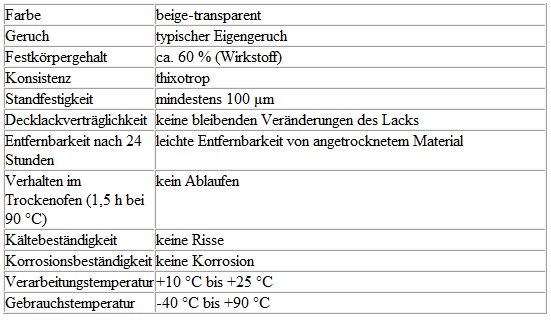
Technical data for cavity preservative -D 330 KD1 A2-
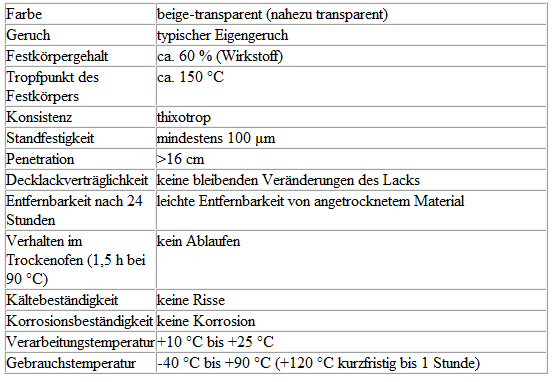
Technical data for cavity preservative -D 330 KD2 A1-
Preservation wax (spray can)
Designation:
- Preservation wax -D 308 SP5 A1-
Product description
Conservation wax -D 308 SP5 A1- provides optimum corrosion protection for corrosion-prone areas of the body, such as sheet metal seams (folds, gaps, flanges), edges and surfaces.
This long-term corrosion protection offers very good penetration and excellent adhesion to the metal surface.
It is compatible with topcoats and can be removed, and it is compatible with rubber and plastic attachment parts.
Application information
Application
- The recommended dry film thickness is approx. 30 μm.
Technical Data