City Safety Obstacle Detection
City Safety1 can help the driver detect other vehicles, cyclists, large animals and pedestrians.
Vehicles
City Safety can detect most vehicles that are stationary or are moving in the same direction as your vehicle. In some cases, it can also detect oncoming vehicles and crossing traffic.
For City Safety to be able to detect a vehicle in the dark, its headlights and taillights must be on and clearly visible.
Cyclists

Examples of what City Safety would interpret to be a cyclist: clear body and bicycle shapes.
For good performance, the system's function for cyclist detection needs the clearest possible information about the contours of the bicycle and of the cyclist's head, arm, shoulders, legs, torso and lower body in combination with normal human movements.
If large portions of the cyclist's body or the bicycle itself are not visible to the function's camera, it will not be able to detect a cyclist.
The system can only detect adult cyclists riding bicycles intended for adults.
- Partially hidden cyclists.
- Cyclists when the contrast against the background is poor.
- Cyclists wearing clothing that obscures the outline of their body.
- Bicycles loaded with large objects.
Warnings and brake interventions may occur late or not at all. The driver is always responsible for ensuring that the vehicle is driven correctly and with a safe distance suitable for the speed.
1 This function is not available in all markets.
Pedestrians

Examples of what the system considers to be a pedestrian: clear body contours.
For good performance, the system's function for pedestrian detection needs the clearest possible information about the contours of the pedestrian's head, arm, shoulders, legs, torso and lower body in combination with normal human movements.
In order to detect a pedestrian, there must be a contrast to the background, which could depend on clothing, weather conditions, etc. If there is little contrast, the person may be detected late or not at all, which may result in a delayed reaction from the system or no reaction at all.
City Safety can detect pedestrians even in dark conditions if they are illuminated by the vehicle's headlights.
- partially obscured pedestrians, people in clothing that hides their body contour or pedestrians shorter than 80 cm (32 in.).
- Pedestrians when the contrast against the background is poor.
- Pedestrians carrying large objects.
Warnings and brake interventions may occur late or not at all. The driver is always responsible for ensuring that the vehicle is driven correctly and with a safe distance suitable for the speed.
Large animals
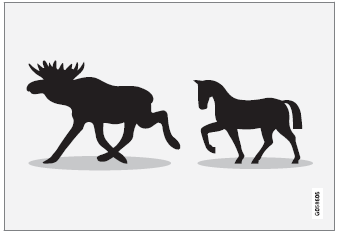
Examples of what City Safety would interpret as a large animal: stationary or moving slowly and with clear body contours.
For good performance, the large animal detection function (e.g. elk, horses, etc.) requires the clearest possible information about the body outline. This entails being able to detect the animal straight from the side in combination with normal movements for that animal.
If parts of the animal's body are not visible to the function's camera, the system will not be able to detect the animal.
City Safety can detect large animals even in dark conditions if they are illuminated by the vehicle's headlights.
- Partially hidden large animals.
- Large animals seen from the front or rear.
- Running or quickly moving large animals.
- Large animals when the contrast against the background is poor.
- Smaller animals, such as cats and dogs.
Warnings and brake interventions may occur late or not at all. The driver is always responsible for ensuring that the vehicle is driven correctly and with a safe distance suitable for the speed.
1 This function is not available in all markets.
Test yourself
A quick Volvo XC90 quiz: every answer comes with an explanation and a link to the manual page.