Driver and Front Passenger Airbags

DRIVER AND FRONT PASSENGER AIRBAGS
Driver Airbag The driver airbag module is located in the center of the steering wheel.
Front Passenger Airbag The front passenger airbag module is located in the instrument panel above the glove box.
Airbags are only a supplemental restraint system and are most effective when used together with seat belts.
To minimize the risk of serious injury or death in a collision, the driver and all passengers must wear seat belts regardless of whether the seating position is equipped with an airbag or not.
• Front airbags do not deploy in side or rear impacts.
No safety system can protect the driver and passengers who are not wearing their seat belts properly, so in these types of collisions they may suffer serious injury or death.
• Drivers and passengers without properly fastened seat belts may be thrown forward during braking before a collision and end up near the airbag modules or on the modules themselves.
This may result in serious injury from being struck by a deploying airbag.
Airbags are designed to help protect the head, neck and chest from striking the instrument panel, steering wheel or windshield in a frontal collision. They do not deploy in rear impacts, rollovers or most side impacts. Airbags are designed to deploy in collisions with deceleration forces equal to or greater than those of a vehicle impacting a fixed, rigid barrier at speeds from 15 to 23 km/h.
The airbag system deploys either in severe frontal collisions or when the angle of impact does not deviate from a straight line by more than 30°.
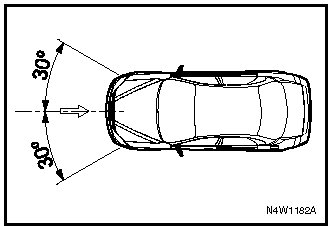
The deceleration level at which the airbag deploys is set so that deployment occurs at a deceleration no lower than the level for which statistical data show a risk of death in a frontal collision.
In practice, vehicles rarely collide with fixed walls. In most cases, airbags deploy in collisions between vehicles. The actual speed at which airbags deploy may be higher in practice, since real accidents usually involve more complex multi-vehicle collisions, at angles and not fully frontal (for example, offset or glancing), and the impacted objects are usually not fixed.
The airbag may also deploy at moderate and high deceleration without a collision (for example, when the chassis and other rigid vehicle components strike a pothole in the road), if the deceleration sensors generate a signal equivalent to a collision with a fixed, rigid barrier at speeds from 15 to 23 km/h.
The airbags deploy if the sensor registers a frontal collision with deceleration sufficient to deploy the airbags. In this case, the deceleration sensor initiates the airbag deployment signal.
A combustible compound ignites and burns rapidly inside the airbag module, generating enough nitrogen gas to inflate the airbag. This chemical process and the nitrogen gas are harmless to the occupants of the vehicle. Within 0.045 seconds after collision detection, the deployment pressure breaks the plastic module cover, which in turn opens the steering wheel hub trim or the passenger-side instrument panel.
The airbag fully inflates, forming a surface that stops the forward movement of the person's head and upper body.
When a person contacts the airbag, gas escapes from the airbag through the vents in its base, cushioning the load from the person's movement.
Airbags do not restrict breathing or limit freedom of movement. Airbags have vents through which gas escapes immediately after cushioning.
The entire process, from initial contact through inflation and gas release, takes about 0.2 seconds, faster than the blink of an eye. The collision lasts only a fraction of a second, and the colliding vehicles come to a complete stop only one or two seconds after initial contact. Therefore, to protect the driver and passengers, the supplemental restraint system must detect the collision and deploy the airbags almost instantly.
Test yourself
A quick Chevrolet Lacetti quiz: every answer comes with an explanation and a link to the manual page.