ESP system
It is a monitoring system for vehicle stability and supports directional control when the tyres lose grip.
The intervention of the ESP system is therefore particularly useful when the grip conditions of the road surface change.
The ESP, ASR and Hill Holder systems are also accompanied by the MSR system (engine drag torque control when downshifting), where fitted.
System interventionIntervention of the system is indicated by the flashing of the warning light on the
instrument panel to inform the driver that the vehicle is in a critical stability and grip situation.
The ESP system switches on automatically when the vehicle is started and cannot be switched off.
 Note
However, the performance of the ESP system should not lead the driver to take unnecessary and unjustified risks.
Driving style must always be adapted to road conditions, visibility and traffic. Responsibility for road safety always remains with the driver of the vehicle.
Fault warningIn the event of a malfunction, the ESP system switches off automatically and the warning light on the instrument panel comes onsteadily (on some
versions a message appears on the display) (see chapter "Warning lights and indicators"). In this case, contact the Fiat service network as soon as possible.
The system is part of the ESP system and assists when starting off on uphill gradients.
It is activated automatically under the following conditions:
- Uphill: with the vehicle stationary on a road with a gradient over 5%, engine running, clutch and brake pedals depressed and gear lever in neutral or in any gear other than reverse.
- Downhill: with the vehicle stationary on a road with a gradient over 5%, engine running, clutch and brake pedals depressed and reverse gear engaged.
When starting off, the ESP control unit maintains brake pressure at the wheels until the engine speed required for departure is reached, or for a maximum of 2 seconds in any case. This makes it possible to comfortably move the right foot from the brake pedal to the accelerator pedal.
If the vehicle has not moved off after 2 seconds, the system switches off automatically and gradually releases the brake pressure.
During this phase, the typical mechanical release noise of the brakes can be heard, which signals that the vehicle is about to move.
Fault warningsIn the event of a malfunction, the warning light on the
instrument panel comes on (together with a message on the multifunction display) (see chapter "Warning lights and indicators").
Please note: the Hill Holder system is not a parking brake. Therefore, do not leave the vehicle without first applying the parking brake, switching off the engine and engaging first gear.
 Note
For correct operation of the ESP system, it is essential that the tyres on all wheels are of the same make and type, in perfect condition and, above all, match the specified type, make and size.
NoteThe ESP system also works when the temporary spare wheel is fitted. However, note that the temporary spare wheel, being smaller than a normal tyre, has less grip than the other tyres on the vehicle.
ASR system (anti-slip regulation)The ASR system is an integral part of the ESP system; it monitors the vehicle and intervenes automatically when one or both driven wheels begin to slip.
Depending on the slip conditions, two different control systems are active:
- If both driven wheels spin, the ASR function intervenes and reduces the drive power of the vehicle;
- If only one of the two driven wheels spins, the ASR function automatically brakes the spinning wheel.
Intervention of the ASR function is particularly beneficial under the following conditions:
- Slipping of the inside wheel in a bend due to dynamic load changes or excessive acceleration;
- Excessive drive force transmitted to the wheels, also in relation to the road condition;
- When accelerating on slippery surfaces, snow or ice;
- Loss of grip on wet surfaces (aquaplaning).
ASR switches on automatically when the engine is started.
Switching the system on or off is indicated by a message on the display (see chapter "Warning lights and indicators").
NoteHowever, the performance of the system should not lead the driver to take unnecessary and unjustified risks. Driving style must always be adapted to road conditions, visibility and traffic.
Responsibility for road safety always remains with the driver of the vehicle.
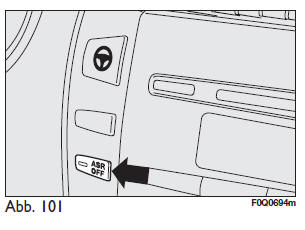
While driving, the ASR system can be switched off and on again by pressing the ASR OFF switch on the dashboard next to the steering wheel, fig. 101.
Switching off is indicated by the LED on the switch lighting up (and a message appears on the display) (see chapter "Warning lights and indicators").
If the ASR function is switched off while driving, it is switched back on automatically the next time the engine is started.
When driving on snow-covered surfaces with snow chains fitted, it may be useful to switch off the ASR function.
Under these conditions, wheel slip of the driven wheels during the starting phase provides greater traction.
Fault warningsIn the event of a malfunction, the ASR system switches off automatically and the warning light on the
instrument panel comes on steadily (and a message appears on the display) (see chapter "Warning lights and indicators"). In this case, contact the Fiat service network as soon as possible.
 Note
While the temporary spare wheel is in use, the ASR system cannot be used, and the warning lightthe
instrument panel warning light stays on (and a message appears on the display) (see chapter "Warning lights and indicators").
NoteFor the ESP and ASR systems to operate correctly, the tyres on all wheels must be of the same make and type and in perfect condition. In particular, they must match the specified type, make and size.
MSR system (engine drag torque control)This system is an integral part of the ASR system. It intervenes when the gears are downshifted abruptly and adjusts the engine torque.
This prevents the drive wheels from being driven too hard, which could cause the vehicle to skid, especially on poor grip surfaces.
Test yourself
A quick Fiat Bravo quiz: every answer comes with an explanation and a link to the manual page.