Battery Condition Check
Always disconnect the negative cable from the battery first and connect it last!
INSPECTION
PROCEDURE
1. Disconnect both cables from the battery.
Always disconnect the negative cable first and connect it last. If the vehicle's audio system has an anti-theft code, make sure you have the correct code to reactivate the unit before disconnecting the battery!

2. Check the electrolyte level in the battery (applies only to batteries with removable caps that require maintenance). The electrolyte must fully cover the plates; if not, add the required amount of distilled water to the cells. DO NOT OVERFILL: excess electrolyte will overflow from the filler openings when the battery is overcharged. Using a hydrometer (available at automotive accessory stores), measure the electrolyte specific gravity. Remove the filler caps and draw a sample of electrolyte with the hydrometer from each battery cell in turn. Following the manufacturer's instructions, determine the electrolyte specific gravity from the position of the hydrometer float. At normal charge level the specific gravity should be 1.270 (green zone of the scale). If the electrolyte density is too low (red zone of the scale), charge the battery (see Maintenance and Minor Adjustments section). Maintenance-free batteries usually have a special color indicator. When the spot in the indicator window turns black, charge the battery without delay. After checking electrolyte density, measure the battery output voltage with a digital voltmeter.
Before connecting the voltmeter, remove the surface charge from the battery: turn on the high beams for about 10 seconds, then turn off all electrical loads and wait about two minutes. With the engine off and all electrical loads off, connect the black voltmeter probe to the negative battery terminal and the red probe to the positive terminal. Battery output voltage should be 11.5 ÷ 12.5 V or slightly higher.
The nominal electrolyte specific gravity depends on ambient temperature (and is directly proportional to it); use the temperature chart supplied by the battery manufacturer.
If the above checks are satisfactory, there is no need to perform a load test on the battery (see below).
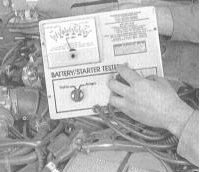
3. A more accurate check of the battery condition can be performed with a universal battery tester (available at automotive accessory stores). The tester determines the battery's ability to crank the starter and supply power to the vehicle's electrical loads under high engine load. Connect the tester to the battery terminals (see accompanying illustration). Follow the tester manufacturer's instructions - with a 15-second load applied, battery voltage must not drop below 9.6 V; otherwise, replace the battery.
At ambient temperatures below 0°C (32°F), the minimum acceptable reading is reduced to 9.1 V.
Test yourself
A quick Honda Accord quiz: every answer comes with an explanation and a link to the manual page.