Ignition System Operation Check
PROCEDURE
Because very high voltage is generated in the ignition system, its components must be serviced with particular care. This caution applies not only to the main parts of the electronic ignition system, but also to all related components, including spark plug wire terminals, the tachometer and other diagnostic equipment.
1. If the ignition system malfunctions, perform the following preliminary checks before beginning distributor diagnosis:
a) Check the battery terminal connections and make sure the clamps and wire terminals are tightly secured;
b) Check the battery condition (refer to Battery Inspection and Replacement). If necessary, replace the battery;
c) Visually inspect the distributor and ignition coil spark plug wires and make sure they are securely connected to the terminals;
d) If equipped, check the fuses in the engine compartment junction block (refer to the Electrical Systems chapter). Replace any blown fuses.
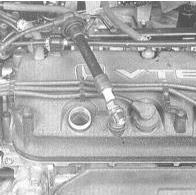
2. Check for spark at the spark plugs. If the engine cranks but does not start, disconnect the high-tension lead from one of the spark plugs and connect it to a special calibrated spark tester (available from automotive accessory stores). Secure the tester clamp to a bolt or metal bracket on the engine block, grounding it to the body. If a calibrated spark tester is not available, disconnect the lead from the spark plug and, holding it with insulated pliers, pull the rubber boot up along the lead and bring the contact terminal to a well-grounded point on the engine block at a distance of approximately 6.4 mm. When cranking the engine, a clearly visible bright blue spark must jump between the electrode of the tester or the terminal of the high-tension lead and ground.
3. If the spark jumps properly and its intensity is not in doubt, repeat the check for the high-tension leads of the remaining spark plugs. This check confirms the condition of the distributor cap and rotor, but does not rule out a faulty spark plug. Therefore, remove the spark plugs and inspect them as described in the Maintenance and Tune-Up chapter of this Manual.
4. If there is no spark, remove the distributor cap and inspect it, as well as the rotor (see Maintenance and Tune-Up chapter). If moisture is present, thoroughly wipe the cap and rotor surfaces with a clean, dry cloth, then reinstall the cap and repeat the spark check.
5. If removing moisture does not solve the problem (spark is still weak or absent), on V6 models disconnect the coil secondary wire from the distributor cap and connect the spark tester to it (be sure the high-tension leads are connected to all spark plugs). Repeat the test procedure described above.
If a spark tester is not available, check the coil wire the same way as the spark plug high-tension leads, by bringing the terminal to ground at a distance of approximately 6.4 mm.
6. If there is no spark on 4-cylinder models, check the spring and carbon contact button inside the distributor cap for burning and mechanical damage. Replace the distributor cap if necessary.
7. If spark is now normal, the fault lies in the distributor cap, rotor, or the corresponding spark plug leads (see Maintenance and Tune-Up chapter).

8. If there is still no spark at this stage, check the connections of the ignition coil primary circuit: inspect the condition and security of the terminals. Check that primary voltage is supplied to the coil from the ignition switch, by measuring voltage at the positive side of the coil.
Because on 4-cylinder models the ignition coil is built into the distributor, remove the distributor cap, disconnect the leads from the coil, then check for battery voltage at the terminal of the black/yellow wire. Make the necessary repairs, then repeat the check.
9. If voltage is present at the coil but there is still no spark, measure the resistance of the coil primary and secondary windings (see Coil Testing and Replacement section). If an open circuit is found (infinite ohmmeter reading), replace the coil.
10. If the coil is good, check the operation of the Ignition Control Module (ICM) (see Ignition Control Module Operation Check and Replacement section).
11. Further checks of the PGM-IG system should be referred to a dealer service technician.
Test yourself
A quick Honda Accord quiz: every answer comes with an explanation and a link to the manual page.