Shift Indicators for Recommended Upshift and Downshift
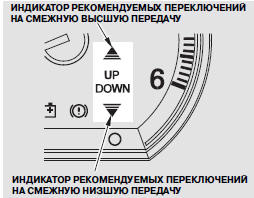
For vehicles with manual transmission
When the ACC system is on, the shift indicator for recommended shifts to the next higher or next lower gear will appear to inform you of the optimal shift timing for good fuel economy.
This function is not available when the ACC system is active.
Instead of the optimal shift timing, the indicator will inform you that a shift is required because the engine has reached its limit in the gear you have selected.
Shifting up or down as indicated by the shift indicator ensures smooth engine operation. It also helps the Adaptive Cruise Control (ACC) system operate efficiently.
The indicator illuminates when the tachometer needle approaches the red zone of the scale (at approximately 5500 rpm on gasoline engine vehicles, or approximately 4200 rpm on diesel engine vehicles).
The Adaptive Cruise Control (ACC) system automatically cancels when engine speed reaches 6000 rpm on gasoline engine vehicles and 4500 rpm on diesel engine vehicles.
The Adaptive Cruise Control (ACC) system is canceled if the engine speed reaches the red zone of the tachometer.
The shift indicator for recommended shifts to the next lower gear illuminates to prevent the engine from stalling when crankshaft speed drops.
The Adaptive Cruise Control (ACC) system is canceled when engine crankshaft speed drops below 1000 rpm.
To avoid engine damage, never drive with the tachometer needle in the red zone of the scale.
If you do not follow the shift indicator prompts for the next higher or next lower gear, the Adaptive Cruise Control (ACC) system will cancel after 10 seconds. For more information on automatic cancellation and activation of the ACC system, refer to page 314.
Limitations
• The ACC system does not operate at speeds below 25 km/h. Therefore, the ACC system does not bring the vehicle to a complete stop.
• The ACC system does not sound a warning chime or display a message on the multi-information display if the vehicle is stationary or moving at less than 20 km/h. In such cases, the driver must maintain a safe distance from other vehicles by using the brake pedal.
• The ACC system may not detect motorcycles or other small vehicles traveling ahead of you.
• When cornering, driving in narrow lanes, turning the steering wheel sharply, etc., the ACC system may suddenly react to a vehicle traveling in a parallel path, or even to a closely located building, and may abruptly apply the brakes and sound a warning chime.
Test yourself
A quick Honda CR-V quiz: every answer comes with an explanation and a link to the manual page.