Fuses
Fuses are used to interrupt a circuit when the current reaches a specified value, in order to protect components and wires that could be damaged by excessive current. A sudden increase in current is usually caused by a fault in the circuit, most often a short circuit.
The circuits protected by fuses are identified on the cover of the fuse box.
Before removing a fuse, switch off the corresponding circuit (or the ignition), then remove the fuse from its contacts. The wire inside the fuse should be visible; if the fuse has blown, the wire will be broken or melted.
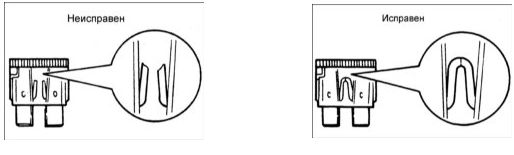
Always use fuses of the specified rating. Never use a fuse of a different rating or substitute anything else for a fuse.

Do not replace a fuse more than once without correcting the cause of the trouble. The current protected by the fuse is marked on top of the fuse; note that fuses are color-coded for easy identification.
If a fuse blows immediately after replacement, do not replace it again until the cause of the trouble has been located and corrected. In most cases the cause is a short circuit due to insulation damage. If the fuse protects several circuits, locate the circuit causing the fuse to blow by checking each circuit in turn (if possible). Always keep a set of spare fuses of various ratings in the vehicle. They should be secured at the base of the fuse block.
Electrical Circuits Protected by Fuses in the Engine Compartment
Circuit Current, A
Alternator 100
ECM 20
Power Windows 30
Condenser 20
Battery 50
Lamps 20
Radiator 20
ABS 30
ABS 20
Ignition 30
Fan 30
Test yourself
A quick Hyundai Accent quiz: every answer comes with an explanation and a link to the manual page.