Charging System
The charging system includes the battery, the alternator with an integrated regulator and charge warning lamp, and wiring. The vehicle is equipped with an AC alternator with a rectifier.
The alternator is a three-phase synchronous electrical machine with electromagnetic excitation. The voltage is regulated by the integrated voltage regulator.
During alternator operation, the electric current flowing through the field coil creates a magnetic flux around the rotor poles. As the rotor rotates, south and north rotor poles alternately pass under each stator tooth, and the working magnetic flux passing through the stator teeth changes in magnitude and polarity. This alternating magnetic flux induces an electromotive force in the stator winding.
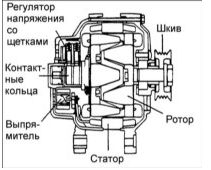
At high rotor speeds, when the alternator voltage exceeds 13.6–14.6 V, the voltage regulator switches off and no current flows through the field coil. The alternator voltage drops, the regulator switches on again and current flows through the field coil. The higher the alternator rotor speed, the longer the regulator remains off, and therefore the greater the drop in alternator output voltage. The regulator switches on and off at a high frequency, so voltage fluctuations at the alternator output are not noticeable and the output can be considered practically constant, maintained at 13.6–14.6 V.
Test yourself
A quick Hyundai Accent quiz: every answer comes with an explanation and a link to the manual page.