Five-Position Transfer Case — If Equipped
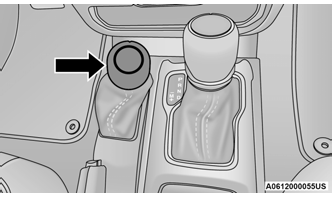
Four-Wheel Drive Selector
The transfer case provides five operating modes:
- 2H (2WD High) — two-wheel drive, high range
- 4H AUTO (4WD High AUTO) — four-wheel drive, high range, automatic
- 4H PT (4WD High PT) — four-wheel drive, part-time, high range
- N (Neutral)
- 4L (4WD Low) — four-wheel drive, low range
For more information on the proper use of each transfer case position, refer to the information below:
2WD High
2WD High Range — this range is intended for normal street and highway driving on dry, hard-surfaced roads.
4WD High AUTO
Four-Wheel Drive Automatic High Range — this range delivers power to the front wheels. The four-wheel drive system will engage automatically when the vehicle detects a loss of traction. Provides additional traction for various road conditions.
4WD High PT
Four-Wheel Drive Part-Time High Range — this range maximizes torque to the front driveshaft, causing the front and rear wheels to rotate at the same speed. This range provides additional traction only on loose, slippery road surfaces.
N (Neutral)
Neutral — this range disconnects both front and rear driveshafts from the powertrain. Used for flat towing behind another vehicle.
4WD Low
4WD Low Range — this range provides low-speed four-wheel drive. It maximizes torque to the front driveshaft, causing the front and rear wheels to turn at the same speed. This range provides additional traction and maximum pulling power only on loose, slippery road surfaces. Do not exceed 25 mph (40 km/h).
This transfer case is designed for 2WD or 4WD AUTO for normal driving conditions on dry, paved roads. Driving in 2WD will provide better fuel economy, since the front axle is not engaged in 2WD.
The 4WD AUTO mode can be used for changing driving conditions. In this mode, the front axle is engaged, but vehicle power is directed to the rear wheels. Four-wheel drive will engage automatically when the vehicle detects a loss of traction. Because the front axle is engaged, this mode will result in lower fuel economy than 2WD.
If additional traction is required, the 4WD High and 4WD Low transfer case positions can be used to lock the front and rear driveshafts together, causing the front and rear wheels to rotate at the same speed. The 4WD High and 4WD Low positions are intended for loose, slippery road surfaces only and are not intended for normal driving. Driving in 4WD High and 4WD Low on dry paved roads causes increased tire wear and damage to driveline components. Refer to "Shifting Procedures" in this section for further information on shifting into 4WD High or 4WD Low.
The instrument cluster warns the driver that the vehicle is in four-wheel drive and the front and rear driveshafts are locked together. The light illuminates when the transfer case is shifted into the 4WD High position.
When operating the vehicle in 4WD Low, engine speed will be approximately three times higher (four times for Rubicon models) than in 2WD High or 4WD High at the same road speed. Take care not to exceed the engine speed limit.
Proper operation of four-wheel drive vehicles depends on tires of the same size, type and circumference on each wheel. Any difference will adversely affect shifting and may cause damage to the transfer case.
Because four-wheel drive provides improved traction, there is a tendency to exceed safe speeds in turns and stops. Do not drive faster than road conditions allow.
Shifting Procedures
2WD High to 4WD High AUTO or 4WD High AUTO to 2WD High
Shifting between 2WD High and 4WD High AUTO can be done with the vehicle stopped or while moving. The preferred shift speed is from 0 to 72 km/h. With the vehicle moving, the transfer case will engage/disengage more easily if you momentarily release the accelerator pedal after the shift is completed. Do not accelerate while shifting the transfer case. Apply steady force when moving the transfer case shift lever.
2WD High/4WD High AUTO to 4WD High PT or 4WD High PT to 2WD High/4WD High AUTO
Shifting between 2WD High/4WD High AUTO and 4WD High PT can be done with the vehicle stopped or while moving. The preferred shift speed is from 0 to 45 mph (72 km/h). With the vehicle moving, the transfer case will engage/disengage more easily if you momentarily release the accelerator pedal after the shift is completed. Do not accelerate while shifting the transfer case. Apply steady force when moving the transfer case shift lever.
NOTE:
- Do not attempt to shift while only the front or rear wheels are slipping. The front and rear driveshaft speeds must be equal for the shift to take place. Shifting while only the front or rear wheels are slipping may cause damage to the transfer case.
- A delay when shifting out of four-wheel drive may be caused by uneven tire wear, low or uneven tire pressure, excessive vehicle load, or low temperatures.
- The shifting effort increases as vehicle speed increases. This is normal.
In cold weather, you may experience increased shifting effort until the fluid in the transfer case warms up. This is normal.
4WD High PT/4WD High AUTO to 4WD Low or 4WD Low to 4WD High PT/4WD High AUTO
When the vehicle is coasting at 1 to 3 mph (2 to 5 km/h), shift the automatic transmission to NEUTRAL (N), or depress the clutch pedal on manual transmission vehicles. While the vehicle is coasting at 1 to 5 km/h, move the transfer case shift lever to the desired position. Do not pause when the transfer case is in the N (Neutral) position. Once shifting is complete, place the automatic transmission in DRIVE or release the clutch pedal on manual transmission vehicles.
NOTE:
Engaging or disengaging 4WD Low is possible with the vehicle completely stopped; however, difficulty may occur if the mating teeth are not properly aligned. Several attempts may be required to align the teeth and complete engagement. The preferred method is while the vehicle is moving at 1 to 3 mph (2 to 5 km/h). Avoid attempting to engage or disengage 4WD Low when the vehicle is moving faster than 1 to 3 mph (2 to 5 km/h).
Test yourself
A quick Jeep Wrangler quiz: every answer comes with an explanation and a link to the manual page.