Anti-lock Brake System (ABS) (if equipped)
WARNING The ABS (or ESC) does not prevent accidents caused by incorrect or dangerous driving manoeuvres. Although vehicle control is improved during emergency braking, always maintain a safe distance from the vehicles ahead. In extreme road conditions, always reduce vehicle speed.
The braking distance of vehicles equipped with an anti-lock brake system (or electronic stability control system) may be longer than that of vehicles without one in the following road conditions.
Therefore, in these conditions, reduce your driving speed:
- On rough roads, or roads covered with gravel or snow.
- When driving with snow chains.
- On roads with potholes or bumps.
The safety performance of vehicles equipped with ABS (or ESC) must not be tested by driving and cornering at high speed. These manoeuvres could endanger the occupants and other people.
The ABS continuously monitors wheel speed. When the wheels tend to lock, the ABS repeatedly modulates the hydraulic brake pressure.
When braking in conditions that may cause the wheels to lock, the driver may feel a slight vibration in the brake pedal and hear a kind of ticking or clicking noise from the braking system. These conditions are part of normal ABS operation.
To get the maximum benefit from the ABS in emergency situations, do not try to modulate the brake pressure and do not pump the brake pedal.
Press the brake pedal with as much force as possible, or with the force necessary for the particular situation, and let the ABS control the braking action on the wheels.
NOTE When the vehicle starts moving again after the engine has been stopped, you may hear a clicking sound from the engine compartment.
This condition is normal and indicates that the anti-lock brake system is operating correctly.
- Even with an anti-lock brake system, the vehicle still needs sufficient braking distance. Always maintain a safe distance from the vehicle ahead.
- Always slow down when approaching corners. The anti-lock brake system cannot eliminate the risks arising from excessive speed.
- On loose or low-grip road surfaces, the intervention of the anti-lock braking system (ABS) may result in a longer braking distance compared to vehicles equipped with conventional brakes.
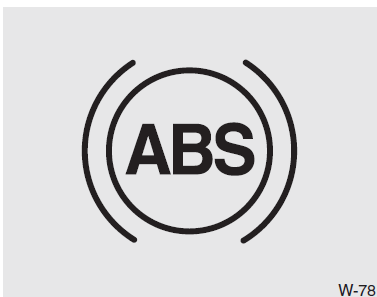
WARNING
- If the ABS warning light comes on and stays on, there may be a problem with the ABS system. In this case, the conventional brakes will continue to work normally.
- When the ignition switch is turned to ON, the ABS warning light stays on for approximately 3 seconds. During this time the ABS performs a self-diagnosis and, if everything is in order, the light goes off. If the warning light stays on, there may be a problem with the ABS system. Contact an authorized Kia dealer as soon as possible.
WARNING
- When driving on low-grip road surfaces, such as icy roads, if the brake pedal is pressed repeatedly, the ABS will continuously intervene and the warning light may come on.
Stop in a safe place and turn off the engine.
NOTE When starting the engine with an auxiliary battery because the vehicle battery is discharged, the engine speed may be irregular and the ABS warning light may come on. This is due to the low battery charge. It does not mean that the ABS is malfunctioning.
- Do not pump the brake pedal!
- Recharge the battery before driving.
Test yourself
A quick Kia Picanto JA quiz: every answer comes with an explanation and a link to the manual page.