Emergency Tire Change
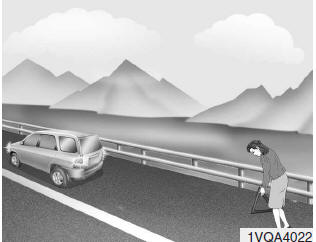
- Park the vehicle on level ground and firmly apply the parking brake.
- Shift the gear lever into R (Reverse) for a manual transmission, or into P (Park) if the transmission is automatic.
- Turn on the hazard warning lights.
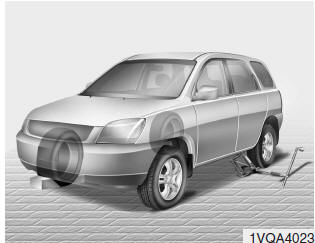
- Remove the wheel nut wrench, jack, jack handle and spare tire from the vehicle.
- Chock the wheel diagonally opposite the wheel being changed, both in front and behind.
- To prevent the vehicle from moving during a tire change, always fully apply the parking brake and always chock the wheel diagonally opposite the wheel being changed.
- It is recommended that the vehicle wheels be chocked and that no person remain inside the vehicle while it is supported on the jack.
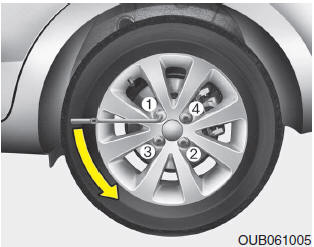
- Loosen each wheel nut by one turn counterclockwise, but do not remove any nut until the wheel is off the ground.
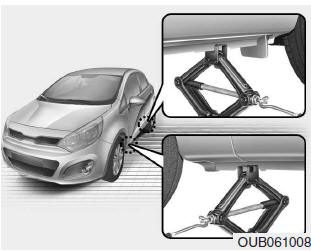
- Place the jack at the front or rear jacking point nearest to the wheel being changed. Position the jack at the marked locations under the frame. The jacking points are plates welded to the frame with two projections and a dot above them indicating where the jack should be placed.
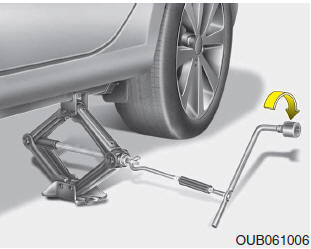
- Insert the jack handle into the jack and turn it clockwise to raise the vehicle until the wheel is just lifted off the ground, approximately 30 mm (1.2 in). Before removing the wheel nuts, make sure the vehicle is stable and cannot move or slip off.
- Loosen and remove the wheel nuts by hand. Slide the wheel off the wheel studs and lay it flat so it cannot roll away. To install the spare tire on the hub, lift the wheel, align the holes with the wheel studs and slide it on. If this is difficult, tilt the wheel slightly and align the upper hole in the wheel with the upper wheel stud. Then rotate the wheel clockwise and counterclockwise until it can be slid onto the remaining studs.
If any such material is present, remove it. If the mounting surface between the wheel and hub does not seat flush, the wheel nuts could loosen and the wheel could come off. Losing a wheel may cause loss of vehicle control, resulting in serious injury or death.
- To reinstall the wheel, hold it against the wheel studs, fit the nuts onto the studs and tighten by hand. The nuts should be installed with the tapered ends facing inward. Rotate the wheel to make sure it is fully seated in place, then tighten the nuts by hand again firmly.
- Lower the vehicle to the ground by turning the wheel nut wrench counterclockwise.
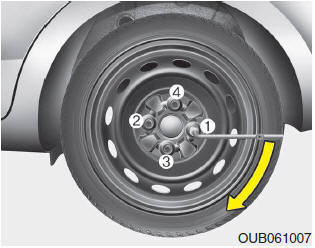
Then place the wrench in the position shown in the illustration and tighten the nuts. Make sure the socket fully engages the nut. Do not stand on the wrench handle or extend it with a pipe. Tighten each wheel nut until all of them are firmly tightened. Then check again that each nut is securely tightened.
After replacing the wheel, have the wheel nuts tightened to the correct torque by an authorized Kia dealer as soon as possible.
Wheel nut tightening torque: Steel and aluminum alloy wheels: 9~11 kg.m (65~79 lb-ft)
If a pressure gauge is available, remove the valve cap and check the tire air pressure. If the pressure is lower than recommended, drive slowly to the nearest service station and inflate the tires. If the pressure is higher than recommended, release some air until the pressure is correct. Always reinstall the valve cap after checking or adjusting the pressure. If the valve cap is not installed, the tire may lose pressure. If the valve cap is lost, buy a new one and install it as soon as possible.
After changing a wheel, always secure the damaged wheel in its proper place and return the jack and tools to their storage places in the vehicle.
CAUTION The vehicle uses metric threads on wheel bolts and wheel nuts. When removing a wheel, make sure that the same nuts are installed afterwards or, if the nuts need replacing, that nuts with the same metric thread and the same taper seat configuration are used. Installing nuts with a non-metric thread on bolts with a metric thread, or vice versa, will not secure the wheel properly to the hub and will damage the bolt to the extent that it must be replaced.Note that most wheel nuts do not have a metric thread. Be sure to check the thread type very carefully before installing replacement nuts or wheels. If you have any doubts, consult an authorized Kia dealer.
WARNING - Wheel Studs If the studs are damaged, they may lose the ability to hold the wheel in place. This may lead to the wheel coming off, causing a collision and serious injury.To prevent the jack, jack handle, wheel nut wrench and spare wheel from rattling while the vehicle is moving, store them properly in the vehicle.
WARNING - Incorrect Spare Tire Pressure After installing the spare tire, check the tire pressure as soon as possible. If necessary, adjust it to the specified value. See "Tires and Wheels" in section 9.Important - using the compact spare tire (if equipped)
The vehicle is equipped with a compact spare tire. This spare tire takes up less space than a full-size wheel. It is smaller than a standard wheel and is intended for temporary use only.
CAUTION- When using the compact spare tire, drive the vehicle carefully. At the first opportunity, replace the temporary spare with a wheel and tire of standard size.
- Driving the vehicle is not recommended if more than one compact spare tire is installed at the same time.
The compact spare tire should be inflated to an air pressure of 420 kPa (60 psi).
NOTE After installing the spare wheel, check its tire pressure.
If necessary, adjust the pressure to the specified value.
When using the compact spare tire, observe the following precautions:
- Never exceed a speed of 80 km/h. Higher speed may damage the tire.
- To avoid hazards, always drive at a speed suitable for road conditions. Road hazards such as potholes or rocks can seriously damage the compact spare tire.
- Continued driving on this tire may lead to tire damage, loss of vehicle control and possible injury.
- Do not exceed the maximum load or load capacity rating shown on the sidewall of the compact spare tire.
- Avoid driving over obstacles. The diameter of the compact spare tire is smaller than that of a standard tire, which reduces ground clearance under the vehicle by approx. 25 mm (1 in.), and may cause damage to the vehicle.
- When the compact spare tire is installed, do not take the vehicle through an automatic car wash.
- Do not fit snow chains to the compact spare tire. Because of its smaller diameter, the chain will not fit it properly.
This could damage the vehicle and cause the chain to come off.
Test yourself
A quick Kia Rio YB quiz: every answer comes with an explanation and a link to the manual page.