TVD (Torque Vectoring Differential)
The TVD (Torque Vectoring Differential) in the Lexus GS F delivers impressive driving dynamics. It actively distributes torque between the rear wheels, which optimizes cornering behavior and traction. Various modes, including STANDARD, SLALOM and TRACK, are available for selection. This chapter describes operation, display functions and warnings to protect the system. Tips for handling TVD oil overheating complement the practical explanations.
The TVD system automatically distributes drive force (driving torque) between the right and left rear wheels. The system helps improve steering response when cornering and increases traction when exiting corners, providing a dynamic driving experience.
Changing the TVD Control Modes
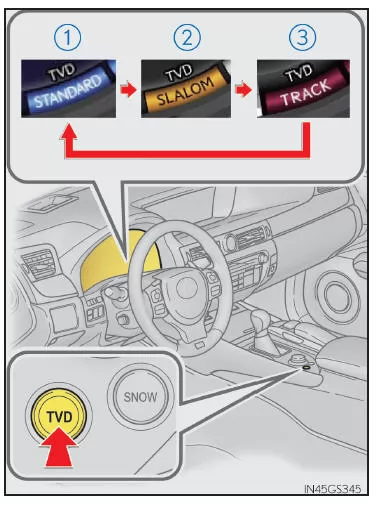
To change the TVD control mode, press the TVD switch while the engine switch is in the IGNITION ON mode.
The current TVD control mode is shown on the gauges.
- STANDARD mode.
This is the default mode and provides an optimal balance between driving dynamics and driving stability.
- SLALOM mode.
This mode emphasizes improved steering response.
- TRACK mode.
This mode is designed for fast, sporty driving and emphasizes driving stability.
TVD Control Status Display on the Multi-Information Display
The multi-information display shows how drive force is distributed between the right and left rear wheels.
■ Automatic Cancellation of the Selected TVD Control Mode
When the engine switch is turned off, the SLALOM and TRACK modes are canceled.
When the engine switch is set to IGNITION ON mode, the TVD system is activated in STANDARD mode.
■ Automatic Deactivation of the TVD System
If a malfunction of the TVD system is detected, a warning message appears on the multi-information display and the TVD system is automatically deactivated.
When the system is deactivated, drive force is not distributed by the TVD but by the standard differential.
■ System Protection
If the TVD oil temperature rises excessively because the vehicle has been driven under extremely high loads for a long time, a warning message is shown on the multi-information display.
WARNING
■ Precautions for using the system
As the driver, you alone are responsible for safely operating your vehicle. Do not rely too heavily on the TVD system. Always drive carefully and pay attention to your surroundings.
The TVD system (Torque Vectoring Differential) in the Lexus GS GRL1 provides a dynamic driving experience through targeted distribution of drive force between the rear wheels. With the STANDARD, SLALOM and TRACK modes, the handling can be optimally adjusted for public roads or the race track. The sport sedan shows its strengths in agility and traction, especially in corners.
The Lexus GS 2016–2020 sets the standard in its class with its TVD system, offering ambitious drivers a high level of control and driving enjoyment.
FAQWhen is SLALOM mode especially useful?
It is suited to winding roads where precise steering response is required.
What happens if the TVD oil overheats?
The system reduces its function to prevent damage and warns the driver via the multi-information display.
Test yourself
A quick Lexus GS quiz: every answer comes with an explanation and a link to the manual page.