BSM (Blind Spot Monitor)
The Blind Spot Monitor (BSM) system in the Lexus GS (2016–2020) improves safety when changing lanes and backing out of parking spaces. It reliably warns of vehicles in blind spots and helps prevent collisions when reversing. This chapter explains how the system works, its detection areas and how to operate it, and gives clear warnings about when you should not rely solely on the system. This keeps the driver attentive and safe in every situation.
Summary of Blind Spot Monitor Functions

The Blind Spot Monitor (BSM) combines 2 functions in one system:
- Blind Spot Monitor (BSM).
This system assists the driver in deciding the best time to change lanes.
- Rear Cross Traffic Alert (RCTA).
Assists the driver when reversing.
Both functions use the same sensors.
- Switching the Blind Spot Monitor on and off.
The Blind Spot Monitor (BSM) and Rear Cross Traffic Alert (RCTA) can be turned on and off using the Multi-Information Display.
When the system is on, the BSM indicator light on the instrument panel illuminates and the warning buzzer sounds.
- Outside mirror indicators.
Blind Spot Monitor (BSM): When a vehicle is detected in the blind spot, the outside mirror indicator illuminates while the turn signal lever is not operated, and the outside mirror indicator flashes when the turn signal lever is operated.
Rear Cross Traffic Alert (RCTA): When a vehicle is detected approaching from the right or left behind your vehicle, the outside mirror indicators flash.
- Rear Cross Traffic Alert (RCTA) warning buzzer (for this function only).
When a vehicle approaches from the right or left behind your vehicle, a warning buzzer sounds behind the rear seat.
■ Visibility of the outside mirror indicators
In strong sunlight, the outside mirror indicators may be difficult to see.
■ Hearing the Rear Cross Traffic Alert (RCTA) warning buzzer
With loud background noise, such as when the audio volume is high, the Rear Cross Traffic Alert (RCTA) warning buzzer may be difficult to hear.
■ If the Blind Spot Monitor (BSM) malfunctions
If a system malfunction is detected for any of the following reasons, warning messages are displayed:
- A sensor malfunction has occurred
- The sensors are dirty
- The outside temperature is extremely high or low
- The sensor voltage is abnormal
■ Turning the Blind Spot Monitor (BSM) and Rear Cross Traffic Alert (RCTA) on and off
The settings can be changed using on the Multi-Information Display.
- Press
 or
 on the meter switch and select "BSM".
- Each time
 on the meter switch is pressed, the function switches between "On" and "Off".
WARNING
■ Handling the radar sensor
A sensor for the Blind Spot Monitor (BSM) is located on the left and right sides inside the rear bumper, respectively. Observe the following to ensure the Blind Spot Monitor (BSM) functions properly. 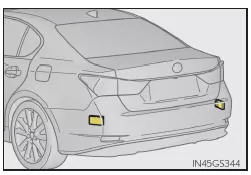
- Always keep the sensor and the area around it on the bumper clean.
- Do not subject the sensor and the area around it on the bumper to strong impacts. The slightest change in the sensor position may cause a system malfunction, and vehicles entering the detection area may not be detected. If the sensor or the area around it has been subjected to a strong impact, always have it inspected by a Lexus dealer or an authorized repairer, or another qualified and properly equipped repair shop.
- Do not disassemble the sensor.
- Do not attach accessories or stickers to the sensor or the area around it on the bumper.
- Do not modify the sensor or the area around it on the bumper.
- Do not paint the sensor or the area around it on the bumper.
Blind Spot Monitor (BSM)
The Blind Spot Monitor (BSM) uses radar sensors to detect vehicles in an adjacent lane that are in an area not visible in the outside mirrors (blind spot). It alerts the driver to the presence of these vehicles via the side mirror indicators.
Detection Zones of the Blind Spot Monitor (BSM)
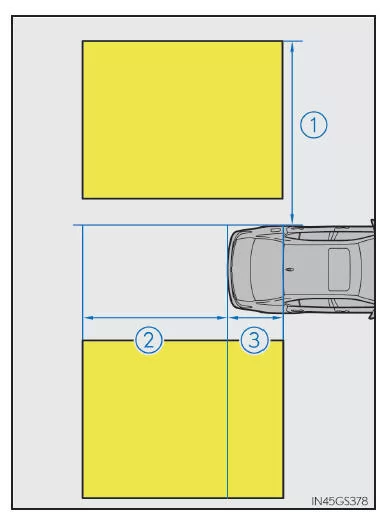
The areas in which vehicles can be detected are shown below.
The detection zone extends to the following distances:
- Approx. 3.5 m from the side of the vehicle.
The first 0.5 m from the side of the vehicle is not within the detection zone.
- Approx. 3 m from the rear bumper.
- Approx. 1 m in front of the rear bumper.
WARNING
■ Precautions for using the system
As the driver, you alone are responsible for safely operating your vehicle. Always drive carefully and pay attention to your surroundings.
The Blind Spot Monitor (BSM) is a supplementary system that warns you when a vehicle is in your blind spot. Do not rely too much on the Blind Spot Monitor (BSM). The system cannot judge whether a lane change can be carried out safely. Blind trust may therefore lead to accidents resulting in death or serious injury.
Depending on various conditions, the system may not function properly. Therefore, check carefully over your shoulder and make sure there is no danger.
■ Requirements for operating the Blind Spot Monitor (BSM)
- The BSM function is switched on.
- The speed is above approx. 16 km/h.
■ The Blind Spot Monitor (BSM) detects a vehicle in the following situations
- A vehicle overtakes your vehicle in an adjacent lane.
- Another vehicle enters the detection zone when changing lanes.
■ Conditions under which the Blind Spot Monitor (BSM) does not detect a vehicle
The Blind Spot Monitor (BSM) is not designed to detect the following vehicle types and/or objects:
- Mopeds, bicycles, pedestrians, etc.*
- Vehicles travelling in the opposite direction
- Guardrails, walls, signs, parked vehicles and similar stationary objects*
- Vehicles following in the same lane*
- Vehicles travelling two lanes away from your vehicle*
*: Depending on the conditions, however, the vehicle and/or object may be detected.
■ Conditions under which the Blind Spot Monitor (BSM) may not function properly
- Under the following conditions, the Blind Spot Monitor (BSM) may not detect vehicles properly:
When ice or mud, etc. adheres to the rear bumper
When driving on roads that are wet from rain or deep puddles
When there is a considerable speed difference between your vehicle and a vehicle entering the detection area
When a vehicle is in the detection area while stopped and remains in the detection area when your vehicle accelerates
When driving on roads with repeated steep downhill and uphill grades, such as hills, dips in the road, etc.
When several vehicles are approaching and there is only a small gap between them
When the lanes are wide and the vehicle in the adjacent lane is too far from your vehicle
When a vehicle entering the detection area is traveling at approximately the same speed as your vehicle
When there is a considerable difference in height between your vehicle and a vehicle entering the detection area
Immediately after the BSM function is turned on
When towing a trailer (vehicles with a trailer hitch)
- The likelihood that the Blind Spot Monitor (BSM) detects a vehicle and/or object unnecessarily may increase under the following conditions:
When there is only a small gap between your vehicle and a following vehicle
When the lanes are narrow and a vehicle two lanes away from your vehicle enters the detection area
When objects such as a bicycle carrier are attached to the rear of the vehicle
Rear Cross Traffic Alert (RCTA)
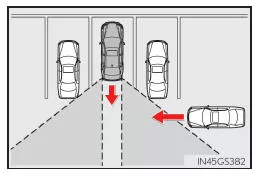
The Rear Cross Traffic Alert (RCTA) is activated when reverse gear is engaged.
It can detect other vehicles approaching from the right or left behind your vehicle. Other vehicles are detected using radar sensors, and the driver is alerted to their presence by the side mirror indicators flashing and a warning buzzer sounding.
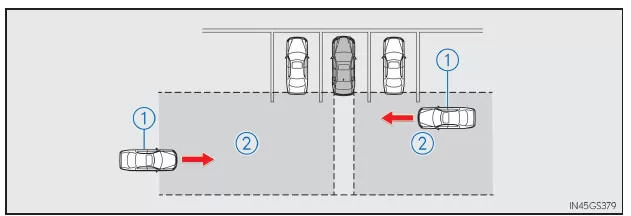
- Approaching vehicles
- Detection Zones
WARNING
■ Precautions for using the system
As the driver, you alone are responsible for safely operating your vehicle. Always drive carefully and pay attention to your surroundings.
The Rear Cross Traffic Alert (RCTA) is only a support function and does not replace attentive and careful driving. Even when using the Rear Cross Traffic Alert (RCTA), you must take care when reversing. Check carefully over your shoulder and make sure there are no pedestrians, other vehicles, etc. behind your vehicle before reversing. Failure to do so may result in death or serious injury.
Depending on various conditions, the system may not function properly. Therefore, check carefully over your shoulder and make sure there is no danger.
Detection Zones of the Rear Cross Traffic Alert (RCTA)
The areas in which vehicles can be detected are shown below.
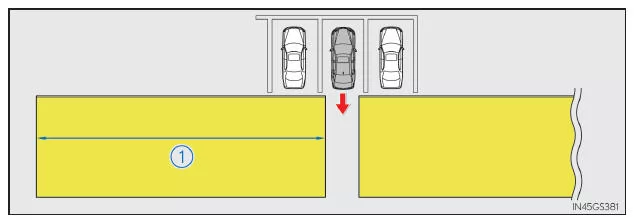
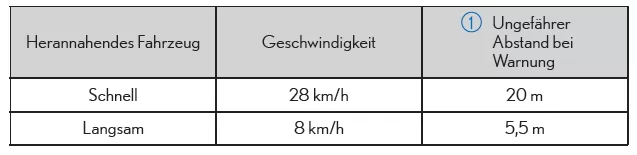
To give the driver sufficient time to react, the warning buzzer may sound early for fast-approaching vehicles that are farther away.
Example:
■ Requirements for operating the Rear Cross Traffic Alert (RCTA)
- The BSM function is switched on.
- The shift lever is in "R".
- The vehicle speed is less than approx. 8 km/h.
- The speed of the approaching vehicle is between approx. 8 km/h and 28 km/h.
■ Conditions under which the Rear Cross Traffic Alert (RCTA) does not detect a vehicle
The Rear Cross Traffic Alert (RCTA) is not designed to detect the following vehicle types and/or objects.
- Mopeds, bicycles, pedestrians, etc.*
- Vehicles approaching directly from behind
- Guardrails, walls, signs, parked vehicles and similar stationary objects*
- Vehicles moving away from your vehicle
- Vehicles approaching from a parking space next to your vehicle*
- Vehicles reversing out of a parking space next to your vehicle*
*: Depending on the conditions, however, the vehicle and/or object may be detected.
■ Conditions under which the Rear Cross Traffic Alert (RCTA) may not function properly
The Rear Cross Traffic Alert (RCTA) may not detect vehicles properly under the following conditions:
- In bad weather such as heavy rain, fog, snow, etc.
- When ice or mud, etc. is adhering to the rear bumper
- When multiple vehicles are approaching at the same time
- When the vehicle is parked at an angle
- When a vehicle is approaching at high speed
- When the vehicle is parked on a steep slope, such as a hill or a dip in the road
- Immediately after switching on the BSM function
- When towing a trailer with your vehicle (vehicles with towing package)
- When objects such as a bicycle carrier are attached to the rear of the vehicle
- Immediately after starting the engine while the BSM function is on
- When the sensors cannot detect other vehicles due to obstructions
The Blind Spot Monitor (BSM) in the Lexus GS GRL1 (2016–2020) improves safety when changing lanes and reversing out of parking spaces. The system uses radar sensors to monitor the blind spot and warns of approaching vehicles. The combination of a visual indicator in the outside mirror and an audible warning makes these maneuvers considerably easier.
This feature makes the fourth-generation Lexus GS the ideal sports sedan for demanding drivers who value safety and comfort. It perfectly complements the overall package of modern driver assistance systems.
Test yourself
A quick Lexus GS quiz: every answer comes with an explanation and a link to the manual page.