PCS (Pre-Crash Safety System)
The Pre-Collision System (PCS) of the Lexus GS (4th generation, L10, 2016–2020) is an advanced collision avoidance system. Using radar and camera technology, it detects potential collisions and warns the driver in time. If necessary, it provides automatic brake assistance or an emergency stop. This chapter describes the operation, activation and limitations of the system. Important notes on sensor cleaning and safe use under various conditions help ensure the maximum protective effect of the PCS.
The Pre-Collision System uses a radar sensor and a camera sensor to detect vehicles and pedestrians*1 in front of your vehicle. If the system determines that there is a high probability of a frontal collision with a vehicle or pedestrian, it issues a warning prompting the driver to take action to avoid a collision. It also increases the potential brake force to help the driver avoid the collision.
If the system determines that the probability of a frontal collision with a vehicle or pedestrian is extremely high, the brakes are applied automatically*2 to help avoid the collision or reduce the effects of the collision.
You can turn the Pre-Collision System on/off and change the warning timing.
*1: Depending on the sales area, the pedestrian detection function may not be available. For details, contact your Lexus dealer or an authorized Lexus repairer, or another qualified and properly equipped repair facility.
*2: Depending on the sales area, the Pre-Collision Braking system (automatic braking function) may not be available. For details, contact your Lexus dealer or an authorized Lexus repairer, or another qualified and properly equipped repair facility.
Pre-Collision Warning
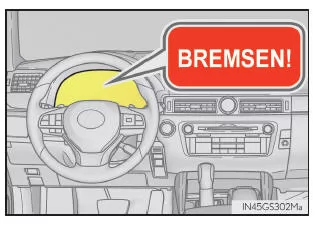
If the system determines that there is a high probability of a frontal collision, a warning buzzer sounds and a warning message appears on the multi-information display, prompting the driver to brake or steer away.
Pre-Collision Brake Assist
If the system determines that there is a high probability of a frontal collision, it applies more braking force in proportion to how hard the brake pedal is pressed.
Pre-Collision Braking*3
If the system determines that there is a high probability of a frontal collision, it warns the driver. If the system determines that the probability of a collision is extremely high, the brakes are applied automatically to help avoid the collision or to reduce the impact speed.
*3: Depending on the sales area, the Pre-Collision Braking system may not be available.
Suspension Control (if equipped)
If the system determines that there is a high probability of a frontal collision, the Adaptive Variable Suspension (AVS) adjusts the damping force of the shock absorbers.
WARNING
Limitations of the Pre-Collision System
- As the driver, you alone are responsible for operating your vehicle safely. Always drive carefully and pay attention to your surroundings. Never use the Pre-Collision System as a substitute for normal braking. The system cannot prevent collisions, avoid collision damage or reduce injuries in every situation. Do not rely too heavily on this system. Otherwise, accidents resulting in death or serious injury may occur.
- Although this system is designed to help avoid a collision or reduce its effects, its effectiveness may be impaired under various circumstances, so the system may not always perform the same.
Read the following conditions carefully. Do not over-rely on this system, and always drive carefully.
- Do not attempt to test the Pre-Crash Safety System function yourself, as the system may not function properly, which may result in an accident.
WARNING
Pre-Crash Brake System*3
- The Pre-Crash Brake System may not activate if the driver performs certain operations. If the accelerator pedal is pressed firmly or the steering wheel is turned sharply, the system may assume that the driver is taking action to avoid a collision, and activation of the Pre-Crash Brake System may be suppressed.
- In some situations, activation of the Pre-Crash Brake System may be cancelled because the accelerator pedal is pressed firmly or the steering wheel is turned, and the system assumes that the driver is taking action to avoid a collision.
- When the Pre-Crash Brake System activates, the brakes are applied very strongly. Because activation of the Pre-Crash Brake System is cancelled after the vehicle has come to a stop for approx. 2 seconds, the driver should also depress the brake pedal if necessary.
- If the brake pedal is depressed, the system may assume that the driver is taking the necessary corrective action, and activation of the Pre-Crash Brake System may be delayed.
*3: Depending on the sales area, the Pre-Collision Braking system may not be available.
WARNING
Situations in which the Pre-Crash Safety System must be turned off
Turn off the system in the following situations, as it may not function properly, which may result in a fatal or serious injury accident:
- When the vehicle is being towed
- When providing towing assistance with your vehicle
- When the vehicle is being transported on a truck, ship, train, or similar transport
- When the vehicle is raised on a lift while the engine is running and the wheels can turn freely
- When the vehicle is being inspected on a chassis dynamometer, such as a dynamometer or speedometer tester, or when using a wheel balancer on wheels mounted on the vehicle
- When the front bumper or front grille has been subjected to a strong impact, whether in an accident or for other reasons
- When the vehicle cannot be driven stably, such as after an accident or due to a vehicle malfunction
- When the vehicle is driven in a sporty manner or off-road
- When the tire pressure is not at the specified values
- When the tires are heavily worn
- When tires of a size other than the specified size are installed
- When snow chains are installed
- GS350/GS200t: When a temporary spare tire or a tire repaired with the tire repair kit is in use
- GS F: When a spare tire or a tire repaired with the tire repair kit is in use
Changing the Pre-Crash Safety System Settings
Turning the Pre-Crash Safety System On/Off

The Pre-Crash Safety System can be turned on/off using the on the multi-information display.
The system is automatically turned on each time the engine switch is set to IGNITION ON mode.
When the system is turned off, the PCS warning light comes on and a message is displayed on the multi-information display.
Changing the Timing of the Pre-Crash Warning Output
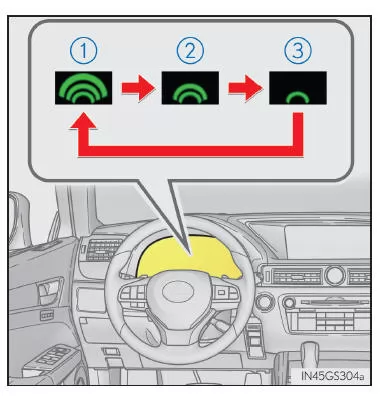
You can change the timing of the Pre-Crash Safety System warning underon the multi-information display.
The timing setting is retained even when the engine switch is turned off.
- Far.
The warning is given earlier than the standard timing.
- Medium.
This is the default setting.
- Near.
The warning is given later than the standard timing.
Operating conditions
The availability of the Pedestrian Detection function and the Pre-Crash Brake System depends on the sales region.
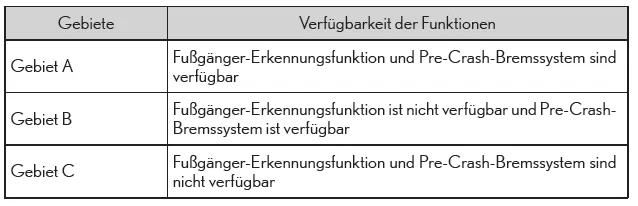
For more details, refer to the following:
Area A (Pedestrian Detection function and Pre-Crash Brake System are available)
The Pre-Crash Safety System is turned on and detects a high probability of a frontal collision with a vehicle or a pedestrian.
The individual functions are available at the following speeds:
- Pre-Crash Warning:
- Pre-Crash Brake Assist:
- Pre-Crash Brake System:
The system may not function in the following situations:
- After a battery terminal has been disconnected and reconnected, and the vehicle has not been driven for a certain period of time
- When the shift lever is in the "R" position
- When the VSC system is turned off (in this case, only the Pre-Crash warning function operates)
- When the PCS warning light is flashing or illuminated
Zone B (pedestrian detection function is not available and Pre-Crash Brake Assist is available)
The Pre-Crash Safety System is activated and the system determines that there is a high probability of a frontal collision with a vehicle.
The individual functions are available at the following speeds:
- Pre-Crash Warning:
- Pre-Crash Brake Assist:
- Pre-Crash Brake System:
The system may not function in the following situations:
- After a battery terminal has been disconnected and reconnected, and the vehicle has not been driven for a certain period of time
- When the shift lever is in the "R" position
- When the VSC system is turned off (in this case, only the Pre-Crash warning function operates)
- When the PCS warning light is flashing or illuminated
Zone C (pedestrian detection function and Pre-Crash Brake Assist are not available)
The Pre-Crash Safety System is activated and the system determines that there is a high probability of a frontal collision with a vehicle.
The individual functions are available at the following speeds:
- Pre-Crash Warning:
- Pre-Crash Brake Assist:
The system may not function in the following situations:
- After a battery terminal has been disconnected and reconnected, and the vehicle has not been driven for a certain period of time
- When the shift lever is in the "R" position
- When the VSC system is turned off (in this case, only the Pre-Crash warning function operates)
- When the PCS warning light is flashing or illuminated
Pedestrian detection function*4
The Pre-Crash Safety System detects pedestrians based on the size, profile and movement of a detected object. However, depending on the ambient brightness and the movement, posture and angle of the detected object, the system may not detect a pedestrian and therefore may not operate properly.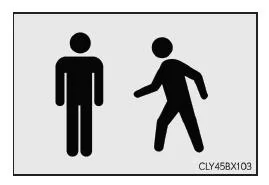
*4: Depending on the sales region of the vehicle, the pedestrian detection function may not be available.
Deactivation of Pre-Crash Brake Assist*3
- In the following cases, the activated Pre-Crash Brake Assist is deactivated:
- If the vehicle has been stopped by the Pre-Crash Brake Assist intervention, the intervention is cancelled after the vehicle has been at a standstill for approx. 2 seconds.
*3: Depending on the sales area, the Pre-Collision Braking system may not be available.
Conditions under which the system may intervene even when there is no risk of collision
- In some situations, such as the following, the system may detect a risk of a frontal collision and intervene.
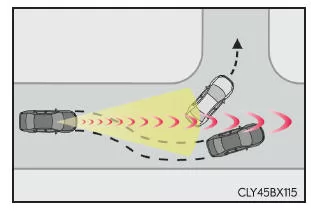 When driving past an oncoming vehicle that has stopped to turn
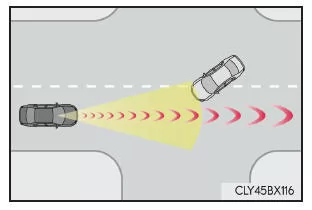 When driving on a road where the relative position of the vehicle ahead in an adjacent lane may change, such as on a winding road
 When a vehicle ahead suddenly loses speed When the front of the vehicle rises or falls, such as on uneven road surfaces or over bumps When approaching roadside objects, such as guardrails, electricity pylons, trees or walls When a vehicle, pedestrian*4 or roadside object is at the entrance to a curve
 When driving in a narrow lane bordered by structures, such as in a tunnel or on a steel bridge When a metal object (manhole cover, steel plate, etc.), stairs or a projection is on or next to the road surface When a pedestrian crosses the road very close to the vehicle*4
 When driving through an area with low overhead structures (low bridges, road signs, etc.)
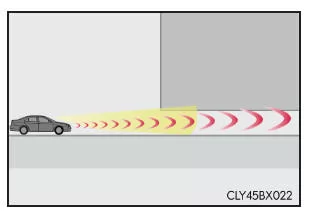 When driving under an object (billboard, etc.) at the crest of an uphill road
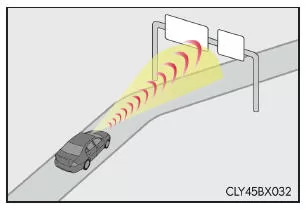 When rapidly approaching an electronic toll gate, parking barrier or other barrier that opens and closes When using an automatic car wash When driving between or under objects that could touch the vehicle (such as dense grass, branches or flags)
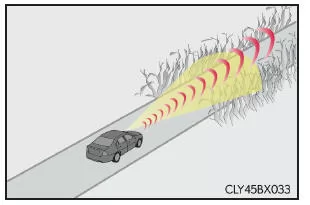 When water, snow, dust, etc. is kicked up by a vehicle ahead and hits your vehicle When driving through steam or smoke When patterns or painted markings on the road or a wall could be mistaken for a vehicle or pedestrian*4 When driving near an object that reflects radio waves, such as a large truck or guardrail When driving near a TV tower, radio station, power plant or other location where strong radio waves may occur or electrical noise may be present
*4: Depending on the sales region of the vehicle, the pedestrian detection function may not be available
Situations in which the system may not operate properly
- In some situations, such as the following, a vehicle may not be detected by the radar sensor and camera sensor, and the system will not operate properly:
 When a vehicle ahead is carrying loads that extend beyond the rear bumper When a vehicle ahead has extremely high ground clearance
 When a vehicle ahead has an unusual shape, such as a tractor or sidecar When sunlight or light from another light source shines directly onto a vehicle ahead When a vehicle ahead cuts in or suddenly appears next to a vehicle When a vehicle ahead performs an abrupt maneuver (such as sudden evasive action, acceleration or braking) When you suddenly cut in behind a vehicle ahead When a vehicle ahead is not directly in front of your vehicle
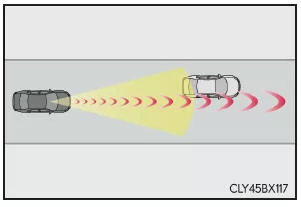 When driving in poor weather conditions, such as heavy rain, fog, snow or a sandstorm When water, snow, dust, etc. is kicked up by a vehicle ahead and hits your vehicle When driving through steam or smoke When driving in an area where the ambient brightness changes abruptly, such as at a tunnel entrance or exit When very bright light, such as sunlight or the headlights of oncoming traffic, shines directly onto the camera sensor In diffuse ambient light, such as at dawn or dusk, at night or in a tunnel Since the engine was started, the vehicle has not been driven for a certain period of time During turning and for a few seconds after turning During driving through a curve and for a few seconds after driving through a curve When your vehicle skids When the front of the vehicle is raised or lowered When the wheels are misaligned When a wiper blade covers the camera sensor The vehicle is swaying. The vehicle is being driven at extremely high speed. When driving on a hill When the radar sensor or camera sensor is not correctly aligned
- In some situations, such as the following, sufficient braking force may not be achieved, so the system may not function properly:
- Some pedestrians, such as the following, may not be detected by the radar sensor and camera sensor, so the system may not function properly*4:
Pedestrians whose outlines are not clearly visible because they wear loose clothing (such as a raincoat or a long skirt)
Pedestrians whose bodies are partially hidden, for example by large luggage or an umbrella
Pedestrians who are bent forward or crouching
Pedestrians pushing a baby stroller, wheelchair, bicycle or other vehicle
Groups of closely gathered pedestrians
Pedestrians dressed in white who appear extremely bright
Pedestrians in the dark, such as at night or in a tunnel
Pedestrians whose clothing is very similar in color or brightness to the surroundings
Pedestrians near walls, fences, guardrails or large objects
Pedestrians standing on a metal object on the road (manhole cover, steel plate, etc.)
Pedestrians walking quickly
Pedestrians who suddenly change speed
Pedestrians who suddenly and quickly appear from behind a vehicle or a large object
Pedestrians very close to the side of the vehicle (next to the outside mirror, etc.)
*4: Depending on the sales region of the vehicle, the pedestrian detection function may not be available.
When the PCS warning light flashes and a warning message is displayed on the multi-information display
The Pre-Collision System may be temporarily unavailable or a system malfunction has occurred
- In the following situations, the warning light goes off, the message is cleared, and the system becomes operational again once normal operating conditions are restored:
When the radar sensor, camera sensor or the area around the sensors is cold, such as in an extremely cold environment
When the radar sensor or the front grille emblem is dirty or covered with snow, etc.
When the camera sensor is blocked, such as by the hood being open or a sticker on the windshield in the area of the camera sensor
- If the PCS warning light continues to flash or the warning message does not clear, the system may have a malfunction. Have the vehicle inspected immediately by a Lexus dealer or repairer, or another qualified and properly equipped workshop.
When VSC is turned off
- When the Vehicle Stability Control VSC system is turned off, the Pre-Collision Brake Assist and the Pre-Collision Brake System are also turned off.
- The PCS warning light comes on and "VSC OFF Pre-Collision Brake System unavailable." is displayed on the multi-information display.
The Pre-Collision System of the Lexus GS 4th generation constantly monitors the area around the vehicle. If there is a risk of collision, it warns the driver and automatically applies braking to reduce the consequences of an accident. In this way, the Lexus GS GRL1 sets new standards in safety technology.
The precise coordination between radar and camera sensors ensures a fast and reliable response in hazardous situations. This makes every drive safer, an important aspect of this sport sedan.
FAQWhen does the Pre-Collision Brake System intervene?
When the system detects a high probability of a frontal collision and the driver does not react in time.
Can the Pre-Collision System be turned off?
Yes, the system can be turned on or off using the multi-information display.
Test yourself
A quick Lexus GS quiz: every answer comes with an explanation and a link to the manual page.