Limitations
In some cases, the CMBS may not activate. Examples include:
• The distance between your vehicle and the vehicle ahead is too short.
• A vehicle traveling at low speed changes lanes into your lane or brakes suddenly.
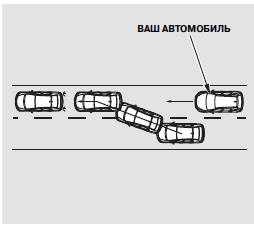
• A vehicle changes lanes from another lane into your lane and brakes suddenly.
• You accelerate rapidly and approach a vehicle ahead at high speed.
• Immediately after starting to move.
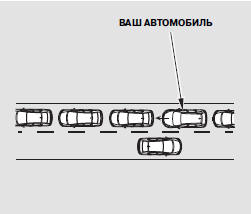
• When driving in heavy traffic with frequent stops.
• When a motorcycle or other small vehicle is ahead of you.
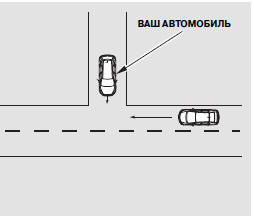
• When a vehicle suddenly crosses in front of you laterally.
CAUTION
The CMBS is not designed to detect pedestrians.
The system is designed to detect emergency situations and warn of a possible collision in time. Therefore, the system may activate unnecessarily.
Even if the risk of collision with another vehicle is low or nonexistent, the CMBS may activate under the following conditions:
• When changing lanes quickly and then overtaking a vehicle ahead.
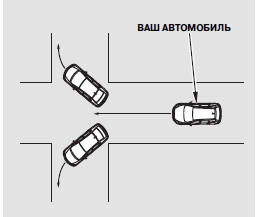
• When approaching an intersection where another vehicle turns from your lane to the right or left.
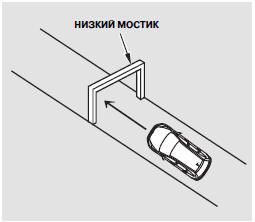
• When driving at high speed under a low overpass.
• When driving over an obstacle with sharp edges at high speed.
• When driving on a road under repair.
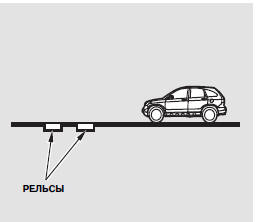
• When approaching railway tracks.

Depending on road conditions (such as when driving through a curve or on winding roads) and driving conditions (steering angle, lane position, etc.), the CMBS may activate by mistaking a stationary object (such as a utility pole, road sign, guardrail, etc.) for a moving vehicle. This is normal.
Test yourself
A quick Honda CR-V quiz: every answer comes with an explanation and a link to the manual page.