Anti-lock Braking System (ABS)
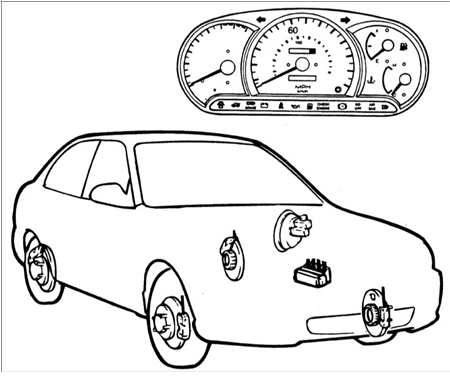
The anti-lock brake system (ABS) is designed to prevent wheel lock-up during hard braking.
Main ABS functions:
– reduces braking distance by preventing wheel lock-up during hard braking;
– improves vehicle directional stability during braking.
The anti-lock brake system operates based on information from four wheel speed sensors sent to the ABS control module. The system controls each wheel individually and reduces brake fluid pressure in the wheel brake assembly of a wheel that begins to lock.
Under normal conditions, the conventional brake system brakes the vehicle up to the point of wheel lock, which is detected by the ABS control module. During normal braking, the inlet valves are normally open and the outlet valves are normally closed.
When the ABS control module detects wheel lock, it controls each valve to increase or decrease pressure.
The ABS control module determines the rotational speed and deceleration rate of each wheel based on information from the wheel speed sensors. During braking, wheel rotational speed decreases, and the ABS control module calculates the difference between vehicle speed and wheel speed. If the deceleration of some wheels exceeds the expected value, the ABS control module detects the onset of wheel lock and opens the corresponding solenoid valves to reduce brake fluid pressure. As a result, wheel speed increases, the pressure release solenoid valve closes, and brake fluid pressure in the corresponding wheel cylinder increases.
Test yourself
A quick Hyundai Accent quiz: every answer comes with an explanation and a link to the manual page.