Vehicle Detection
The sensor may be limited when:
- The radar sensor or camera is blocked by a foreign object or debris.
- Bad weather, such as heavy rain or snow, blocks the field of view of the radar sensor or camera.
- Electromagnetic interference or waves are present.
- Strong irregular reflections are present at the radar sensor.
- Radar sensor/camera recognition is limited
- The vehicle ahead is too small to be detected (e.g. a motorcycle or bicycle, etc.).
- The vehicle ahead is an oversized vehicle or trailer that is too large to be detected by the camera recognition system (e.g. a tractor-trailer, etc.).
- The driver's view is poorly lit (either too dark, or too much glare or backlight blocking the field of view).
- The vehicle ahead does not have its tail lights correctly illuminated.
- External brightness changes suddenly, for example when entering or exiting a tunnel.
- When light comes from street lights or an oncoming vehicle is reflected on a wet road surface, such as a puddle on the road.
- The field of view ahead is blocked by sun glare.
- The windshield is fogged up; a clear view of the road is obstructed.
- The vehicle ahead is driving erratically.
- The vehicle is on unpaved or uneven, rough surfaces, or on a road with sharp changes in gradient.
- The vehicle is driving near areas containing metallic objects, such as a construction zone or railway, etc.
- The vehicle enters a building, such as a multi-level underground parking garage.
- Excessive vehicle vibration during driving due to adverse road conditions
- Sensor recognition changes suddenly when driving over a speed bump.
- The vehicle ahead moves vertically relative to the direction of travel.
- The vehicle ahead is stopped across the direction of travel.
- The vehicle ahead moves toward your vehicle or in reverse.
- You are at a roundabout and the vehicle is in the front circles.
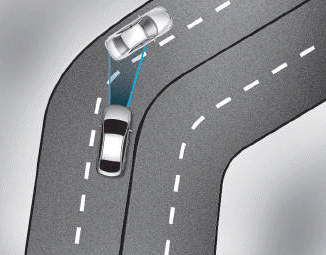
- Driving on curves
FCA system performance may be limited when driving on a curved road.
On curved roads, another vehicle in the same lane may not be recognized and FCA system performance may degrade. This may cause unnecessary warnings or braking, or no warnings or braking when needed.
Also, in some cases, the front radar sensor or camera recognition system may not detect a vehicle driving on a curved road.
In these cases, the driver must maintain a safe braking distance and, if necessary, press the brake pedal to reduce vehicle speed and keep a safe distance.
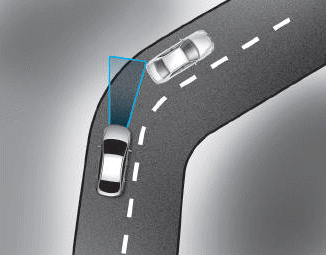
The FCA system may recognize a vehicle in the adjacent lane while driving on a curved road.
In this case, the system may warn the driver unnecessarily and apply the brakes.
Always pay attention to the road and driving conditions while driving. If necessary, press the brake pedal to reduce vehicle speed and keep a safe distance.
Also, if necessary, press the accelerator pedal so that the system does not unnecessarily decelerate your vehicle.
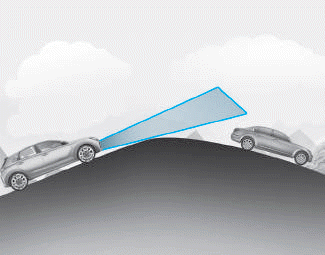
- Driving on slopes
FCA performance is reduced when driving uphill or downhill, as it may not recognize a vehicle ahead in the same lane. It may unnecessarily give a warning message and warning alarm, or it may not give a warning message and warning alarm at all.
When FCA suddenly recognizes a vehicle ahead while overtaking on a slope, you may experience sudden deceleration.
Always look ahead while driving uphill or downhill and, if necessary, press the brake pedal to reduce driving speed to keep a safe distance.
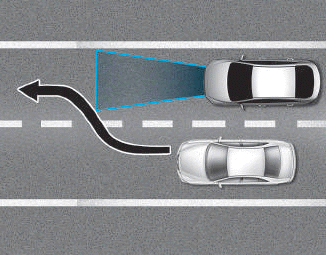
- Lane change
When a vehicle changes lanes in front of you, the FCA system may not immediately detect the vehicle, especially if it changes lanes abruptly. In this case, maintain a safe braking distance and, if necessary, press the brake pedal to reduce vehicle speed and keep a safe distance.
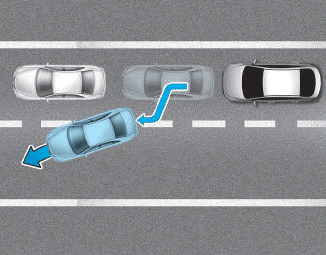
When driving in stop-and-go traffic, and a stopped vehicle ahead moves out of the lane, the FCA system may not immediately detect the new vehicle now in front of you. In this case, maintain a safe braking distance and, if necessary, press the brake pedal to reduce vehicle speed and keep a safe distance.
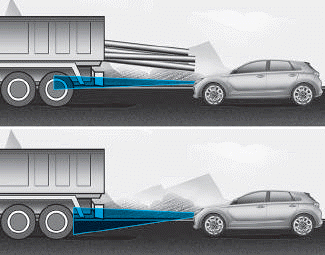
- Detection of the vehicle ahead
If the vehicle ahead is carrying a load that extends rearward beyond the cab, or when the vehicle ahead has increased ground clearance, special attention is required. The FCA system may not be able to detect a load extending from the vehicle. In these cases, you must keep a safe braking distance from the rearmost object and, if necessary, press the brake pedal to reduce vehicle speed and keep a safe distance.
Test yourself
A quick Hyundai i30 quiz: every answer comes with an explanation and a link to the manual page.